Why status matters at Higher Level: The same ideas as SL, with different real cases: the European eel, the Sumatran orangutan, wolves in Europe and the snow leopard. At HL, law and ethics sit behind each group's perspective: who makes the rules, and whose needs come first.
Practise this as you read
- Explain how each group responds to a listing, and why.
- Weigh the case for and against changing a status.
Free preview
This is the free notes preview
You're reading the free notes. Aimnova Pro unlocks the full study experience — and you can try it with your first topic free to keep:
- FlashcardsLock in vocabulary and key terms with spaced repetition.
- Practice questionsAnswer exam-style questions and get instant AI marking.
- Mock exams & past-paper vaultSit full mocks and see exactly how examiners award marks.
- Personalised study planA daily plan built around your exam date and weak areas.
A label that makes people act: Giving a species a global status does two jobs: it tells the world the species is in trouble, and it helps governments, NGOs and ordinary citizens decide what to protect first and how.
The points to remember
- A Red List status publicizes how vulnerable a species is: the news, schools and the public hear of it.
- It shows which species are at most risk, so limited money and effort go to them first.
- Governments use it to justify laws, protected areas and hunting or trade bans.
- NGOs use it to choose which species to campaign, raise funds and do research for.
- Individual citizens use it to choose what to buy, which charities to support, what to report.
- Repeated assessments show whether a strategy is working: a species moves down a rank.
Remember it as: Status tells the world, then tells us where to start.
Real example: in 2008 the IUCN listed the European eel as critically endangered, after the young eels reaching Europe's rivers fell by about 95%. Its trade came under CITES, and from 2010 the European Union stopped all exports of European eels to the rest of the world.
Say both jobs: In an answer, use the guide's two ideas: the status publicizes vulnerability, and it lets groups choose priorities and strategies.
Know your predicted grade
Take timed mock exams and get detailed feedback on every answer. See exactly where you're losing marks.
Once a species is listed, each group has its own tools.
What each group can do
- Governments: pass and enforce laws, create protected areas, fund research, sign international agreements.
- NGOs: fund projects, research and monitor species, raise awareness, campaign for better protection.
- Businesses: use sustainable materials, cut pollution and waste, support projects, build monitoring technology.
- Individuals: choose sustainable products, consume less, support organisations, join citizen science.
Governments
- Indonesia paused new oil palm permits in forest (2018-2021).
- Hunting orangutans is illegal by law.
NGOs
- Greenpeace campaigns against palm oil from cleared forest.
- Rescue centres return orphaned orangutans to the forest.
Businesses and individuals
- Firms buy certified sustainable palm oil.
- Shoppers check labels; volunteers count orangutan nests.
Real example: the Sumatran orangutan, critically endangered since 2008, loses its forest to oil palm. Government, NGOs, businesses and shoppers each work on a different link of that chain.
The groups often want different things, because they have different perspectives.
The points to remember
- Governments weigh protection against jobs, the economy, development and votes; they act through law.
- NGOs put the species or habitat first, often with a global, long-term view; they act through campaigns and funding.
- Individuals act on their own values, livelihoods and costs: a farmer who loses cattle sees a predator differently.
- The same listing can bring support from one group and resistance from another.
Wants more protection
- Conservation NGOs: wolves are recovering, keep them strictly protected.
- Many city dwellers value wolves in the wild.
Wants less protection
- Sheep farmers who lose animals to wolves.
- Some governments, answering rural voters.
Real example: wolves have returned to much of Europe. In 2024-2025 European governments lowered the wolf's legal protection from 'strictly protected' to 'protected', after pressure from farmers who lose livestock. Conservation NGOs opposed the change, saying wolves are still recovering.
Show the difference: When asked how perspectives differ, give one point for each group and make the contrast clear: 'the farmer sees a pest; the NGO sees a threatened species'.
Get feedback like a real examiner
Submit your answers and get instant feedback — what you did well, what's missing, and exactly what to write to score full marks.
When a species recovers, the IUCN may move it down a rank (downlisting). Some conservationists often disagree.
Why some disagree with a lower status
- Low genetic diversity: the species can still be hit by disease or failed breeding.
- It may survive only thanks to feeding, care or guarding programmes, which could stop.
- Its habitat may still be lost or degraded.
- A lower status may mean less protected area, funding and effort.
- People who see it as a pest or a resource may start killing it again.
- If most of it lives in one place, one disaster or disease could hit the whole population.
- If captive breeding has failed, protection in the wild is the only safety net.
Remember it as: Numbers up is not danger gone.
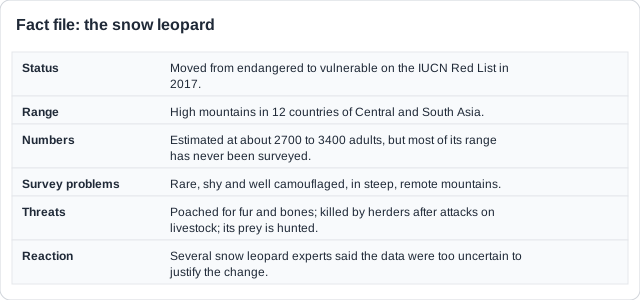
Real example: when the snow leopard was moved to vulnerable in 2017, several experts disagreed: most of its mountains have never been surveyed, so no one knows if numbers really rose, and poaching and killing by herders go on.
Two answers that are too thin: 'Numbers are still low' alone, and 'low genetic diversity makes it vulnerable' alone. Say what could happen: 'low genetic diversity, so one disease could kill many of them'.
How this comes up: Paper 2, Section B (b): explain how governments, NGOs and individuals respond differently to a listing [7]; Paper 1: why some disagree with changing a status, from a fact file [3].
The Sumatran orangutan is listed as critically endangered, mainly because its forest is cleared for oil palm plantations.
Explain how governments, non-governmental organizations (NGOs) and individual citizens may respond differently to a species being listed as critically endangered.
Model answer plan
See the mark-by-mark plan — for / against / judgement, with marking guidance — in study mode.