Environmental justice in conservation at Higher Level: This statement is Higher Level only. It asks who pays the price when nature is protected, through one community forced off its land: the Maasai of the Serengeti.
Practise this as you read
- Name the community, the park and the country.
- Weigh wildlife gains against people's losses.
Free preview
This is the free notes preview
You're reading the free notes. Aimnova Pro unlocks the full study experience — and you can try it with your first topic free to keep:
- FlashcardsLock in vocabulary and key terms with spaced repetition.
- Practice questionsAnswer exam-style questions and get instant AI marking.
- Mock exams & past-paper vaultSit full mocks and see exactly how examiners award marks.
- Personalised study planA daily plan built around your exam date and weak areas.
Fair to nature and to people: You met environmental justice in topic 1. Here it means that protecting wildlife must not push the costs onto the poorest people who live with it.
Why justice matters in conservation
- The places expected to suffer most from biodiversity loss are home to many indigenous people.
- These communities are often low income and have no legal support or written title to their land.
- They depend directly on the ecosystem for sustenance: food, water, grazing, fuel and medicine.
- Conservation itself can harm them: parks have forcibly moved people off their land (fortress conservation).
- The costs fall on local people; the benefits go to tourists, governments and the wider world.
- Critics call parks set up by outsiders on indigenous land green colonialism.
Remember it as: Who pays, who gains, who decides?
Real example: in 1991 Uganda made Bwindi a national park. The Batwa were moved out, mostly without land or payment. Tourists now pay hundreds of dollars to see the gorillas, while many Batwa live landless at the forest edge.
Learn what examiners really want
See exactly what to write to score full marks. Our AI shows you model answers and the key phrases examiners look for.
The guide's example is the Maasai, moved out of the Serengeti and nearby areas.
The Maasai and the Serengeti
- The Maasai are cattle herders of Kenya and Tanzania who have lived beside wildlife for centuries.
- They were moved out of the Serengeti in 1959, and later off the Ngorongoro Crater floor.
- They lost dry-season grazing and water, so cattle died and families went hungry.
- They lost sacred sites and a way of life, and had no say and no land title to defend it.
- Anger and mistrust grew, which makes conservation harder, not easier.
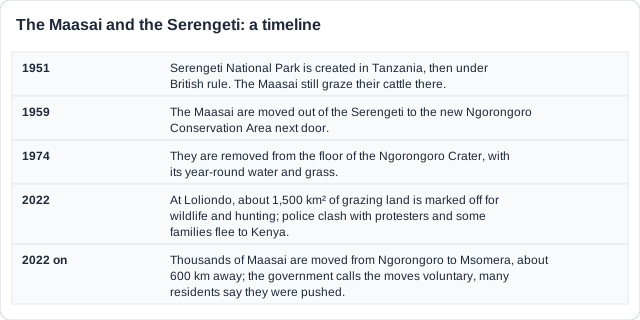
The other side: Tanzania says people in Ngorongoro rose from about 8,000 in 1959 to over 100,000, with more cattle and houses, which crowd the wildlife. A fair answer weighs this against the Maasai's rights.
Conservation can protect wildlife and be fair to people. These are the ways to build justice in.
Making conservation fair
- Free, prior and informed consent: ask the community first, explain the plan, accept a 'no'.
- Secure land rights: give written title, so people cannot simply be moved.
- Co-management: the community helps plan and run the protected area.
- Benefit-sharing: a fair share of park fees and tourism income goes to local people.
- Keep access to the land for grazing, food and sacred sites where it does not harm wildlife.
- Redress past harm: compensation, or the return of land.
Fortress conservation
- People moved out of the park.
- Decided by governments and outsiders.
- Income goes to tour firms and the state.
Community conservation
- People stay and help run it.
- Consent asked first.
- Income shared with the community.
Real example: around Kenya's Maasai Mara, Maasai landowners have joined their land into conservancies. Safari camps pay them a monthly rent, and they still graze cattle under agreed rules.
The 2007 UN Declaration on the Rights of Indigenous Peoples and the 2022 Kunming-Montreal targets both call for this consent and these rights.
Never wonder what to study next
Get a personalized daily plan based on your exam date, progress, and weak areas. We'll tell you exactly what to review each day.
How this comes up: Paper 2, Section B (a) [4] on a relocated community, or (b) [7] on how to make conservation fair. In a (c) [9] on conservation, environmental justice is a term worth using, with the Serengeti as the example.
Some protected areas were created by moving people off land that fed them.
Outline four impacts of conservation on a named indigenous or marginalized community that was relocated from its homeland.
Model answer plan
See the mark-by-mark plan — for / against / judgement, with marking guidance — in study mode.