Indigenous land management at Higher Level: This statement is Higher Level only. It asks why traditional indigenous ways of managing land can be more sustainable, and what now threatens them, from outside and from within.
Practise this as you read
- Name one practice and the place.
- Sort its threats into outside and within.
Free preview
This is the free notes preview
You're reading the free notes. Aimnova Pro unlocks the full study experience — and you can try it with your first topic free to keep:
- FlashcardsLock in vocabulary and key terms with spaced repetition.
- Practice questionsAnswer exam-style questions and get instant AI marking.
- Mock exams & past-paper vaultSit full mocks and see exactly how examiners award marks.
- Personalised study planA daily plan built around your exam date and weak areas.
Old ways that last: Indigenous peoples have managed land for thousands of years. Their traditional ways are often more sustainable than modern farming or logging.
Why they can be more sustainable
- Deep knowledge of the land, built up and passed down over many generations.
- Sustainable harvesting: take only what is needed, and let plants and animals recover.
- Rotation and movement: fields, pastures and hunting grounds are rested in turn.
- Fire management: small, cool fires that stop huge wildfires and keep a mix of habitats.
- Spiritual and cultural ties to the land, held in common for future generations.
- Low-impact land use: small scale, few machines, few chemicals.
- Result: Indigenous lands often hold as much or more wildlife than many protected areas.
Remember it as: Know it, rest it, share it, keep it for the grandchildren.
How much land? Indigenous peoples manage or have rights to at least a quarter of the world's land, about 40% of all its protected and near-untouched land.
Real example: in West Arnhem Land, Aboriginal rangers light small, cool fires early in the dry season, as their ancestors did. The patchwork of burnt ground stops huge late-season wildfires. Since 2006 this has cut the greenhouse gases from fires by more than a third, and the rangers are paid for the carbon they save.
Know your predicted grade
Take timed mock exams and get detailed feedback on every answer. See exactly where you're losing marks.
In the exam you need one named practice and the threats to it. This page uses reindeer herding by the Sámi people.
Sámi reindeer herding
- The Sámi live in the far north of Norway, Sweden, Finland and Russia.
- Herders move their reindeer between seasonal pastures, as the animals would move in the wild.
- Each pasture is used for one season, so plants and slow-growing lichen can recover.
- Families herd together in a siida, which shares the land and decides how many animals it can hold.
- Herders read snow, ice and weather with hundreds of words for snow conditions.
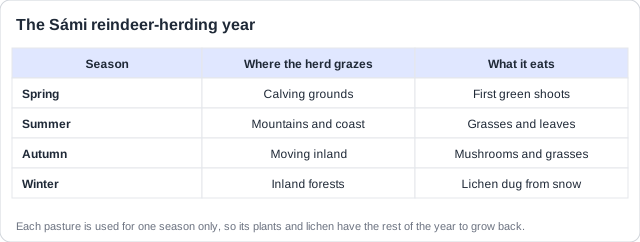
Why it matters: lichen grows only a few millimetres a year. Grazing it for one season, then leaving it, keeps it from being eaten away.
Name the practice, not just the people: Write 'Sámi reindeer herding in northern Norway and Sweden', not just 'indigenous people'.
Most threats to Sámi herding come from outside the community: a warming climate and other people's plans for the same land.
Threats from outside
- Climate change: rain falls on snow and freezes, locking the lichen under ice, so reindeer starve.
- Economic development: mines, wind farms, dams, roads and holiday cabins cut up the pastures.
- Lack of government support: governments approve projects on herding land and rarely enforce rulings.
- Herders have little say in decisions, and their land rights are often not recognised in law.
Climate change
- Winter rain freezes into ice over the lichen.
- Yamal, Russia, 2013-14: about 61,000 reindeer of the Nenets herders starved.
- Herders must buy feed, which costs money.
Development on herding land
- Wind farms at Fosen, Norway: 151 turbines.
- Kallak iron mine, Sweden, approved in 2022.
- Roads, dams and cabins split the migration routes.
Real example: in 2021 Norway's Supreme Court ruled that the Fosen wind farms broke the Sámi herders' right to their culture. The turbines kept turning, and the first deal with the herders came only in December 2023: a clear lack of government protection.
Get feedback like a real examiner
Submit your answers and get instant feedback — what you did well, what's missing, and exactly what to write to score full marks.
The guide stresses that threats also come from within, as the society develops and wants to live like the rest of the country.
Threats from within, and population growth
- As a society develops, people want the same lifestyle as the rest of the country: cash, cars, phones.
- Machines (snowmobiles, quad bikes) cost money, so herders keep bigger herds to pay for them.
- Bigger herds overgraze the lichen, as in parts of Finnmark, Norway: the opposite of the old limits.
- Young people leave for school and jobs in towns, so the knowledge is not passed on.
- Population growth means more plots each year, so the fallow (rest) becomes too short.
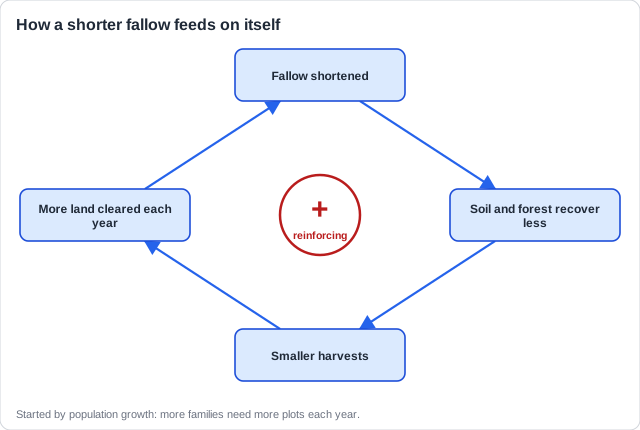
Development is not only a threat: Cash, machines and the law can also keep a practice going, if the community stays in control: carbon income for Aboriginal fire rangers, or a court ruling that protects Sámi pastures.
Real example: many Karen villages farm in rotation: clear a small plot, grow rice for a year, then let the forest regrow for 7 to 10 years. With more people, forest laws that ban clearing, and traders paying cash for maize, the rest period shrinks and the soil wears out.
Not 'indigenous people destroy the land': The practice was sustainable. Say what changed: more people, new markets, machines, laws or climate.
How this comes up: Paper 2, Section B (a) [4]: outline the challenges facing a named practice. Or (c) [9]: to what extent traditional approaches are more sustainable, or can stay sustainable as the society develops.
Many indigenous communities still manage their land in traditional ways.
Outline four challenges facing a named traditional indigenous land management practice.
Model answer plan
See the mark-by-mark plan — for / against / judgement, with marking guidance — in study mode.