Loss of biosphere integrity at Higher Level: This statement is Higher Level only. It builds on the planetary boundaries model: the extinction boundary is already crossed, and you weigh the claim that this could tip the whole Earth system.
Practise this as you read
- Link species loss to climate, water and soil.
- Weigh the claim for and against.
Free preview
This is the free notes preview
You're reading the free notes. Aimnova Pro unlocks the full study experience — and you can try it with your first topic free to keep:
- FlashcardsLock in vocabulary and key terms with spaced repetition.
- Practice questionsAnswer exam-style questions and get instant AI marking.
- Mock exams & past-paper vaultSit full mocks and see exactly how examiners award marks.
- Personalised study planA daily plan built around your exam date and weak areas.
A line already crossed: You met the planetary boundaries model in topic 1, and the two measures of biosphere integrity in topic 2. This statement makes one claim about it: for species extinctions, we are already past the safe limit.
The boundary that is crossed
- Biosphere integrity is one of the nine planetary boundaries: the health of all life on Earth.
- Its boundary for species extinctions has already been crossed: a critical threshold is behind us.
- Species now die out tens to hundreds of times faster than the natural background rate.
- About 1 million species are threatened with extinction, many within decades (IPBES, 2019).
- Richardson and colleagues (2023) found six of nine boundaries crossed, this one deep in the high-risk zone.
Remember it as: Background 1, boundary 10, today over 100: already over the line.
Real example: the IPBES 2019 report, written by about 150 experts from 50 countries, found that about 1 million of an estimated 8 million species face extinction. A 2025 update of the boundaries found seven of nine crossed.
Study smarter, not longer
Most students waste 40% of study time on topics they already know. Our AI tracks your progress and optimizes every minute.
Why would losing species matter to the whole planet, not just to one forest? Because living things do jobs that keep the Earth system steady.
Life holds the Earth system steady
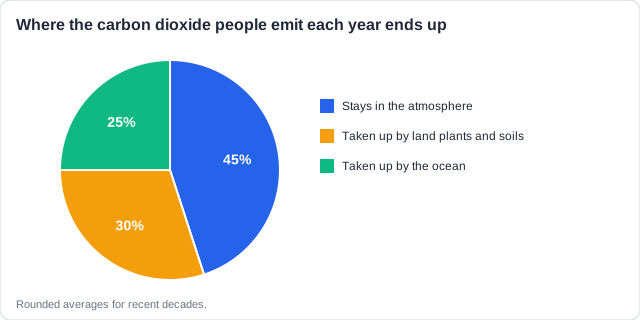
- Plants, soils and ocean life take up about half of the carbon dioxide people emit.
- Forests pump water vapour into the air and make much of their own rain.
- Living things build soil, pollinate crops and clean water.
- Each job depends on many species working together in food webs.
- Lose the species and the Earth system loses the brakes that keep climate and water steady.
Real example: forest elephants trample and eat small trees, so large, slow-growing trees with dense wood take their place. Scientists estimate that losing the elephants would cut the carbon stored in these forests by about 7%.
The guide asks you to consider a claim: extinctions caused by people could push the whole Earth system past a tipping point. This is how it could happen.
How extinctions could tip the whole system
- Biosphere integrity and climate are the two core boundaries: either could shift the whole Earth system.
- Losing a keystone species sets off a cascade through its food web.
- Ecosystem losses feed climate change, and climate change kills more species: a positive feedback.
- Past a tipping point, change runs on by itself and is hard or impossible to reverse.
- Many local collapses at once could add up to a planetary shift.
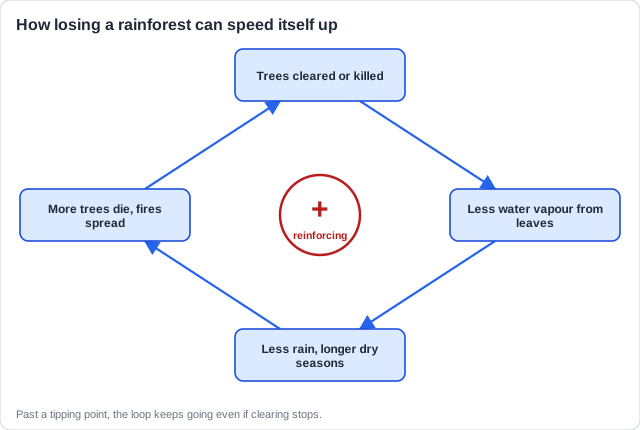
Real example: about 17% of the Amazon has been cleared, and scientists suggest it could tip into dry grassland at 20 to 25%. Measurements from 2010 to 2018 found that the south-east Amazon now gives out more carbon than it takes in.
Practice with exam-style questions
Answer exam-style questions and get AI feedback that shows you exactly what examiners want to see in a full-marks response.
'Consider the claim' means weigh it: the evidence for it, the doubts, then your judgement.
Weighing the claim
- For: extinction is over ten times the boundary, so the critical threshold is already crossed.
- For: links to climate are real: parts of the Amazon already give out more carbon than they take in.
- For: past mass extinctions went with changes to the whole Earth system.
- Against: biodiversity loss is mostly local and gradual; no single global threshold has been found.
- Against: the boundary value is uncertain, and most species have never been counted.
- Against: other species may take over lost jobs (redundancy), so function may hold for a time.
Real example: in 2012 a team led by Anthony Barnosky warned that, with about 43% of Earth's ice-free land already turned into farms and cities, the biosphere could be nearing a planetary state shift. In 2013 a team led by Barry Brook replied that such a single global tipping point is unlikely, because losses happen place by place.
A claim, not a fact: Do not write that the Earth system has already tipped. The boundary is crossed; the tipping point is a risk.
How this comes up: Paper 2, Section B (c) [9]: to what extent extinctions could tip the Earth system. Or (b) [7]: explain how species loss could lead to a tipping point, or a Section A graph with a threshold line.
The planetary boundaries model shows that the boundary for biosphere integrity has been crossed.
To what extent could species extinctions caused by human activity lead to a tipping point in the whole Earth system?
Model answer plan
See the mark-by-mark plan — for / against / judgement, with marking guidance — in study mode.