Mass extinctions at Higher Level: This statement is Higher Level only. It covers the five mass extinctions of the past, what caused them, why new species evolve so fast afterwards, and how today's sixth extinction differs.
Practise this as you read
- Read a diversity graph: the lowest point, with units.
- Link empty niches to rapid speciation.
Free preview
This is the free notes preview
You're reading the free notes. Aimnova Pro unlocks the full study experience — and you can try it with your first topic free to keep:
- FlashcardsLock in vocabulary and key terms with spaced repetition.
- Practice questionsAnswer exam-style questions and get instant AI marking.
- Mock exams & past-paper vaultSit full mocks and see exactly how examiners award marks.
- Personalised study planA daily plan built around your exam date and weak areas.
When most life disappears at once: Species die out all the time, at a slow background rate. A mass extinction is different: most of life vanishes together.
The points to remember
- A mass extinction is the loss of a large share of Earth's species, 75% or more, in a short time.
- 'Short' in geology means less than about 2 million years.
- There have been five: 445, 372, 252, 201 and 66 million years ago.
- The worst, 252 million years ago, wiped out about 90% of sea species: diversity was at its lowest.
- On a diversity graph, a mass extinction is a sharp dip below the trend line.
Remember it as: Five times, most of life vanished: 445, 372, 252, 201, 66.
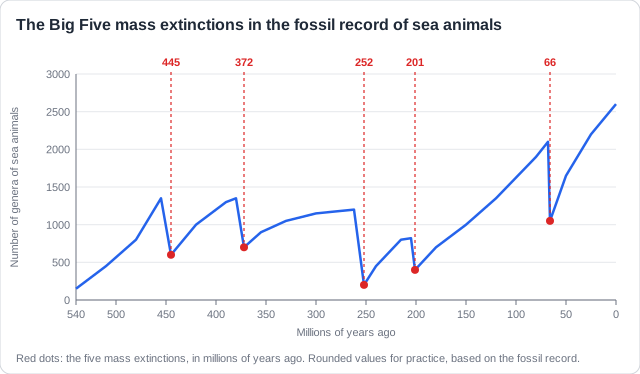
Reading a diversity graph: Give the time with its unit: 'about 250 million years ago'. A number such as '250' on its own does not count. Read the lowest point only within the time span the question asks about.
Memorize terms 3x faster
Smart flashcards show you cards right before you forget them. Perfect for definitions and key concepts.
Each of the five had natural causes, often several acting together. Most changed the climate or the oceans faster than species could adapt.
The causes, in the guide's words
- Tectonic plate movements: continents join or split, changing seas, climate and habitats.
- Super-volcanic eruptions: huge floods of lava release carbon dioxide and sulfur gases.
- Climatic changes: sudden warming or an ice age.
- Changes in sea level: shallow seas, rich in life, dry up or lose oxygen.
- Meteorite impact: dust blocks the Sun, so photosynthesis and food chains collapse.
Remember it as: Plates, volcanoes, climate, sea level, meteorite.
| Mass extinction | Million years ago | Main cause |
|---|---|---|
| End-Ordovician | 445 | Ice age on the southern continent, Gondwana; sea level fell |
| Late Devonian | 372 | Oceans lost oxygen; climate cooled; sea level changed |
| End-Permian | 252 | Super-volcano: the Siberian Traps; warming, acid seas |
| End-Triassic | 201 | Eruptions as the supercontinent Pangaea split apart |
| End-Cretaceous | 66 | Meteorite impact at Chicxulub, Mexico; volcanoes in India |
Real example: 66 million years ago an asteroid about 10 km wide hit Chicxulub, in Mexico. Dust and soot darkened the sky, plants stopped photosynthesising, and about 75% of species died, including every dinosaur except the birds.
A mass extinction is also a new start. The survivors inherit a world full of empty niches.
Why speciation speeds up afterwards
- A mass extinction leaves many niches empty: roles no species now fills.
- Survivors face less competition and fewer predators.
- They spread into the empty niches; each group meets new selection pressures.
- So new species evolve quickly: rapid speciation, called an adaptive radiation.
- Diversity takes 5 to 10 million years to recover, then often rises above its old level.
Remember it as: Empty niches, less competition, fast new species.
66 million
- The asteroid kills the dinosaurs. Mammals are small, shrew-sized animals that survive.
Empty niches
- No large plant-eaters or large predators are left on land, so these roles are empty.
Spread
- Mammals spread into the empty niches, meeting different selection pressures in each.
New species
- Within about 10 million years there are early bats, primates, horses and the land ancestors of whales.
Real example: the same happened 201 million years ago. The end-Triassic extinction removed the dinosaurs' crocodile-like competitors, and dinosaurs spread and diversified to rule the land for the next 135 million years.
Know your predicted grade
Take timed mock exams and get detailed feedback on every answer. See exactly where you're losing marks.
The five were natural. Today, extinctions are rising again, and the cause is us: they are anthropogenic.
The sixth mass extinction
- Many scientists say a sixth mass extinction has begun, caused by people: it is anthropogenic.
- Species are dying out an estimated 100 to 1,000 times faster than the natural background rate.
- The causes are human: habitat loss, overharvesting, invasive species, pollution, climate change.
- Past mass extinctions had natural, physical causes; this one is caused by one species.
- It is happening in centuries, not thousands or millions of years.
The Big Five
- Natural causes: plates, volcanoes, climate, sea level, meteorites.
- Over thousands to millions of years.
- Followed by rapid speciation.
The sixth
- Caused by one species: humans.
- Over a few centuries.
- Recovery would take millions of years.
Real example: the passenger pigeon was probably North America's commonest bird, with billions in the 1800s. Hunting and forest clearing wiped it out; the last one, Martha, died in Cincinnati Zoo in 1914. Today the IUCN lists more than 46,000 species as threatened with extinction.
How this comes up: Paper 2, Section A: a graph of diversity through deep time with a trend line. Identify the lowest point [1], then describe what caused a dip marked X [2].
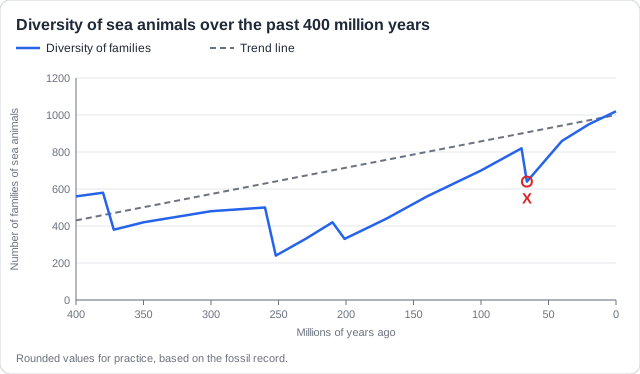
Figure 1 shows the diversity of sea animals over the past 400 million years.
(a) Identify when the diversity of sea animals was lowest in the past 400 million years.
(b) Describe what may have caused the deviation from the trend line at point X.
Model answer plan
See the mark-by-mark plan — for / against / judgement, with marking guidance — in study mode.