Reproductive isolation at Higher Level: An HL-only statement. A river, a mountain range, or just a different courtship song can stop two groups of one species from breeding together. Given enough time, they become two species. Here is how, with the apes of the Congo and the flies of New York.
Practise this as you read
- Explain how geographical, ecological, temporal and behavioural isolation lead to speciation, with examples.
- Explain why isolated islands have many endemic species, and how plate movement drives speciation.
Free preview
This is the free notes preview
You're reading the free notes. Aimnova Pro unlocks the full study experience — and you can try it with your first topic free to keep:
- FlashcardsLock in vocabulary and key terms with spaced repetition.
- Practice questionsAnswer exam-style questions and get instant AI marking.
- Mock exams & past-paper vaultSit full mocks and see exactly how examiners award marks.
- Personalised study planA daily plan built around your exam date and weak areas.
No interbreeding, no gene flow: Reproductive isolation can be achieved by geographical separation or, for populations living in the same area, by ecological or behavioural differences. Once there is no gene flow, populations can split into new species.
The points to remember
- Reproductive isolation: two populations can no longer interbreed, so there is no gene flow.
- Each population meets different selective pressures: climate, food, predators.
- Natural selection favours different traits in each, and each gathers its own mutations.
- Over many generations they diverge until they cannot produce fertile offspring together.
- Then they are separate species: this is speciation.
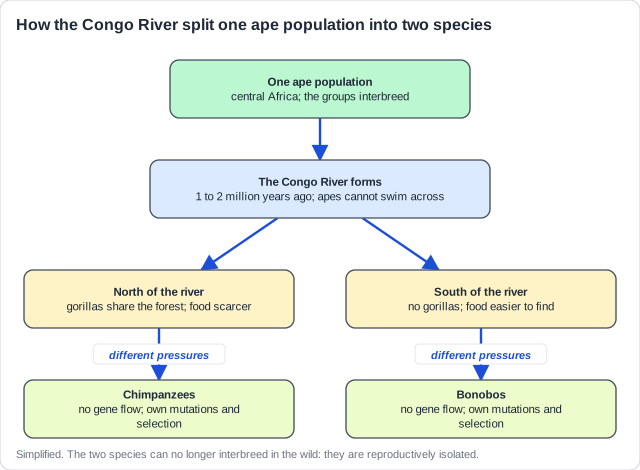
Real example: chimpanzees live north of the Congo River and bonobos south of it. When the river formed, between one and two million years ago, it split one ape population in two. Today bonobos are more slender and settle conflicts with less violence than chimpanzees: two species.
See how examiners mark answers
Answer exam-style questions with model answers. Learn exactly what earns marks and what doesn't.
The simplest way to stop interbreeding is to put something in the way.
Geographical isolation
- A physical barrier splits one population: a river, mountain range, sea or desert.
- Colonists that reach an island are cut off from the mainland population.
- Human barriers count too: a highway or a dam can split the populations of small animals.
- Speciation after geographical separation is called allopatric speciation.
Real example: the Grand Canyon, in Arizona, is too deep and dry for tree squirrels to cross. The Kaibab squirrel on the north rim has a black belly and a white tail; Abert's squirrel on the south rim has a white belly and a grey tail. They are classed as separate subspecies: a speciation still under way.
Remember it as: Barrier, no gene flow, different pressures, new species.
Over millions of years, moving tectonic plates build and break the barriers.
How plate movement drives speciation
- Plates split continents and open seas, isolating populations (Gondwana broke up).
- Colliding plates push up mountains: new barriers and new altitude habitats.
- Volcanoes build new islands: empty habitats to colonise.
- Land bridges join continents, bringing species together under new selective pressures.
- Drifting continents move into new climate zones, so food and conditions change.
- Eruptions can wipe out species, opening new niches for survivors.
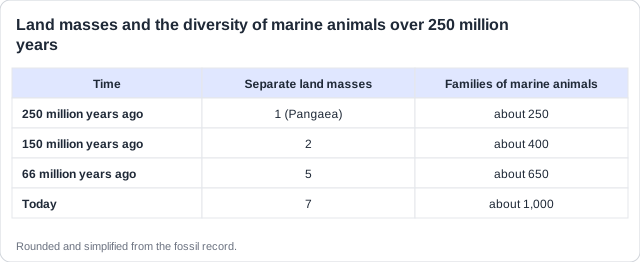
Real example: New Zealand split from Gondwana about 85 million years ago, with no land mammals except bats. Birds took over the ground: the kiwi, kakapo and takahe cannot fly. Where two plates collide, the Southern Alps rise, with alpine plants found nowhere else.
Study smarter, not longer
Most students waste 40% of study time on topics they already know. Our AI tracks your progress and optimizes every minute.
Populations can also be isolated while living side by side.
Isolation in the same place
- Ecological: groups use different habitats or food in the same area, so they rarely meet.
- Temporal: groups breed at different times of day or year.
- Behavioural: different courtship songs, dances or colours, so they do not choose each other as mates.
- Each stops gene flow with no barrier at all: speciation in the same place (sympatric).

Real example: the apple maggot fly of New York laid its eggs only on hawthorn fruit until apples were planted there. Since the 1860s some flies have used apples. The flies mate on their own fruit, and apples ripen weeks earlier, so apple flies breed earlier: only a few per cent now mate across the groups.
Colour keeps two fish apart: In Lake Victoria, females of two closely related cichlid fish choose males by colour, red or blue. Where the water has become murky and colours cannot be seen, the two now interbreed.
Isolated islands hold far more endemic species than the same area of mainland.
Why isolated islands have many endemic species
- An endemic species is found naturally in one area and nowhere else.
- Few colonists arrive: a small population with low genetic diversity (the founder effect).
- Many empty niches and little competition: one colonist splits into many species (adaptive radiation).
- No gene flow with the mainland: newcomers cannot breed with the island species.
- An old island gives time for speciation; varied landscapes give many habitats.
- Island species cannot move away, so they stay unique to the island.
Real example: Madagascar split from Africa about 160 million years ago and from India about 88 million years ago. About 90% of its plants and animals are found nowhere else, including more than 100 species of lemur, all descended from a few early colonists.
'It is remote' is not enough: Saying only that an island is isolated or remote is not enough. Link the isolation to what it causes: no gene flow, speciation, adaptive radiation.
Practice with exam-style questions
Answer exam-style questions and get AI feedback that shows you exactly what examiners want to see in a full-marks response.
How this comes up: Island endemism and isolation are asked in Paper 1 case studies and Paper 2 Section A [2]-[3]; plate tectonics and speciation as a Section B (b) [7]. May 2026 used a grid of three types of isolation.
The Hawaiian Islands lie about 3,800 km from the nearest continent. About 90% of their native flowering plants are found nowhere else, and more than 50 species of honeycreeper, a group of birds, evolved there from one kind of finch.
Explain why isolated islands such as Hawaii have high rates of endemism.
Model answer plan
See the mark-by-mark plan — for / against / judgement, with marking guidance — in study mode.
Name the mechanism: Founder effect, adaptive radiation, no gene flow: each is a separate mark.