Mutation and sexual reproduction at Higher Level: An HL-only statement. Why are no two ladybirds, strawberries or people quite the same? Two processes keep making living things different, and that difference is what lets a species survive change.
Practise this as you read
- Explain how mutation makes new alleles and sexual reproduction makes new combinations.
- Outline why genetic diversity matters for natural selection and resilience.
Free preview
This is the free notes preview
You're reading the free notes. Aimnova Pro unlocks the full study experience — and you can try it with your first topic free to keep:
- FlashcardsLock in vocabulary and key terms with spaced repetition.
- Practice questionsAnswer exam-style questions and get instant AI marking.
- Mock exams & past-paper vaultSit full mocks and see exactly how examiners award marks.
- Personalised study planA daily plan built around your exam date and weak areas.
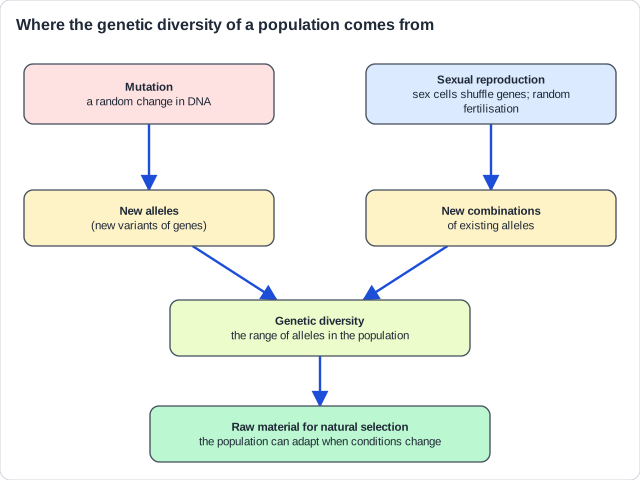
Two sources of genetic diversity: Mutation generates new variants of genes. Sexual reproduction generates new combinations of genes. Both increase the genetic diversity of a population.
The points to remember
- A gene is a length of DNA that controls one feature; its different versions are alleles.
- Genetic diversity is the range of alleles in a population or a species.
- It has two sources: mutation makes new alleles; sexual reproduction makes new combinations.
- Genetic diversity is the raw material that natural selection acts on.
Real example: the harlequin ladybird is one species, yet its wing cases range from orange with many black spots to black with two red spots. Each colour form is controlled by different alleles: genetic diversity you can see.
Stop wasting time on topics you know
Our AI identifies your weak areas and focuses your study time where it matters. No more overstudying easy topics.
Every new allele in the living world started as a mutation.
Mutation: new variants
- A mutation is a random change in the DNA of a gene.
- It can happen when DNA is copied before a cell divides, or be caused by UV light, radiation or some chemicals.
- Most mutations are harmless or harmful; a few give an advantage.
- Only mutations in sex cells (eggs, sperm, pollen) are passed on to offspring.
- Mutation is the only source of brand-new alleles; over many generations, new mutations accumulate.
Real example: most mammals lose the ability to digest lactose after they are weaned. Within the last 10,000 years, a mutation that keeps the lactose-digesting gene switched on appeared in cattle-herding peoples in Europe and East Africa. It spread where people drank milk: today most adults of north-west European descent can digest milk, while most adults in East Asia cannot.
Mutations are random: A mutation does not happen because an organism needs it. It appears by chance; natural selection then decides whether it spreads.
Sexual reproduction makes no new alleles. It shuffles the ones that already exist into new mixes.
Sexual reproduction: new combinations
- Each parent makes sex cells that carry half of its genes.
- As sex cells form, the genes are shuffled, so each sex cell gets a different mix of alleles.
- Fertilisation is random: any sperm or pollen grain can join any egg.
- So every offspring has a new combination of alleles (except identical twins).
- Asexual reproduction makes clones, with the same genes as the parent: no new combinations.
Mutation
- Makes new alleles
- Random change in DNA
- Rare in any one gene
Sexual reproduction
- Makes new combinations
- Shuffling and random fertilisation
- Every generation
Real example: a strawberry plant spreads by runners, and every runner plant is a clone. The seeds on its fruit come from sexual reproduction, so each seedling is different. In people, one couple can make more than 70 trillion different combinations of chromosomes.
Remember it as: Mutation makes new cards; sex shuffles the deck.
See how examiners mark answers
Answer exam-style questions with model answers. Learn exactly what earns marks and what doesn't.
Why does genetic diversity matter? Because it decides whether a population can cope with change.
Why genetic diversity matters
- More alleles means more variation for natural selection to act on.
- When conditions change (a new disease, a drought, a warmer climate), some individuals are more likely to survive and breed.
- So high genetic diversity makes a population more resilient: it can adapt.
- With low genetic diversity, one disease can wipe out most of a population.
- Over long periods, new variants and combinations let isolated populations diverge into new species.
Real example: Tasmanian devils have very low genetic diversity. Devil facial tumour disease was first seen in 1996. Because the devils are so alike genetically, their bodies do not reject the tumour cells, and the disease has killed about 80% of all devils.
Link it up: Mutation and sex give diversity; diversity gives selection something to work on; selection lets the population adapt. Say how each factor changes diversity, not just its name.
How this comes up: Genetic diversity is asked in Paper 2 Section B (a) [4] and inside longer questions on natural selection and speciation. A point earns its mark only when it says how the factor changes diversity.
Every Przewalski's horse alive today descends from about a dozen horses caught in the wild. Conservationists breed them in zoos and release them in Mongolia.
Outline how mutation and sexual reproduction can increase the genetic diversity of the Przewalski's horse population.
Model answer plan
See the mark-by-mark plan — for / against / judgement, with marking guidance — in study mode.
New alleles v new combinations: Mutation is the only source of new alleles; sexual reproduction only recombines them. Keep the two apart in your answer.