Global action on nitrogen at Higher Level: An HL-only statement. Nitrogen from one country's farms ends up in another country's sea. You will see why only countries working together can bring the nitrogen cycle back within its boundary, and how hard that is.
Practise this as you read
- Explain why collaboration must be global.
- Evaluate the measures, using laws and economics.
Free preview
This is the free notes preview
You're reading the free notes. Aimnova Pro unlocks the full study experience — and you can try it with your first topic free to keep:
- FlashcardsLock in vocabulary and key terms with spaced repetition.
- Practice questionsAnswer exam-style questions and get instant AI marking.
- Mock exams & past-paper vaultSit full mocks and see exactly how examiners award marks.
- Personalised study planA daily plan built around your exam date and weak areas.
A problem no country can solve alone: To bring the nitrogen cycle back within its planetary boundary, countries must work together on the uncontrolled use of nitrogen in farming and industry.
The points to remember
- Nitrogen crosses borders: rivers, winds and shared seas carry it from one country to the next.
- One country acting alone cannot clean a shared sea or air, and its farmers bear costs its neighbours avoid.
- Nitrous oxide warms the whole planet, wherever it is released.
- Use is uneven: some regions spread far too much, while many African farms have too little.
- So the aim is to halve nitrogen waste, not to stop using fertiliser everywhere.
- That needs shared targets, laws, money and science, agreed between countries.
Remember it as: Nitrogen has no passport.
Real example: nine countries surround the Baltic Sea, and nitrate from farms and cities in all of them feeds its dead zones. The River Danube flows through ten countries into the Black Sea, carrying their fertiliser with it.
Too little is a problem too: In 2006 African governments set a goal of 50 kg of fertiliser per hectare (the Abuja Declaration), because many farms used far less and harvests were poor. Fairness means cutting waste where use is high, not everywhere.
Memorize terms 3x faster
Smart flashcards show you cards right before you forget them. Perfect for definitions and key concepts.
Countries have built agreements at every scale, from the whole world down to one shared sea.
Agreements at every scale
- Global targets: Kunming-Montreal Target 7 (2022) and the Colombo Declaration (2019) aim to halve nitrogen waste by 2030.
- Shared science: the International Nitrogen Management System measures flows and advises governments.
- Regional law: the Gothenburg Protocol sets each country a ceiling for nitrogen oxides and ammonia.
- Shared seas: the Baltic Sea Action Plan gives each country a quota for cutting nutrients.
- National law: the EU Nitrates Directive limits manure to 170 kg of nitrogen per hectare a year.
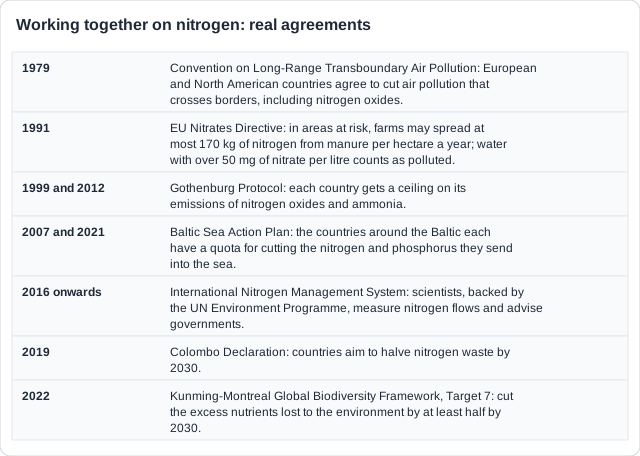
Real example: the Baltic Sea Action Plan: The countries around the Baltic, working through HELCOM, agreed in 2007 how much nitrogen and phosphorus each must cut. The plan was updated in 2021, and inputs to the sea have fallen since the 1980s.
Agreements only work through measures on the ground: on farms, beside rivers and in cities.
The measures
- Precision farming: test the soil and spread only what the crop needs, when it needs it.
- Cover crops and legumes in rotation hold nitrate over winter and fix nitrogen naturally.
- Buffer strips and wetlands beside streams take up nitrate before it reaches the water.
- Store manure safely and inject it into the soil, so less ammonia escapes.
- Organic fertilisers, and eating less meat and wasting less food, cut the nitrogen needed.
- In industry and cities: catalytic converters, cleaner power stations and sewage works that remove nitrogen.
On the farm
- Soil tests and precision spreading
- Cover crops and legumes
- Manure stored and injected
Between farm and water
- Buffer strips of grass and shrubs
- Restored wetlands
- No spreading before heavy rain
In cities and industry
- Sewage works that remove nitrogen
- Catalytic converters
- Renewable energy instead of fuel
Real example: from 1985 Denmark brought in a series of action plans: limits on fertiliser for each farm, winter cover crops, safe manure storage and new wetlands. Nitrogen leaching from its fields fell by about half, while harvests stayed about the same.
Know your predicted grade
Take timed mock exams and get detailed feedback on every answer. See exactly where you're losing marks.
Measures cost money and change how people farm, so they need laws (HL.a) and economic tools (HL.b).
Laws and money
- Laws set limits: caps on fertiliser and manure, closed seasons for spreading, protected zones.
- Money changes choices: taxes on fertiliser, payments for cover crops, buying out farms near nature.
- Cuts are costly for farmers, so plans need fairness: help for those who lose income.
- Without support, farmers resist, and governments may back down.
Real example: the Netherlands nitrogen crisis: In 2019 a Dutch court ruled that the government's nitrogen permits broke EU nature law, halting thousands of building and farm projects. The government then planned to halve nitrogen emissions by 2030, with about 25 billion euros to buy out and change livestock farms near protected nature.
What happened next: farmers blocked motorways with tractors in 2019 and 2022, and a new Farmer-Citizen Movement won the most votes in the 2023 provincial elections. Cutting nitrogen is as much a political problem as a scientific one.
Can global action really bring nitrogen back within its boundary? There are good reasons for hope, and real limits.
Limits, and reasons for hope
- Time lags: nitrate in groundwater and slow-flushing seas take decades to clear.
- Most targets are voluntary; there is no binding global treaty on nitrogen yet.
- Millions of farms each leak a little, so rules are hard to check and enforce.
- Cuts can raise food prices; poorer regions need more fertiliser, not less.
- But it can work: Denmark and the Black Sea show losses and dead zones can shrink.
Real example: the Black Sea: When farming collapsed in eastern Europe after 1990, fertiliser use in the Danube basin fell sharply, and the dead zone on the Black Sea's north-west shelf shrank within a few years.
Why the Baltic is slower: its water is replaced only about every 30 years, and its low-oxygen mud keeps releasing stored nutrients, so its dead zones shrink far more slowly than inputs fall.
Get feedback like a real examiner
Submit your answers and get instant feedback — what you did well, what's missing, and exactly what to write to score full marks.
How this comes up: Paper 2, Section B (b) [7]: explain why action must be global, or evaluate measures. Section B (c) [9]: to what extent can collaboration bring nitrogen back within its boundary?
In 2022, almost 200 countries agreed to cut the excess nutrients lost to the environment by at least half by 2030.
Explain why global collaboration is needed to bring the nitrogen cycle back within its planetary boundary.
Model answer plan
See the mark-by-mark plan — for / against / judgement, with marking guidance — in study mode.