Classification at Higher Level: The same ideas as SL. At HL you go further in 2.1.26 and 2.1.27: clades, and why the traditional groups do not always fit evolution.
Practise this as you read
- Read a binomial name: genus first, species second.
- Predict features from a shared genus.
Free preview
This is the free notes preview
You're reading the free notes. Aimnova Pro unlocks the full study experience — and you can try it with your first topic free to keep:
- FlashcardsLock in vocabulary and key terms with spaced repetition.
- Practice questionsAnswer exam-style questions and get instant AI marking.
- Mock exams & past-paper vaultSit full mocks and see exactly how examiners award marks.
- Personalised study planA daily plan built around your exam date and weak areas.
Too many species to know one by one: Life is so diverse that classification is needed. Most species on Earth have not even been named yet.
The points to remember
- There is an immense diversity of species: about 8.7 million, but only about 2.1 million are named.
- So we need classification to sort them.
- Hard to count because there are too few taxonomists...
- ...and too little money to pay experts.
- Remote areas, such as mountains and deep forest, are not fully explored.
- Some species are hard to find, and some are hard to tell apart from close relatives.
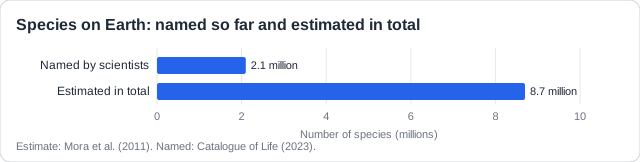
Reasons that do not count: 'It has high biodiversity', 'animals migrate' or 'they live in protected areas' do not explain why a count is hard. Give a real barrier: too few taxonomists, no money, remote places, species hard to find or tell apart.
Real example: in the mountains of Papua New Guinea, expeditions still find new frogs and birds, because some valleys have almost never been visited by scientists.
Know your predicted grade
Take timed mock exams and get detailed feedback on every answer. See exactly where you're losing marks.
Classification puts organisms that share features into the same group.
Why classify: identify and predict
- Organisms are grouped by shared features.
- Efficient identification: a new find is quickly narrowed down to its group.
- Prediction: members of a group share traits, so we can predict an organism's features.
- Species in the same genus are closely related and have similar traits.
- Genera are grouped into bigger groups, such as families, in the same way.
Remember it as: Group it, then you can find it and predict it.
Identification
- Narrow a new find down to its group.
- Then check a few species, not millions.
Prediction
- Members of a group share traits.
- So guess its features before studying it.
Real example: blackbirds and song thrushes are both in the genus Turdus. Both feed on worms and snails on the ground and build cup-shaped nests, so other Turdus birds are predicted to do the same.
Scientists give each species a two-part name, called a binomial name.
The points to remember
- Every species has a two-part scientific name.
- First name: the genus, with a capital letter.
- Second name: the species, all in lower case.
- Both names in italics, or underlined when handwritten.
- One name, used by scientists in every language.
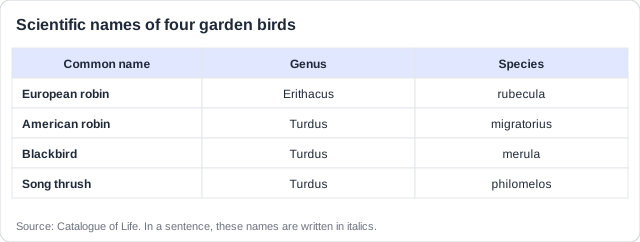
Write it right: Panthera leo: capital P, small l, in italics. By hand: underline both words.
Real example: a 'robin' in London is Erithacus rubecula, but in New York it is Turdus migratorius, a thrush. The common name misleads; the scientific name does not.
Get feedback like a real examiner
Submit your answers and get instant feedback — what you did well, what's missing, and exactly what to write to score full marks.
How this comes up: Paper 1 and Paper 2 short parts: why species are hard to count [1-2], or reading and writing binomial names.
Papua New Guinea has steep mountains, thick rainforest and few roads. Scientists think many of its species are still unknown.
Outline two reasons why it is difficult to determine the exact number of species in Papua New Guinea.
Model answer plan
See the mark-by-mark plan — for / against / judgement, with marking guidance — in study mode.