The biosphere at Higher Level: The same levels as SL. At HL they come back when you study niches, life cycles and human impacts on species.
Practise this as you read
- Place each example at the right level.
- Check whether a list includes non-living parts.
Free preview
This is the free notes preview
You're reading the free notes. Aimnova Pro unlocks the full study experience — and you can try it with your first topic free to keep:
- FlashcardsLock in vocabulary and key terms with spaced repetition.
- Practice questionsAnswer exam-style questions and get instant AI marking.
- Mock exams & past-paper vaultSit full mocks and see exactly how examiners award marks.
- Personalised study planA daily plan built around your exam date and weak areas.
Life on Earth, in levels: The biosphere is one huge ecological system. It is built from individuals, populations, communities and ecosystems.
The points to remember
- The biosphere is all the parts of the Earth where life exists.
- It is an ecological system made of four levels.
- Individual: one organism.
- Population: all the organisms of one species in an area, able to breed together.
- Community: all the populations living and interacting in an area.
- Ecosystem: a community plus its non-living surroundings.
Remember it as: One, one kind, all kinds, add the non-living: individual, population, community, ecosystem.
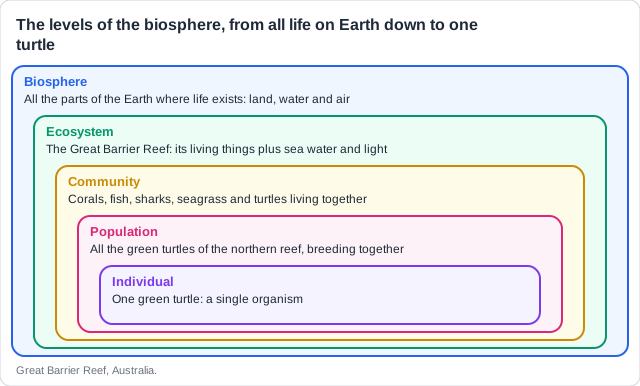
Real example: the Great Barrier Reef is the largest coral reef on Earth. Its green turtles are one population among thousands.
Get feedback like a real examiner
Submit your answers and get instant feedback — what you did well, what's missing, and exactly what to write to score full marks.
The two levels people mix up most are community and ecosystem. The difference is the abiotic parts.
Telling the levels apart
- Population = one species. Community = many species.
- A community is living things only.
- An ecosystem adds the abiotic parts: water, soil, light, temperature.
- Each level sits inside the next: individual, population, community, ecosystem, biosphere.
- Name the place and the species to make each level clear.
Community
- Living things only.
- Many populations, interacting.
Ecosystem
- The community plus the non-living parts.
- Water, soil, light, temperature.
Two common slips: A population is one species, not 'all the animals'. A community has no non-living parts: rocks and water belong to the ecosystem.
Real example: in the Amazon rainforest, all the jaguars form one population; the jaguars, trees, monkeys and fungi form the community; add the rain, soil and heat and you have the ecosystem.
How this comes up: The levels are asked as short definitions in Paper 2 Section A, or as an outline with a named example [4].
The Great Barrier Reef in Australia is home to corals, fish and green turtles in warm, shallow sea water.
Outline the levels of ecological organisation in the biosphere, with reference to the Great Barrier Reef.
Model answer plan
See the mark-by-mark plan — for / against / judgement, with marking guidance — in study mode.