The nitrogen planetary boundary at Higher Level: An HL-only statement. Of the nine planetary boundaries, nitrogen is one of the furthest crossed. You will weigh the evidence, find the main cause, and see why the damage may not be undone.
Practise this as you read
- Explain the evidence that the nitrogen boundary has been crossed.
- Explain why fertiliser is the major cause.
Free preview
This is the free notes preview
You're reading the free notes. Aimnova Pro unlocks the full study experience — and you can try it with your first topic free to keep:
- FlashcardsLock in vocabulary and key terms with spaced repetition.
- Practice questionsAnswer exam-style questions and get instant AI marking.
- Mock exams & past-paper vaultSit full mocks and see exactly how examiners award marks.
- Personalised study planA daily plan built around your exam date and weak areas.
A safe limit, crossed: The planetary boundaries model gives the nitrogen cycle a safe limit. Human activities add so much nitrate and other reactive nitrogen that the limit has been crossed.
The points to remember
- The nitrogen boundary is set on the nitrogen fixed each year by industry and farm crops.
- The safe limit is about 62 million tonnes of nitrogen a year.
- The 2023 estimate is about 190 million tonnes: roughly three times the limit.
- So the boundary has been crossed; the nitrogen cycle is in the high-risk zone.
- Beyond a boundary, irreversible changes to Earth systems become likely.
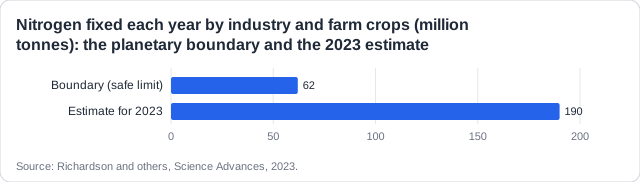
Remember it as: 62 is safe; we are at 190.
Real example: in 2023 a team led by Katherine Richardson checked all nine boundaries. Six were crossed, and nitrogen was one of the furthest out. Phosphorus, the other half of the same boundary, was about twice its limit too.
Memorize terms 3x faster
Smart flashcards show you cards right before you forget them. Perfect for definitions and key concepts.
How do we know it has been crossed? Several separate kinds of evidence point the same way.
The evidence
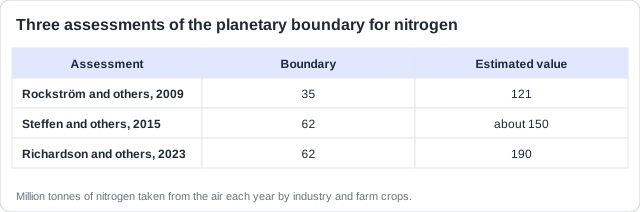
- Every assessment since 2009 puts the value far above the boundary, and it keeps rising.
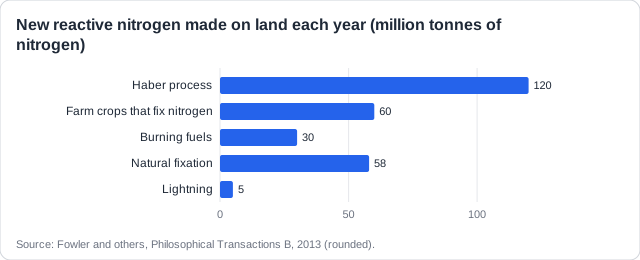
- People now fix more nitrogen on land than all natural processes there.
- Reactive nitrogen entering the biosphere has more than doubled.
- There are over 400 coastal dead zones worldwide, such as the Gulf of Mexico.
- Nitrous oxide in the air rose from about 270 to about 336 parts per billion.
- Nitrate in groundwater is above safe limits in many farming regions.
Real evidence: dead zones: In 2008 two scientists, Robert Diaz and Rutger Rosenberg, counted over 400 coastal dead zones around the world, covering about 245,000 km². Their number had roughly doubled every ten years since the 1960s, as fertiliser use grew.
The major cause: fertiliser: The world depends on inorganic fertiliser to grow its crops. That is the main reason the boundary was crossed.
The points to remember
- Inorganic fertiliser made by the Haber process is the largest new source: about 120 million tonnes a year.
- Farm legume crops add about 60 more: farming makes most of the new reactive nitrogen.
- Only about 30-50% of fertiliser nitrogen is taken up; the rest leaches, runs off or escapes as gases.
- Only a small part reaches the food people eat; most spreads through water, soil and air.
- The world depends on it: crops grown with it feed about half of all people, so it is hard to cut.
Real example: China uses about a quarter of the world's nitrogen fertiliser on under a tenth of its farmland. Studies of Chinese farms found only about a third of it was taken up by the crops, and nitrate in many rivers and wells rose sharply.
Know your predicted grade
Take timed mock exams and get detailed feedback on every answer. See exactly where you're losing marks.
Why does crossing the boundary make irreversible changes likely? Extra nitrogen spreads through every part of the Earth system, and some of its effects cannot simply be undone.
What the extra nitrogen does
- Eutrophication of rivers, lakes and seas: dead zones where fish cannot live.
- Nitrogen-sensitive ecosystems (heaths, bogs, grasslands) lose species: biodiversity falls.
- Nitrous oxide is a strong greenhouse gas and now the main gas damaging the ozone layer.
- Acid deposition from nitrogen oxides harms forests, lakes and soils.
- Nitrate in groundwater can take decades to wash out, even after inputs fall.
- Positive feedback can lock a change in: a system crosses a tipping point and stays changed.
Real example: Dutch heathlands: Nitrogen falling from the air, mostly ammonia from livestock, fertilised the heathlands of the Netherlands. From the 1970s fast-growing grasses took over from heather, and the plants and insects of the heath declined.
Why it may not reverse: in the Baltic Sea, low oxygen on the sea floor makes the mud release phosphate, which feeds more algae and more low oxygen. This positive feedback keeps the dead zones going even after nitrogen inputs fall.
How this comes up: Paper 2, Section A: a chart or table of the boundary, then explain what it shows [3]. Section B (b) [7]: explain how human activities pushed nitrogen past its boundary.
Figure 1 shows the planetary boundary for nitrogen and the estimate for 2023.
Explain why the nitrogen cycle is said to be outside its safe operating space.
Model answer plan
See the mark-by-mark plan — for / against / judgement, with marking guidance — in study mode.