aimnova.
DashboardMy LearningPaper MasteryStudy Plan

Aimnova site navigation

Stay in the loop

Get the latest study resources and updates

New features, study tips and exam insights — straight to your inbox.

IB Diploma

  • IB Past Papers
  • IB Study Notes
  • IB Question Bank
  • IB Mock Exams
  • IB Revision

IB Subjects

  • IB Math AA
  • IB Math AI
  • IB Economics
  • IB Business Management
  • IB Physics
  • IB Biology
  • View all IB subjects→

IB Past Papers

  • IB Math AA HL Past Papers
  • IB Math AA SL Past Papers
  • IB Math AI HL Past Papers
  • IB Math AI SL Past Papers
  • IB Economics HL Past Papers
  • IB Economics SL Past Papers
  • IB ESS Past Papers
  • View all past papers→

Study Resources

  • Study Notes
  • Question Bank
  • Mock Exams
  • Flashcards
  • Revision Guide
  • Exam Skills
  • Command Terms
  • Grade Calculator
  • Exam Timetable 2026

Aimnova

  • Features
  • Pricing
  • For Teachers
  • For Schools
  • For Parents
  • About Us
  • Blog
  • Contact
aimnova.

AI-powered study platform for smarter revision, past-paper analysis and examiner-style feedback.

TermsPrivacyCookies·© 2026 Aimnova. All rights reserved.29b4255

Aimnova is not affiliated with or endorsed by the International Baccalaureate Organization (IB).

NotesESS HLTopic 2.1Organisms and species
Back to ESS HL Topics
2.1.23 min read

Organisms and species (ESS HL)

IB Environmental Systems and Societies • Unit 2

Exam preparation

Practice the questions examiners actually ask

Our question bank mirrors real IB exam papers. Practice under timed conditions and track your progress across topics.

Start Practicing

Contents

  • Organisms and species at Higher Level
  • Organisms and species
  • The test: fertile offspring
  • Exam-style question
Organisms and species at Higher Level: The same species concept as SL. At HL you use it again when you classify species into clades and study their life cycles.

Practise this as you read

  • Apply the fertile-offspring test to each cross.
  • Ignore looks: judge by the young.

Free preview

This is the free notes preview

You're reading the free notes. Aimnova Pro unlocks the full study experience — and you can try it with your first topic free to keep:

  • FlashcardsLock in vocabulary and key terms with spaced repetition.
  • Practice questionsAnswer exam-style questions and get instant AI marking.
  • Mock exams & past-paper vaultSit full mocks and see exactly how examiners award marks.
  • Personalised study planA daily plan built around your exam date and weak areas.
Start Studying Free Full access to Aimnova Pro · cancel anytime
One organism, one species: An organism is a single individual. Each individual organism is a member of a species.

The points to remember

  • An organism is one individual living thing.
  • Every organism is a member of a species.
  • A species is a group of organisms that can interbreed...
  • ...and produce fertile offspring: young that can breed in turn.
  • This is the biological species concept.
Remember it as: Same species: they breed, and their babies breed too.

Real example: a tiny Shetland pony and a tall Arabian horse can breed, and their foals are fertile. So both are one species, the horse, Equus caballus.

Memorize terms 3x faster

Smart flashcards show you cards right before you forget them. Perfect for definitions and key concepts.

Try Flashcards FreeYour first topic is free to keep • No credit card required

The test is what happens to the young. Read the last column of the table.

Using the test

  • Mating is not enough: the young must be fertile.
  • Young that cannot breed show the parents are different species.
  • Looks do not decide it: very different-looking animals can be one species.
  • Similar-looking animals can be two species if they do not interbreed.
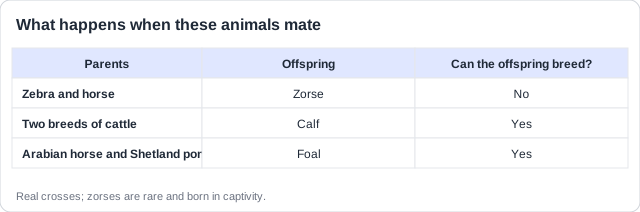
Table: zebra and horse give a zorse, which cannot breed. Two breeds of cattle give a calf, which can breed. An Arabian horse and a Shetland pony give a foal, which can breed.
Fertile young: same species. Infertile young: different species.
Say 'fertile': 'They can have babies' is not the definition. Say they interbreed and produce fertile offspring.

Real example: a zebra and a horse can mate, but their young, the zorse, cannot breed. So zebras and horses are two species.

How this comes up: A short Paper 2 part: define a species, or use it to explain a cross [1-2].
IB-style questionExplain[2 marks]

A zoo in Mexico keeps a zorse, the young of a zebra and a horse. Zorses cannot have young.

Explain why zebras and horses are classified as different species.

Model answer plan

See the mark-by-mark plan — for / against / judgement, with marking guidance — in study mode.

Claim your free topic

Try an IB Exam Question — Free AI Feedback

Test yourself on Organisms and species. Write your answer and get instant AI feedback — just like a real IB examiner.

A textbook on African wildlife uses the biological species concept.

the term species.
[1 mark]

Related ESS HL Topics

Continue learning with these related topics from the same unit:

2.1.1The biosphere
2.1.3Classification
2.1.4Identification of organisms
2.1.5Populations
View all ESS HL topics

Practice with flashcards

Spaced repetition flashcards for Organisms and species

Improve your exam technique

Command terms, paper structure, and mark-scheme tips for ESS HL

Previous
2.1.1The biosphere
Next
Classification2.1.3

6 practice questions on Organisms and species

Students who practiced this topic on Aimnova scored 82% on average. Try free practice questions and get instant AI feedback.

Try 3 Free QuestionsView All ESS HL Topics