The Haber process at Higher Level: An HL-only statement. About half of the nitrogen in your body came from a fertiliser factory. You will see how one industrial reaction feeds billions of people, and what it costs the planet.
Practise this as you read
- Outline how the Haber process makes ammonia.
- Evaluate its use for fertiliser: advantages, disadvantages, judgement.
Free preview
This is the free notes preview
You're reading the free notes. Aimnova Pro unlocks the full study experience — and you can try it with your first topic free to keep:
- FlashcardsLock in vocabulary and key terms with spaced repetition.
- Practice questionsAnswer exam-style questions and get instant AI marking.
- Mock exams & past-paper vaultSit full mocks and see exactly how examiners award marks.
- Personalised study planA daily plan built around your exam date and weak areas.
Fertiliser made from air: The Haber process is an industrial process that makes ammonia from nitrogen and hydrogen, mostly to make fertiliser.
The points to remember
- The Haber process joins nitrogen (N₂) from the air with hydrogen (H₂) to make ammonia (NH₃).
- It needs about 450 °C, about 200 atmospheres of pressure and an iron catalyst.
- The hydrogen comes from natural gas (methane), which also heats the reactor: it is energy-intensive.
- Most ammonia becomes fertiliser; the rest makes explosives and other industrial chemicals.
- It takes N₂ out of the atmosphere: a flow out of the air store, like nitrogen fixation by bacteria.
- Factories now fix more nitrogen on land than all natural processes: reactive nitrogen has doubled.
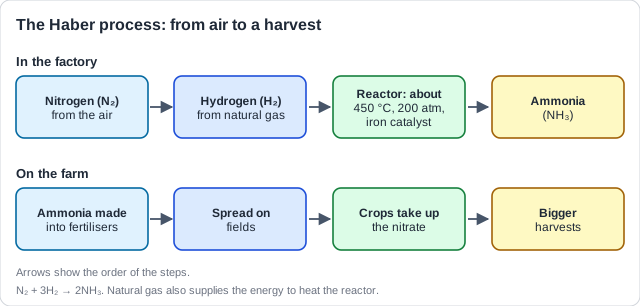
Remember it as: Air plus gas makes food.
Real example: Fritz Haber first made ammonia this way in 1909, and Carl Bosch scaled it up for the German company BASF. The first factory opened at Oppau, Germany, in 1913. Today factories worldwide make over 150 million tonnes of ammonia a year.
Know your predicted grade
Take timed mock exams and get detailed feedback on every answer. See exactly where you're losing marks.
Crops need nitrogen to build proteins and chlorophyll, and soil often has too little. Fertiliser from the Haber process supplies it, cheaply and in large amounts.
Advantages for crop yield
- Nitrogen is often the limiting factor for crop growth; fertiliser lifts that limit.
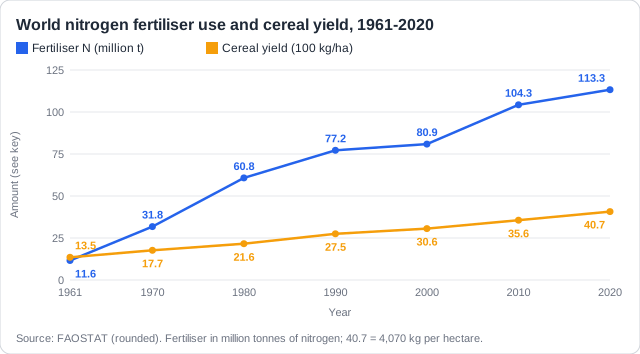
- So crop yields rise: world cereal yield has tripled since 1961 as fertiliser use grew.
- It drove the Green Revolution and more than doubled world food production.
- Crops grown with it feed about half of the world's people today.
- Higher yields need less land, so less forest has to be cleared for farms.
- It is cheap, reliable and made on demand, so farmers can plan their harvests and incomes.
Real example: India's Green Revolution: From the late 1960s, Indian farmers grew new wheat varieties with fertiliser and irrigation. The wheat harvest more than doubled in seven years, from about 12 million tonnes in 1965 to 26 million in 1972, and India stopped depending on food aid.
The land it saves: growing today's harvests at 1961 yields would need about three times as much farmland, much of it cleared from forest.
The costs: The same fertiliser that raises yields costs energy, and much of its nitrogen escapes from the field into water and air.
Disadvantages
- It uses about 2% of world energy, mostly natural gas: a non-renewable fuel that emits CO₂.
- Only about 30-50% of the nitrogen spread is taken up; the rest leaches or runs off.
- That nitrate causes eutrophication and dead zones, and nitrate in drinking water.
- Soil bacteria turn some into nitrous oxide (N₂O), a strong greenhouse gas.
- Ammonium fertilisers make soils more acidic; extra nitrogen lets a few fast plants take over (less biodiversity).
- Farmers come to depend on it, and on the price of natural gas.
Advantages
- Higher crop yields
- Feeds about half the world
- Less land cleared
- Cheap and reliable
Disadvantages
- Burns natural gas: CO₂
- Nitrate leaches: eutrophication
- N₂O: a greenhouse gas
- Acid soils, dependence on gas prices
Real example: in 2022 the price of natural gas in Europe soared after Russia invaded Ukraine. Several European fertiliser factories cut or stopped making ammonia, fertiliser prices hit record highs, and farmers around the world paid far more to grow their crops.
Two different gases: Making ammonia releases carbon dioxide (from natural gas). Using too much fertiliser releases nitrous oxide (from soil bacteria). Both are greenhouse gases: name the right one.
Get feedback like a real examiner
Submit your answers and get instant feedback — what you did well, what's missing, and exactly what to write to score full marks.
Is it worth it? Without the Haber process the world could not feed its people; with it, nitrogen leaks into water and air. The answer depends on how much is used, and how well.
Real example: Sri Lanka, 2021: Sri Lanka banned chemical fertilisers in April 2021 to go fully organic. Rice harvests fell by about a fifth, the country had to import rice, and the ban was lifted in November 2021.
Ways to keep the benefit and cut the cost
- Spread less, at the right time, only where crops need it.
- Grow legumes and use manure alongside it.
- Make green ammonia with hydrogen from renewable electricity: cuts CO₂, not nitrate losses.
Weigh it, then judge: Give the benefit (yield, food, land saved), then the costs (energy, nitrate, N₂O), then say which matters more and under what conditions.
How this comes up: Paper 2, Section B (b) [7]: evaluate the use of a technology or strategy. Both sides are needed: advantages, disadvantages, then a conclusion.
Farmers in the US Corn Belt spread about 150 kg of nitrogen fertiliser on each hectare of maize every year.
Evaluate the use of the Haber process to provide fertiliser for increased crop yield.
Model answer plan
See the mark-by-mark plan — for / against / judgement, with marking guidance — in study mode.