Human activities and the nitrogen cycle at Higher Level: An HL-only statement. People now add more reactive nitrogen to the land each year than nature does. You will follow it from a fertiliser bag, a shrimp pond, a felled forest and a car exhaust into the soil, the sea and the air.
Practise this as you read
- Outline four human activities, each linked to a store or flow.
- Discuss how far these changes can be managed.
Free preview
This is the free notes preview
You're reading the free notes. Aimnova Pro unlocks the full study experience — and you can try it with your first topic free to keep:
- FlashcardsLock in vocabulary and key terms with spaced repetition.
- Practice questionsAnswer exam-style questions and get instant AI marking.
- Mock exams & past-paper vaultSit full mocks and see exactly how examiners award marks.
- Personalised study planA daily plan built around your exam date and weak areas.
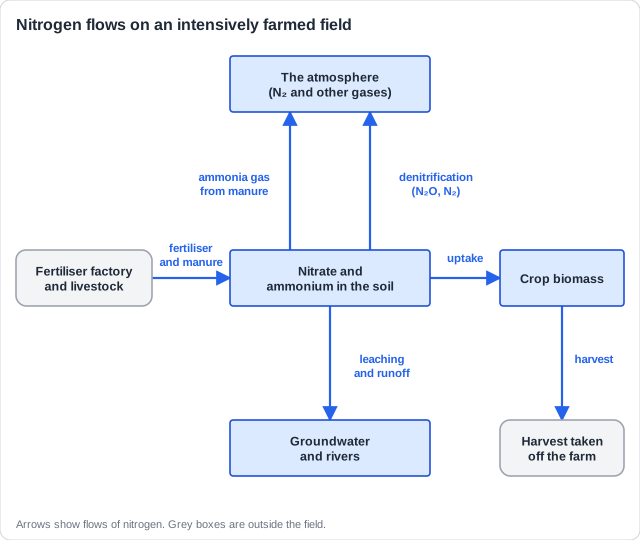
Farming: the biggest change: Agriculture is the largest human source of reactive nitrogen: synthetic fertilisers, livestock waste and nitrogen-fixing crops all add it to the land.
The points to remember
- Fertiliser adds nitrate and ammonium: the soil store grows, crops take up more and nitrification speeds up.
- Only about 30-50% of the nitrogen spread is taken up by the crop; the rest is lost from the field.
- It is lost by leaching into groundwater, runoff into rivers, ammonia gas and denitrification (N₂O).
- Livestock manure and urine release ammonia to the air and nitrate to soil and water.
- Growing legumes (and some GM crops) adds nitrogen fixation; flooded rice fields increase denitrification.
- Harvests carry nitrogen off the farm; monocultures cut the variety of soil microbes that cycle nitrogen.
Remember it as: Add it, and lose up to half of it.
Real example: Iowa, in the US Corn Belt, spreads large amounts of fertiliser and manure on its maize fields. In 2015 the water company of Des Moines took farming districts upstream to court, because nitrate in the Raccoon River was so high it had to be removed before people could drink the water.
Name the store or flow: 'Farming harms the nitrogen cycle' is too vague for a mark. Name the activity, then the store or flow it changes: 'fertiliser raises the nitrate store in the soil, so more is leached into groundwater'.
Learn what examiners really want
See exactly what to write to score full marks. Our AI shows you model answers and the key phrases examiners look for.
Farms in the water: Aquaculture adds nitrogen straight into the water, from fish waste and uneaten feed.
The points to remember
- Farmed fish and shrimp eat feed pellets rich in protein, and protein contains nitrogen.
- Much of it is not kept in the animals: it leaves as waste (ammonia) and uneaten feed.
- So the ammonium and nitrate store in the water around the farm grows.
- That can cause algal blooms and low oxygen, as fertiliser runoff does.
- Clearing mangroves for ponds removes a nitrogen store in trees and mud.
Real example: along the coasts of Thailand, large areas of mangroves were cleared from the 1980s to dig shrimp ponds. The shrimp were fed heavily, and the ponds' nitrogen-rich water was pumped out into canals and the sea. Many ponds were abandoned after a few years as waste and disease built up.
Two changes in one: A shrimp pond changes the cycle twice: the mangrove store is lost (deforestation), and the water store of ammonium and nitrate grows (aquaculture).
Nitrate washed off farms and out of cities makes the nitrate store in water grow. This is eutrophication, taught in full in 4.4.
From extra nitrate to a dead zone
- Extra nitrate (with phosphate) reaches rivers, lakes and seas: nutrient enrichment.
- Algae grow fast (an algal bloom) and block the light, so water plants below die.
- The algae die; bacteria decompose them and use up the dissolved oxygen.
- Oxygen falls (hypoxia): fish leave or die. The area becomes a dead zone.
- Worst near river mouths: rivers bring the nitrate, and fresh water lying on salt water stops oxygen mixing down.
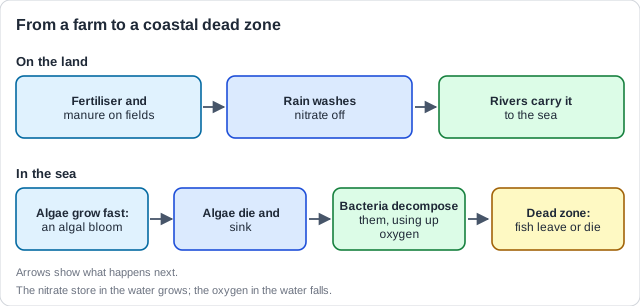
Link every step: Describe the steps in order and join each to the next: 'which causes', 'so'. A list of words with no links shows the order but not the cause.
Real example: the Mississippi River drains most of the farmland of the USA into the Gulf of Mexico. Each summer a dead zone forms off Louisiana: about 15,000 km² in a typical year. The largest measured, in 2017, was about 22,700 km², the size of the US state of New Jersey (NOAA).
Other dead zones: The Baltic Sea (one of the largest in the world), Chesapeake Bay in the USA (nitrate from farms and cities), and Lake Erie between the USA and Canada (algal blooms most summers).
Never wonder what to study next
Get a personalized daily plan based on your exam date, progress, and weak areas. We'll tell you exactly what to review each day.
Cutting down a nitrogen store: A forest holds nitrogen in its trees and keeps the soil's nitrate in place with its roots. Clearing it releases both.
The points to remember
- Trees hold a large nitrogen store in leaves, wood and roots. Felling them removes that store.
- With no roots to take it up, nitrate leaches out of the soil and runs off into streams.
- Bare soil erodes, and the nitrogen in it is washed away.
- Burning the cleared forest (and forest fires) sends nitrogen into the air as nitrogen oxides and N₂O.
- Less leaf litter falls, so less nitrogen is returned to the soil.
Real example: at Hubbard Brook, every tree in one small valley was cut down in 1965-66 and regrowth was stopped with weedkiller. Nitrate in the stream draining the valley rose to about 40 times its usual level, above the safe limit for drinking water.
The same in the Amazon: Forest burned to make cattle pasture sends nitrogen oxides into the air, and the grass that replaces it holds far less nitrogen than the forest did.
Urbanization changes the cycle in two places: the water, through sewage, and the air, through burning fuel.
Cities, traffic and power stations
- Sewage and urban runoff from streets and gardens add nitrate to rivers and the sea.
- Landfills: rotting waste with little oxygen increases denitrification, releasing nitrogen gases.
- Burning fossil fuels in engines and power stations joins N₂ with oxygen: nitrogen oxides (NOₓ).
- NOₓ forms nitric acid, falling as acid deposition on forests, lakes and buildings.
- With sunlight and fumes (VOCs), NOₓ makes ground-level ozone, a secondary pollutant in photochemical smog.
- N₂O traps about 270 times as much heat as CO₂; nitrogen deposition changes plant communities, cutting biodiversity.
How cities cut it: Sewage works that remove nitrogen; catalytic converters on cars; cleaning devices on power station chimneys; and renewable energy, which burns no fuel at all.
Real example: London's old sewers overflowed into the River Thames in heavy rain, tens of millions of tonnes of raw sewage a year. The 25 km Thames Tideway Tunnel, finished in 2025, now stores this overflow and sends it to a treatment works. Los Angeles has had photochemical smog since the 1940s; US cars have needed catalytic converters since 1975.
Two more for the list: Global warming speeds up soil microbes, so nitrification and denitrification get faster. The Haber process takes N₂ out of the air to make fertiliser (2.3.23).
Stop wasting time on topics you know
Our AI identifies your weak areas and focuses your study time where it matters. No more overstudying easy topics.
How this comes up: Paper 2, Section B (a) [4]: outline four ways human activities affect the nitrogen cycle. Section B (c) [9]: discuss how human activities change its flows and stores.
Around Lake Victoria in East Africa, forests are cleared for farms, fish are farmed in cages in the lake, and cities such as Kampala are growing fast.
Outline four ways in which human activities affect the nitrogen cycle.
Model answer plan
See the mark-by-mark plan — for / against / judgement, with marking guidance — in study mode.
The [9] version: Take farming, aquaculture, deforestation and cities in turn, each with a named example. Then give the other side: how each is managed. Conclude: the biggest change is the growth of nitrate stores in water and nitrogen oxides in the air.