Flows in the nitrogen cycle at Higher Level: An HL-only page. Follow one nitrogen atom from a field into a cow and back to the soil: sometimes it just moves, sometimes it becomes a new compound. Telling the two apart is what this page is for.
Practise this as you read
- Name the flows of the nitrogen cycle.
- Distinguish transfers from transformations, in words and on a diagram.
Free preview
This is the free notes preview
You're reading the free notes. Aimnova Pro unlocks the full study experience — and you can try it with your first topic free to keep:
- FlashcardsLock in vocabulary and key terms with spaced repetition.
- Practice questionsAnswer exam-style questions and get instant AI marking.
- Mock exams & past-paper vaultSit full mocks and see exactly how examiners award marks.
- Personalised study planA daily plan built around your exam date and weak areas.
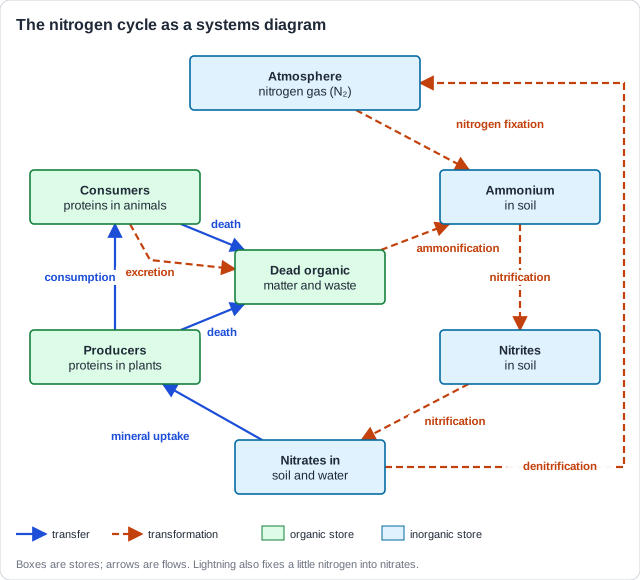
Moved or changed?: Every flow in the nitrogen cycle either moves nitrogen to a new store unchanged (a transfer) or changes it into something new (a transformation).
Transfer or transformation
- A transfer moves nitrogen to another store in the same form, e.g. nitrates taken up by roots.
- A transformation changes nitrogen into a new compound or state, e.g. nitrates into nitrogen gas.
- Ask: is it the same chemical at both ends? Yes: transfer. No: transformation.
- In a systems diagram, show the two kinds with different arrows and a key.
Remember it as: Moving house is a transfer; changing clothes is a transformation.
Transfers (same form)
- Mineral uptake by roots
- Consumption
- Death
- Leaching and run-off
- Nitrogen gas diffusing into soil
- Spreading fertiliser
Transformations (new form)
- Assimilation: nitrates into proteins
- Excretion: protein into urea
- Decomposition and ammonification
- Nitrification
- Denitrification
- Nitrogen fixation
Real example: nitrate washed out of cornfields in Iowa, USA, flows into the Des Moines River. It has moved from the soil to the river but is still nitrate: a transfer. The city's water works has had to run one of the world's largest nitrate-removal plants to keep it out of drinking water.
See how examiners mark answers
Answer exam-style questions with model answers. Learn exactly what earns marks and what doesn't.
Five flows carry nitrogen into and through living things: up from the soil, along the food chain, and out again as waste and dead bodies.
Flows through living things
- Mineral uptake: roots take in nitrates or ammonium from the soil: a transfer.
- Assimilation: the plant builds nitrates into amino acids and proteins: a transformation (not photosynthesis).
- Consumption: animals eat plants or animals and take in their proteins: a transfer.
- Excretion: animals turn spare nitrogen into urea, uric acid or ammonia: a transformation.
- Death: dead bodies and leaves join dead organic matter: a transfer.
Excretion changes the nitrogen: An animal does not pass protein out unchanged: it turns spare nitrogen into urea, uric acid or ammonia. That makes excretion a transformation, although the waste also moves to the soil.
Real example: on islands off Peru, millions of seabirds eat anchovies (consumption) and turn their protein into uric acid in their droppings (excretion). In the dry climate the guano piled up tens of metres deep, and in the 1800s it was dug out and shipped to Europe as fertiliser.
Dead organic matter holds nitrogen in proteins. Decomposers turn it back into ammonium, and bacteria carry it on through the soil and back to the air.
Flows back to the soil and air
- Decomposition: decomposers break the proteins in dead matter into amino acids: a transformation.
- Ammonification: the amino acids become ammonium: a transformation.
- Nitrification (to nitrites, then nitrates) and denitrification (to nitrogen gas) are transformations.
- Nitrogen fixation (nitrogen gas to ammonia) is a transformation.
- Leaching, run-off, diffusion of air into soil and spreading fertiliser are transfers.
Real example: on the floor of the Amazon rainforest, warmth and moisture let decomposers work fast. A fallen leaf is broken down within about a year, and the ammonium released is taken up again by tree roots almost at once, so very little nitrogen is left in the soil.
Study smarter, not longer
Most students waste 40% of study time on topics they already know. Our AI tracks your progress and optimizes every minute.
How this comes up: Paper 2, Section B (a): outline two transfers and two transformations in the nitrogen cycle [4]. At most two of each count, so give exactly two of each and say which is which.
On a pig farm in Denmark, slurry (liquid manure) from the pigs is spread on fields of barley, which is fed back to the pigs.
Outline two transfers and two transformations that occur as part of the nitrogen cycle on this farm.
Model answer plan
See the mark-by-mark plan — for / against / judgement, with marking guidance — in study mode.