Nitrogen-fixing partnerships at Higher Level: An HL-only page. Pull up a clover plant and look at its roots: the small pink swellings are full of bacteria that feed it nitrogen from the air, in return for sugar. That deal lets clover grow where other plants starve.
Practise this as you read
- Explain why plants need bacteria to use the air's nitrogen.
- Outline the competitive advantage of nitrogen-fixing plants, with real examples.
Free preview
This is the free notes preview
You're reading the free notes. Aimnova Pro unlocks the full study experience — and you can try it with your first topic free to keep:
- FlashcardsLock in vocabulary and key terms with spaced repetition.
- Practice questionsAnswer exam-style questions and get instant AI marking.
- Mock exams & past-paper vaultSit full mocks and see exactly how examiners award marks.
- Personalised study planA daily plan built around your exam date and weak areas.
Nitrogen everywhere, none to use: Plants cannot fix nitrogen. The nitrogen gas all round their leaves and roots is unavailable to them unless they form a mutualistic association with nitrogen-fixing bacteria.
Why plants cannot use the air's nitrogen
- Nitrogen gas (N₂) is very stable: its two atoms are held together by a very strong (triple) bond.
- No plant can split it: plants cannot fix nitrogen.
- So the air's nitrogen is unavailable to a plant on its own.
- Only some bacteria can fix it: free-living ones, e.g. Azotobacter in soil, cyanobacteria in water.
- Fixation by bacteria is the largest natural source of usable nitrogen; lightning adds a little.
Remember it as: Plants live in a sea of nitrogen they cannot drink.
Real example: wheat forms no such partnership. So although the air above a wheat field is 78% nitrogen, UK farmers spread on average about 190 kg of nitrogen fertiliser on each hectare of winter wheat every year. Without it, the crop would be small and pale.
See how examiners mark answers
Answer exam-style questions with model answers. Learn exactly what earns marks and what doesn't.
Some plants solve the problem with partners. Legumes and a few other plants grow root nodules where nitrogen-fixing bacteria live.
The partnership
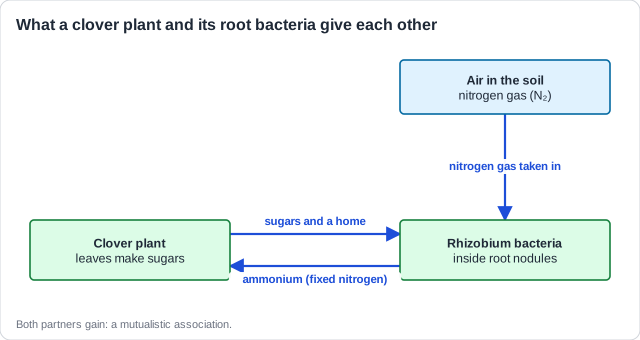
- Some plants form a mutualistic association with nitrogen-fixing bacteria: both gain.
- The bacteria live in root nodules; the plant gives them sugars and a home.
- The bacteria give the plant ammonium, made from the air's nitrogen.
- Legumes (clover, peas, beans, soybeans, lupins) partner with Rhizobium bacteria.
- Alder trees partner with Frankia; the water fern Azolla with a cyanobacterium.
Plant partner
- Clover, peas, beans, soybeans, lupins
- Alder trees
- Azolla, a small water fern
Bacteria partner
- Rhizobium, in root nodules
- Frankia, in root nodules
- A cyanobacterium, in its leaves
Real example: Brazil grows more soybeans than any other country, yet its farmers add almost no nitrogen fertiliser to them. The seeds are coated with Bradyrhizobium bacteria, which form nodules and fix the nitrogen, saving farmers billions of US dollars a year. In Vietnam and China, rice farmers have grown Azolla in flooded paddies for centuries to feed the rice nitrogen.
Where nitrogen is the limiting factor, a plant that brings its own supply has a head start over every plant that must wait for soil nitrates.
The competitive advantage
- In many ecosystems nitrogen is the limiting factor on plant growth.
- Short of nitrogen, plants grow slowly with yellow leaves: less protein, DNA and chlorophyll.
- Plants with fixing partners do not depend on soil nitrates.
- So on nitrogen-poor ground they outgrow and outcompete other plants: a competitive advantage.
- They are often pioneers on bare ground, and their dead leaves enrich the soil for others.
- Where nitrogen is plentiful (fertilised fields), the advantage is lost and grasses take over.
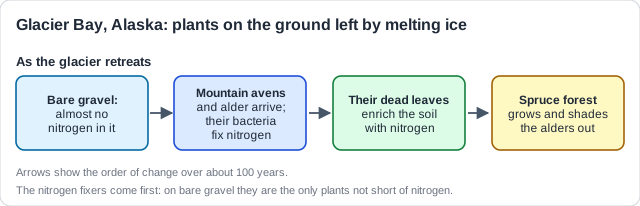
Real example: at Glacier Bay the ground left by the ice has almost no nitrogen. Mountain avens and alder, both with Frankia partners, are among the first plants to spread there. Their fallen leaves build up soil nitrogen, until spruce trees can grow. After the 1980 eruption of Mount St Helens, the prairie lupin, a legume, was one of the first plants on the bare ash.
Study smarter, not longer
Most students waste 40% of study time on topics they already know. Our AI tracks your progress and optimizes every minute.
How this comes up: Paper 2, Section B (a): outline how nitrogen in the atmosphere ends up in the protein of a decomposer [4]. Follow the nitrogen step by step, from the air to the decomposer.
Soybeans on a farm in Mato Grosso, Brazil, grow with almost no nitrogen fertiliser. After the harvest, fungi grow on the fallen soybean leaves.
Outline the processes by which nitrogen in the atmosphere may eventually be found in the protein of one of these fungi.
Model answer plan
See the mark-by-mark plan — for / against / judgement, with marking guidance — in study mode.