Denitrification and waterlogged soils at Higher Level: An HL-only page. Flood a field and its nitrogen starts to vanish into the air. The same soggy ground is home to plants that eat insects to make up for it.
Practise this as you read
- Explain why denitrification needs waterlogged, anaerobic soil.
- Outline how insectivorous plants get their nitrogen.
Free preview
This is the free notes preview
You're reading the free notes. Aimnova Pro unlocks the full study experience — and you can try it with your first topic free to keep:
- FlashcardsLock in vocabulary and key terms with spaced repetition.
- Practice questionsAnswer exam-style questions and get instant AI marking.
- Mock exams & past-paper vaultSit full mocks and see exactly how examiners award marks.
- Personalised study planA daily plan built around your exam date and weak areas.
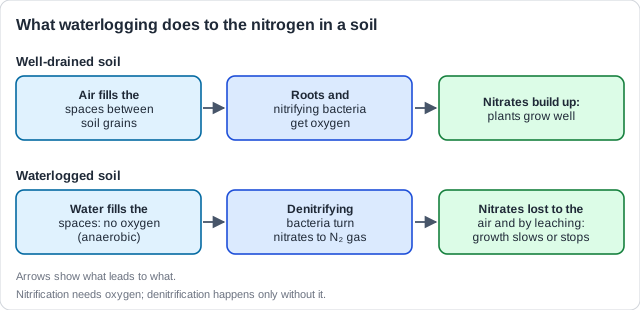
No oxygen, no nitrates: Denitrification only happens in anaerobic conditions, such as soil that is waterlogged. Oxygen decides which bacteria win.
The points to remember
- Denitrifying bacteria work only where there is no oxygen: anaerobic conditions.
- In waterlogged soil, water fills the air spaces, so oxygen cannot get in.
- There the bacteria use nitrates instead of oxygen and give off nitrogen gas.
- In well-drained soil there is oxygen, so nitrification wins and nitrates build up.
- Other anaerobic places: the mud of lakes and wetlands, and flooded fields.
Real example: rice fields in the Philippines are kept flooded for most of the growing season. The water shuts oxygen out of the soil, so denitrifying bacteria turn much of the fertiliser's nitrate into nitrogen gas. Rice plants often take up less than half of the nitrogen the farmer adds.
Feeling unprepared for exams?
Get a clear study plan, practice with real questions, and know exactly where you stand before exam day. No more guessing.
A waterlogged soil is a hard place for most plants to live. Four things go wrong at once, and all of them leave the soil short of nitrates.
What happens in waterlogged soil
- Plant growth is reduced or stops: roots need oxygen, and there are few nitrates.
- Denitrification turns nitrates into nitrogen gas: nitrogen is lost to the air.
- Leaching: water draining through carries dissolved nitrates away from the roots.
- Nitrification stops, because it needs oxygen, so few new nitrates are made.
- So waterlogged soils are low in nitrates, a problem for most plants.
Remember it as: Drowned soil: no air, no nitrates, no growth.
Nitrates dissolve easily, so as water drains through, leaching carries them down to rivers and groundwater. Denitrification sends more of them into the air.
Real example: the Somerset Levels, England: In the winter of 2013 to 2014 about 65 km² of farmland on the Somerset Levels lay under water for weeks. When the floods drained, much of the grass had died: its roots had no oxygen and the soil had lost its nitrates, so many fields had to be ploughed and sown again.
A bog is waterlogged all year, so its soil holds almost no nitrates. Some plants there get their nitrogen from animals instead.
Insectivorous plants
- Insectivorous plants grow in waterlogged, nitrogen-poor soils such as bogs.
- They capture insects and digest them.
- The insects' proteins give them a nitrogen source the soil cannot.
- Pitcher plants: insects slip into a jug-shaped leaf filled with digestive liquid.
- Sundews: sticky hairs on the leaves trap insects, and the leaf curls round them.
Pitcher plants
- A leaf shaped like a jug
- Slippery rim; insects fall in and drown
- Digestive liquid breaks down their proteins
- Example: Nepenthes in Borneo
Sundews
- Leaves covered in sticky hairs
- An insect sticks; the leaf curls round it
- The leaf digests it where it lies
- Example: round-leaved sundew in British bogs
Real example: the Venus flytrap grows wild only in the wet pine savannas and bogs within about 120 km of Wilmington, North Carolina, USA. Its leaves snap shut in about a tenth of a second and digest the insect over several days, giving the plant the nitrogen its soggy, acidic soil lacks.
Memorize terms 3x faster
Smart flashcards show you cards right before you forget them. Perfect for definitions and key concepts.
How this comes up: Paper 2, Section A: a short scenario about a wetland, then explain [3]. Chain it: waterlogged, no oxygen, few nitrates, so another nitrogen source.
Sundews and butterworts, two kinds of insectivorous plant, are common on the blanket bogs of the west of Ireland, where the peat is waterlogged all year.
Explain why insectivorous plants can grow well in waterlogged soils like these.
Model answer plan
See the mark-by-mark plan — for / against / judgement, with marking guidance — in study mode.