Bacteria in the nitrogen cycle at Higher Level: An HL-only page. Organisms too small to see move almost all of Earth's nitrogen: without them the air's nitrogen would stay locked away and dead matter would never give its nitrogen back.
Practise this as you read
- Name the four processes bacteria carry out.
- Outline what each one converts into what.
Free preview
This is the free notes preview
You're reading the free notes. Aimnova Pro unlocks the full study experience — and you can try it with your first topic free to keep:
- FlashcardsLock in vocabulary and key terms with spaced repetition.
- Practice questionsAnswer exam-style questions and get instant AI marking.
- Mock exams & past-paper vaultSit full mocks and see exactly how examiners award marks.
- Personalised study planA daily plan built around your exam date and weak areas.
Unlocking the air's nitrogen: Nitrogen fixation is the conversion of nitrogen gas from the atmosphere into ammonia. Only certain bacteria can do it; plants and animals cannot.
Nitrogen fixation
- Nitrogen fixation: nitrogen gas from the air is converted into ammonia (ammonium in soil).
- It is done by nitrogen-fixing bacteria: some free-living in soil and water...
- ...others inside the root nodules of plants such as clover, peas and beans (2.3.20).
- Lightning also fixes a little nitrogen; factories fix it to make fertiliser (2.3.23).
- Fixation is the only way in for new nitrogen from the air's huge store.
Some fixing bacteria live free in the soil; others live in the root nodules of plants of the pea family, and pass the ammonia they make straight to the plant.
Real example: the Norfolk four-course rotation: From the 1700s, farmers in Norfolk, England, grew wheat, turnips, barley and then clover, one after another in each field. The clover's root bacteria fixed nitrogen, so the next year's wheat grew well without any bought fertiliser. Farmers still rotate crops with peas, beans and clover for the same reason.
Never wonder what to study next
Get a personalized daily plan based on your exam date, progress, and weak areas. We'll tell you exactly what to review each day.
Nitrification turns ammonium into the form most plants take up best: nitrates. It happens in two steps, by two groups of bacteria.
Nitrification
- Nitrification: ammonium (or ammonia) is converted to nitrites, then to nitrates.
- It is done by nitrifying bacteria: one group makes the nitrites, another makes the nitrates.
- Nitrifying bacteria need oxygen, so this happens in well-drained, airy soil.
- Nitrates dissolve in soil water, so plant roots take them up easily.
Two names you may meet: Nitrosomonas turns ammonium into nitrites; Nitrobacter turns nitrites into nitrates. If you write 'ammonia to nitrates' in one step, name it nitrification.
Real example: a new home aquarium must be 'cycled' before it holds many fish. Fish waste releases ammonia. For the first few weeks ammonia builds up, then nitrite, until nitrifying bacteria grow on the filter and turn both into nitrate, which is far less harmful. Owners then remove the nitrate by changing some of the water.
Denitrification runs the cycle back to the start: nitrates become nitrogen gas again, and it returns to the air.
Denitrification
- Denitrification: nitrates are converted back into nitrogen gas, which returns to the air.
- It is done by denitrifying bacteria.
- It happens only where there is no oxygen, as in waterlogged soil (why: 2.3.19).
- It removes nitrogen plants could have used; a little escapes as nitrous oxide.
Do not mix up the two: Nitrification makes nitrates and needs oxygen. Denitrification destroys nitrates and happens without oxygen. One letter pair, opposite jobs.
Real example: the Blue Plains wastewater plant in Washington, DC, one of the largest in the world, treats the city's sewage. In tanks kept without oxygen, denitrifying bacteria turn the nitrates into harmless nitrogen gas, so less nitrogen reaches the Potomac River and Chesapeake Bay.
Stop wasting time on topics you know
Our AI identifies your weak areas and focuses your study time where it matters. No more overstudying easy topics.
Every dead leaf, dead animal, dung pat and drop of urine holds nitrogen in proteins and amino acids. Decomposers release it as ammonium.
Decomposition (ammonification)
- Decomposition (also called ammonification): amino acids in dead matter are converted to ammonium.
- It is done by decomposers: bacteria and fungi.
- They work on dead leaves, dead bodies, dung and urine.
- Without them, nitrogen would stay locked in dead matter for good.
Remember it as: Rot it to release it: decomposers turn protein back into ammonium.
Real example: Pacific salmon swim up Alaskan streams to spawn, then die. Bacteria and fungi decompose their bodies and release ammonium into the soil, and bears drag many carcasses into the forest. Up to about a quarter of the nitrogen in the needles of streamside spruce trees came from the sea this way.
Put the four jobs together and bacteria run most of the cycle between the air, the soil and living things.
Who does what
- Nitrogen-fixing bacteria: nitrogen gas to ammonia.
- Nitrifying bacteria: ammonium to nitrites, and nitrites to nitrates.
- Denitrifying bacteria: nitrates to nitrogen gas.
- Decomposers (bacteria and fungi): amino acids to ammonium.
- You need what each group turns into what, not the chemical reactions.
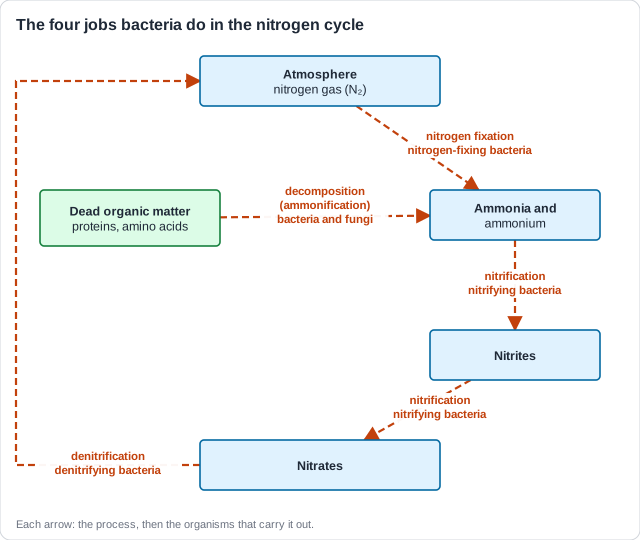
Remember it as: Fix it, nitrify it, rot it, release it.
Real example: in one Irish dairy pasture all four work at once. Bacteria in clover roots fix nitrogen; decomposers turn cow dung into ammonium; nitrifying bacteria turn that into nitrates for the grass; and after heavy winter rain waterlogs the soil, denitrifying bacteria send some of the nitrates back to the air.
See how examiners mark answers
Answer exam-style questions with model answers. Learn exactly what earns marks and what doesn't.
How this comes up: Paper 2, Section A: a nitrogen cycle diagram with letters, then name the processes and the bacteria [1] each; or Section B (a): outline the roles of bacteria [4].
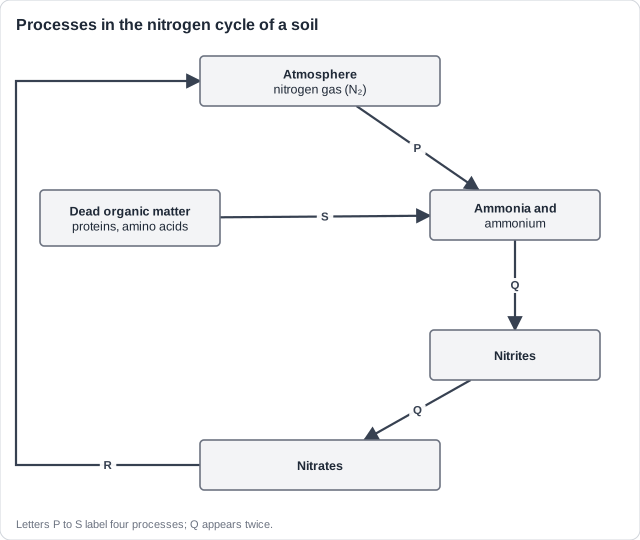
Figure 1 shows processes in the nitrogen cycle of the soil of a wheat field in Kansas, USA.
Outline the roles of bacteria in the processes labelled P, Q, R and S in Figure 1.
Model answer plan
See the mark-by-mark plan — for / against / judgement, with marking guidance — in study mode.