Methane in the atmosphere at Higher Level: An HL-only statement. Methane is rare in the air, short-lived and yet one of the strongest drivers of warming. You will see how long it stays, what it turns into, and why cutting it works so fast.
Practise this as you read
- State methane's residence time and what it is oxidized to.
- Explain why cutting methane slows warming faster than cutting carbon dioxide.
Free preview
This is the free notes preview
You're reading the free notes. Aimnova Pro unlocks the full study experience — and you can try it with your first topic free to keep:
- FlashcardsLock in vocabulary and key terms with spaced repetition.
- Practice questionsAnswer exam-style questions and get instant AI marking.
- Mock exams & past-paper vaultSit full mocks and see exactly how examiners award marks.
- Personalised study planA daily plan built around your exam date and weak areas.
Little gas, big effect: Methane is a potent greenhouse gas. There is far less of it in the air than carbon dioxide, but each molecule traps much more heat.
The points to remember
- Methane (CH₄) is a greenhouse gas: it absorbs heat (infrared) given off by the Earth.
- It is potent: each kilogram traps about 80 times as much heat as carbon dioxide over 20 years.
- Over 100 years the figure falls to about 30 times, because methane does not stay long.
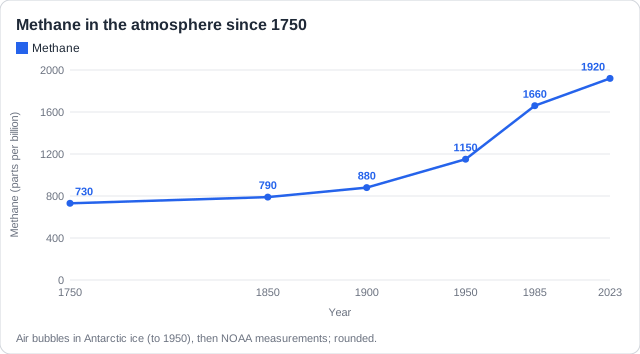
- There is little of it: about 1.9 parts per million, far less than carbon dioxide.
- That is about 2.6 times the level before 1750, mainly because of human activities.
Remember it as: Less gas, more punch.
Real example: NOAA found that the global average reached about 1,920 parts per billion in 2023, the highest level in at least 800,000 years of ice-core records.
Memorize terms 3x faster
Smart flashcards show you cards right before you forget them. Perfect for definitions and key concepts.
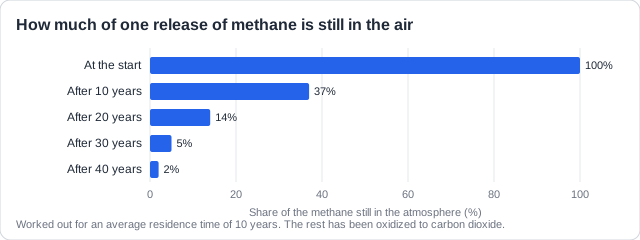
Methane's residence time in the atmosphere is short: about 10 years. That is why it matters so much in the next few decades, and much less after that.
About 10 years in the air
- Residence time is the average time a molecule stays in a store: here, the atmosphere.
- Methane's residence time is about 10 years.
- Carbon dioxide stays far longer: much of it for centuries.
- So if methane emissions fall, its concentration falls within a few decades.
- If emissions keep rising, new methane replaces the old and the level keeps rising.
| Gas | Residence time | Heat trapped per kg, 20 years | Heat trapped per kg, 100 years |
|---|---|---|---|
| Methane | About 10 years | About 80 times CO₂ | About 30 times CO₂ |
| Carbon dioxide | Centuries or more | 1 (the baseline) | 1 (the baseline) |
Short-lived does not mean harmless: About 10 years is an average. While it is there, methane warms strongly, and it then becomes carbon dioxide, which lasts for centuries.
At the end of its time in the air, methane is oxidized: it turns into carbon dioxide and water.
Oxidized to carbon dioxide
- Methane does not just vanish: it is oxidized (it combines with oxygen).
- In the air it reacts with hydroxyl (OH), a very reactive chemical made with the help of sunlight.
- The end products are carbon dioxide and water.
- So methane's carbon stays in the atmosphere, now as carbon dioxide, for centuries.
- Burning methane oxidizes it at once: burnt gas warms less than leaked gas.
In words: methane + oxygen → carbon dioxide + water
Real example: the natural gas piped to homes in the United Kingdom is mostly methane. In a gas cooker it is oxidized in a flash, giving carbon dioxide and water. Gas that leaks from old pipes stays in the air as methane for about 10 years, warming far more, before the air oxidizes it.
Remember it as: Methane's last stop is carbon dioxide.
Know your predicted grade
Take timed mock exams and get detailed feedback on every answer. See exactly where you're losing marks.
Because methane is potent but short-lived, cutting it is one of the fastest ways to slow warming.
Cutting methane: a quick win
- Methane is potent and short-lived, so cutting it slows warming within decades.
- Cutting carbon dioxide matters most in the long run; cutting methane works fastest.
- Main cuts: fix leaks from oil and gas, capture landfill gas, change rice and cattle farming.
- Methane already released still ends up as carbon dioxide, adding to the long-term store.
Cut methane
- Concentration falls within decades
- Warming slows soon
- Short-term win
Cut carbon dioxide
- Concentration falls very slowly
- Warming slows over centuries
- Essential long-term
Real example: at the COP26 meeting, over 100 countries signed the Global Methane Pledge. Scientists estimated this could avoid about 0.2 °C of warming by 2050.
How this comes up: Paper 2, Section A: a graph of a greenhouse gas, then explain what would happen if emissions were cut [2]. Use the residence time.
Figure 1 shows the concentration of methane in the atmosphere since 1750.
Explain why the concentration of methane would begin to fall within a few decades if methane emissions were cut sharply.
Model answer plan
See the mark-by-mark plan — for / against / judgement, with marking guidance — in study mode.