The nitrogen cycle at Higher Level: An HL-only page, and the first of nine on nitrogen. Every protein in your body holds nitrogen, yet the huge store of it in the air is useless to you. Here you sort nitrogen's stores and learn to draw the whole cycle.
Practise this as you read
- Sort nitrogen stores into organic and inorganic.
- Draw the nitrogen cycle as a systems diagram.
- Outline how the air's nitrogen and nitrogen oxides affect ecosystems.
Free preview
This is the free notes preview
You're reading the free notes. Aimnova Pro unlocks the full study experience — and you can try it with your first topic free to keep:
- FlashcardsLock in vocabulary and key terms with spaced repetition.
- Practice questionsAnswer exam-style questions and get instant AI marking.
- Mock exams & past-paper vaultSit full mocks and see exactly how examiners award marks.
- Personalised study planA daily plan built around your exam date and weak areas.
Surrounded by nitrogen, short of it: Every living thing needs nitrogen to build proteins and DNA. The air is mostly nitrogen gas, yet plants and animals cannot use the gas as it is.
The points to remember
- Nitrogen is part of every protein and of DNA; plants also need it to make chlorophyll.
- About 78% of the air is nitrogen gas (N₂).
- Plants and animals cannot use nitrogen gas directly.
- Plants take in nitrogen from the soil as nitrates or ammonium; animals get it by eating.
- The nitrogen cycle is the path nitrogen takes between the air, soil, water and living things.
Remember it as: A fridge full of food with no key: the air is full of nitrogen nobody can open.
Real example: about 3% of your body mass is nitrogen, most of it in the proteins of your muscles, skin and hair. None of it came from breathing: every bit came from food, and the plants at the start of your food chains took it from the soil as nitrates. A maize plant short of nitrogen shows it: its older leaves turn yellow and it stays small.
Learn what examiners really want
See exactly what to write to score full marks. Our AI shows you model answers and the key phrases examiners look for.
An organic store holds nitrogen inside the molecules of life. Living things are one kind; everything they leave behind is the other.
Organic stores
- Organic stores hold nitrogen in proteins and other nitrogen compounds, such as DNA.
- They are in living organisms: producers and consumers.
- They are also in dead organic matter: dead leaves, dead bodies, dung and urine.
- Nitrogen moves between organic stores by feeding, death and excretion.
Living organisms
- Producers: proteins in leaves, stems and roots
- Consumers: proteins in muscles and organs
- Nitrogen passes along food chains when they feed
Dead organic matter
- Dead leaves, roots and bodies
- Waste: dung and urine
- Decomposers break it down and release the nitrogen
Real example: about 1.3 million wildebeest migrate across the Serengeti and Maasai Mara, carrying nitrogen in their muscles (a living store). About 6,200 drown each year crossing the Mara River, adding around 1,100 tonnes of dead bodies to the river: a dead organic matter store that feeds fish, vultures and decomposers, while the bones take about seven years to break down.
An inorganic store holds nitrogen as simple gases and dissolved compounds in the air, soil and water.
Inorganic stores
- Inorganic stores hold nitrogen that is not built into living or dead matter.
- The atmosphere holds nitrogen gas (N₂): the largest nitrogen store.
- Soil and water hold ammonia or ammonium, nitrites and nitrates.
- Plants can take up nitrates and ammonium, never the gas itself.
- The air also holds small amounts of nitrogen oxides and nitrous oxide.
Organic stores
- Proteins and DNA in living things
- Dead organic matter and waste
- Example: a wildebeest's muscles
Inorganic stores
- Nitrogen gas in the atmosphere (the largest)
- Ammonium, nitrites and nitrates in soil and water
- Example: nitrates in a river
Name the compound: Plants take up nitrates (or ammonium), not 'nitrogen'. Write the compound each time: 'nitrogen' alone can mean the gas that no plant can use.
Real example: over Lake Maracaibo storms flash on more than 150 nights a year. Each flash splits some nitrogen gas, and the rain washes the nitrates it makes into the soil and water: nitrogen moves from the largest inorganic store, the air, into a much smaller one.
Never wonder what to study next
Get a personalized daily plan based on your exam date, progress, and weak areas. We'll tell you exactly what to review each day.
The air's nitrogen affects ecosystems in two ways. Nitrogen gas, once fixed, feeds them; nitrogen oxides and nitrous oxide harm them. (Where the nitrogen oxides come from, such as traffic and power stations, is on 2.3.22.)
Seven effects: learn them all, use any four
- Nitrogen-fixing bacteria turn nitrogen gas into compounds that become nitrates plants can use.
- So nitrogen from the air ends up in all the proteins of an ecosystem.
- Lightning turns nitrogen gas into nitrates that fertilise plants.
- Nitrogen oxides dissolve in water to form acid rain, which damages soils, lakes and trees.
- Nitrous oxide is a greenhouse gas, so it warms ecosystems.
- Nitrogen oxides help form ground-level (tropospheric) ozone, which damages leaves.
- They also form photochemical smog, which cuts photosynthesis.
Help ecosystems
- Bacteria fix nitrogen gas: nitrates for plants
- It becomes part of every protein
- Lightning makes nitrates that feed plants
Harm ecosystems
- Acid rain damages soils, lakes and trees
- Nitrous oxide warms the climate
- Ground-level ozone damages leaves
- Smog cuts photosynthesis
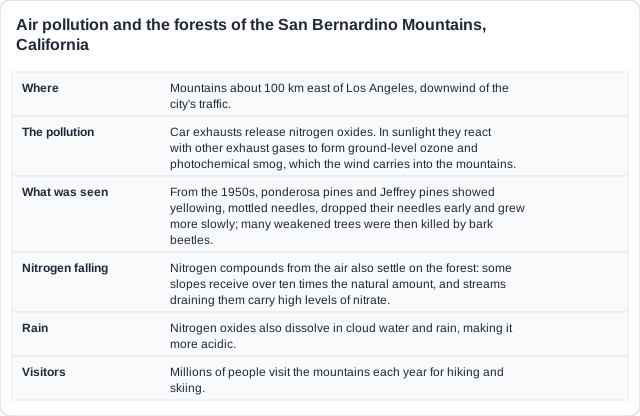
Real example: the San Bernardino Mountains lie downwind of the city's traffic. From the 1950s their ponderosa pines grew slowly, their needles turned yellow and fell early, damaged by ground-level ozone formed from nitrogen oxides in the smog. Many weakened trees were then killed by bark beetles.
A systems diagram of the nitrogen cycle shows where nitrogen is kept and how it moves. You may be asked to draw one.
How to draw it
- Draw each store as a box and name it, e.g. atmosphere, producers, nitrates in soil.
- Draw each flow as an arrow pointing the way the nitrogen moves.
- Label every arrow with its process, e.g. nitrogen fixation, mineral uptake.
- Show transfers and transformations in two different styles, with a key.
- Mark which stores are organic and which are inorganic.
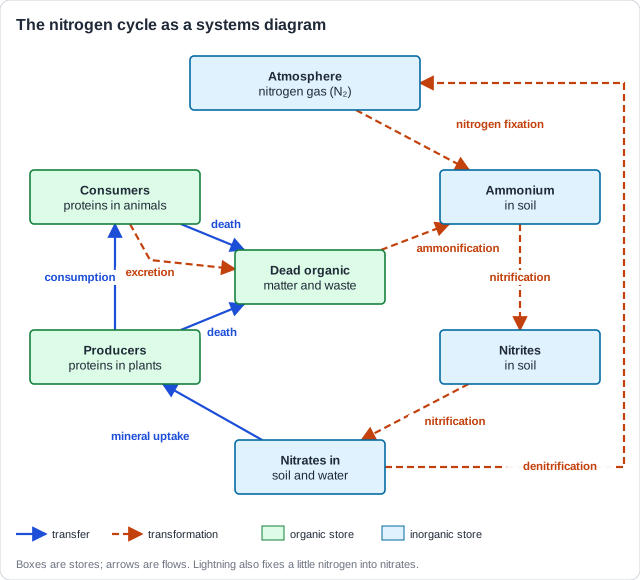
Remember it as: Boxes are stores, arrows are flows, and every arrow gets a name.
Real example: on a New Zealand sheep farm, clover fixes nitrogen from the air (fixation), the grass and clover take up nitrates (uptake), sheep eat both (consumption), and their dung and urine fall on the pasture (excretion), where decomposers release ammonium (ammonification). Each of these is one labelled arrow on the diagram.
Stop wasting time on topics you know
Our AI identifies your weak areas and focuses your study time where it matters. No more overstudying easy topics.
How this comes up: Paper 2, Section B (a): outline four ways the air's nitrogen and nitrogen oxides affect ecosystems [4]. Give some good effects and some harmful ones.
In the 1980s, forests in the Black Forest region of southern Germany were damaged by polluted air, while clover and other plants there still depended on nitrogen from the air.
Outline four ways in which atmospheric nitrogen and nitrogen oxides may influence natural ecosystems.
Model answer plan
See the mark-by-mark plan — for / against / judgement, with marking guidance — in study mode.