Methane from decomposition at Higher Level: An HL-only statement. A rice field, a cow and a rubbish tip have one thing in common: dead matter rotting with no air. You will meet the bacteria that turn it into methane.
Practise this as you read
- Explain why methane forms where there is no oxygen.
- Outline why thawing permafrost is a positive feedback.
Free preview
This is the free notes preview
You're reading the free notes. Aimnova Pro unlocks the full study experience — and you can try it with your first topic free to keep:
- FlashcardsLock in vocabulary and key terms with spaced repetition.
- Practice questionsAnswer exam-style questions and get instant AI marking.
- Mock exams & past-paper vaultSit full mocks and see exactly how examiners award marks.
- Personalised study planA daily plan built around your exam date and weak areas.
Rotting without air: When dead matter rots in anaerobic conditions, methanogenic bacteria break it down. Instead of carbon dioxide, they give off methane.
The points to remember
- Dead organic matter is broken down by decomposers.
- With oxygen (aerobic), decomposition releases carbon dioxide.
- With no oxygen (anaerobic), methanogenic bacteria break it down and release methane (CH₄).
- Methanogens work only where there is no oxygen; oxygen stops them.
- So methane comes from airless, often waterlogged places full of dead matter.
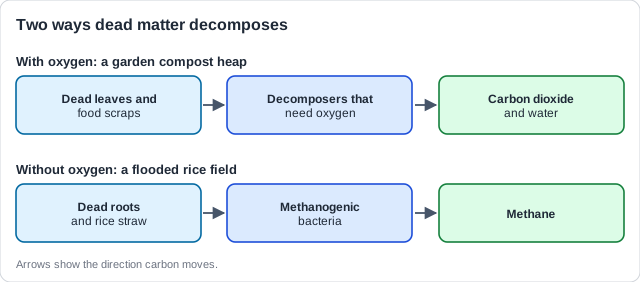
Remember it as: Dead matter + no oxygen + methanogens = methane.
Real example: in 1776 the Italian scientist Alessandro Volta stirred the mud at the edge of Lake Maggiore and collected the bubbles that rose. The gas burned: it was methane, made by bacteria rotting dead plants in the airless mud.
Feeling unprepared for exams?
Get a clear study plan, practice with real questions, and know exactly where you stand before exam day. No more guessing.
Water keeps air out. Where soil is flooded, the only decomposers that can work are the methanogens.
Swamps and rice paddies
- In swamps and other wetlands, water fills the air spaces in the soil: no oxygen.
- Methanogenic bacteria break down the dead plants in the mud: 'marsh gas' bubbles up.
- Wetlands are the largest natural source of methane.
- Rice paddies are flooded fields: the same anaerobic mud, the same methane.
- Letting paddies dry out for a few days lets oxygen in and cuts the methane.
Say why there is no oxygen: Do not just write 'rice paddies release methane'. Say that the flooded soil has no oxygen, so methanogenic bacteria break down the dead matter.
Real example: rice is grown on about 165 million hectares worldwide, mostly in flooded fields. Farmers in Vietnam and Bangladesh now use alternate wetting and drying, which can cut the methane by a third or more while keeping the harvest.
ruminants carry their own swamp inside them: a warm, airless stomach full of chewed grass.
Inside cattle and other ruminants
- Cattle, sheep and goats are ruminants; their first stomach, the rumen, has no oxygen.
- Microbes there break down tough grass; methanogenic bacteria turn some of it into methane.
- The animal burps the methane out: one cow gives off about 100 kg a year.
- Livestock are the biggest farming source of methane.
- Methane can be cut with breeds or feeds that make less of it.
Remember it as: Airless stomach, grass, methanogens: the cow burps methane.
Real example: about half of New Zealand's greenhouse gas emissions come from farming, mostly methane from its roughly 10 million cattle and 25 million sheep. In Australia, trials adding a little red seaweed to cattle feed cut the methane they burped out sharply.
Memorize terms 3x faster
Smart flashcards show you cards right before you forget them. Perfect for definitions and key concepts.
People make airless places too: by burying waste and by flooding land behind dams.
Landfills and flooded reservoirs
- Food and garden waste buried in a landfill is cut off from oxygen.
- Methanogenic bacteria break it down: landfill gas is about half methane.
- Flooding land behind a dam drowns trees and soil; they rot in airless water near the bottom.
- So reservoirs, especially over tropical forest, release methane.
- Landfill gas can be captured and burnt for energy instead of escaping.
| Place | Why there is no oxygen | Dead matter |
|---|---|---|
| Swamp | Water fills the soil | Plants in the mud |
| Rice paddy | The field is flooded | Roots and straw |
| Cattle stomach | Sealed rumen | Chewed grass |
| Landfill | Buried under more waste | Food and garden waste |
| Reservoir | Deep, still water | Drowned trees and soil |
Real example: Fresh Kills still gives off landfill gas; pipes collect it and it is sold as fuel for heating homes. The Petit Saut reservoir drowned over 300 km² of rainforest, and methane has bubbled from it ever since.
The Arctic holds a huge frozen store of dead plants. Warming is turning it into a methane source.
Thawing permafrost
- Permafrost is ground that stays frozen for years; it holds dead plants that never rotted.
- As the Arctic warms, it thaws; the soil becomes waterlogged, with no oxygen.
- Methanogenic bacteria break down the old dead matter and release methane.
- Methane is a greenhouse gas: more warming, more thaw, more methane: positive feedback.
- Warmer wetlands make more methane too; warming seas may free methane from ice-like hydrates.
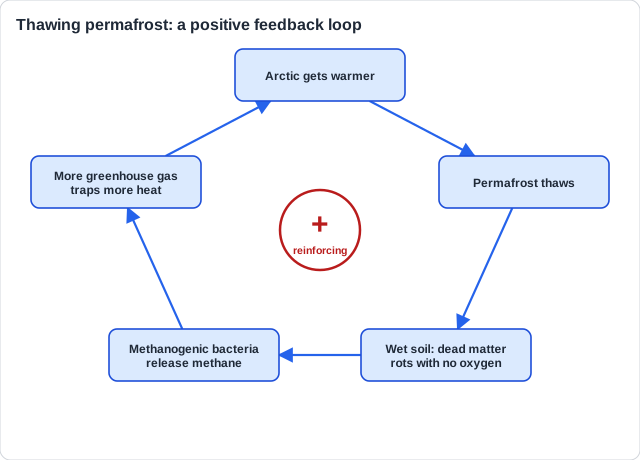
Real example: the permafrost of Siberia, Alaska and northern Canada holds about 1,500 billion tonnes of carbon, almost twice as much as the whole atmosphere. As it thaws, lakes and bogs form on it and methane bubbles up from them.
Know your predicted grade
Take timed mock exams and get detailed feedback on every answer. See exactly where you're losing marks.
How this comes up: Paper 2, Section A: a named place that gives off methane, then explain why [3]. Three links: no oxygen, the bacteria, the gas.
Fresh Kills landfill in New York took food and garden waste for over 50 years. It closed in 2001, but gas is still collected from pipes in the ground.
Explain why the buried waste at Fresh Kills releases methane.
Model answer plan
See the mark-by-mark plan — for / against / judgement, with marking guidance — in study mode.