How fossil fuels formed at Higher Level: An HL-only statement. Every lump of coal was once a swamp forest, and every drop of oil was once sea life. You will see why they never finished rotting and why it took tens of millions of years.
Practise this as you read
- Distinguish between how coal formed and how oil and gas formed.
- Explain why fossil fuels formed mostly in certain eras.
Free preview
This is the free notes preview
You're reading the free notes. Aimnova Pro unlocks the full study experience — and you can try it with your first topic free to keep:
- FlashcardsLock in vocabulary and key terms with spaced repetition.
- Practice questionsAnswer exam-style questions and get instant AI marking.
- Mock exams & past-paper vaultSit full mocks and see exactly how examiners award marks.
- Personalised study planA daily plan built around your exam date and weak areas.
Half-rotted, then buried: Coal, oil and natural gas are the remains of living things that never finished rotting. They were trapped in anaerobic places and buried before decomposers could return their carbon to the air.
The points to remember
- Normally decomposers break dead matter down fully, back to carbon dioxide.
- Fossil fuels formed where dead matter was only partially decomposed.
- That happened in waterlogged or deep-water places with little or no oxygen (anaerobic).
- Rapid burial under mud and sand cut off the oxygen too.
- The half-rotted matter kept most of its carbon: the start of a fossil fuel.
Remember it as: No oxygen, no full rot: the carbon stays.
Real example: Tollund Man was so well kept that his face and stubble could still be seen. The waterlogged peat had almost no oxygen, so decomposers could not break him down. Bogs in Ireland still build up peat in the same way: the first step towards coal.
Never wonder what to study next
Get a personalized daily plan based on your exam date, progress, and weak areas. We'll tell you exactly what to review each day.
Coal is fossilized plant matter. It formed from forests that grew in swamps and fell into the water when they died.
How coal formed
- Coal formed from partially decomposed plants on land.
- Plants in huge swamp forests died and fell into still, oxygen-poor water: peat built up.
- Mud and sand buried the peat; heat and pressure squeezed out water and gases.
- Over millions of years peat turned into brown coal, then hard black coal.
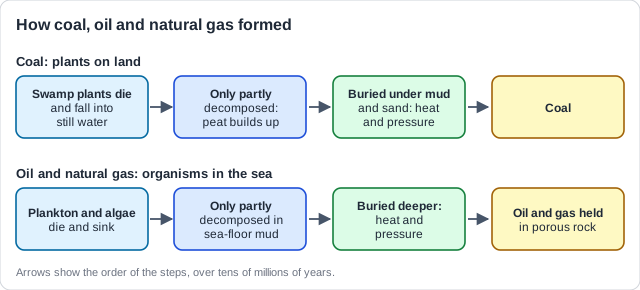
Real example: the coal of South Wales formed in the Carboniferous. Swamp forests of giant club mosses and tree ferns covered the land. Fossil leaves and bark can still be seen in the coal.
Oil and natural gas come from the sea. Tiny plankton and algae died and sank to the sea floor.
How oil and natural gas formed
- Oil and natural gas formed from partially decomposed marine organisms: plankton and algae.
- They sank into mud on the sea floor, where there was little oxygen.
- Buried deeper, heat and pressure turned them into oil; more heat made natural gas.
- Oil and gas are held in porous rocks, in the tiny spaces between the grains.
- They rise through the pores until a cap rock with no pores traps them.
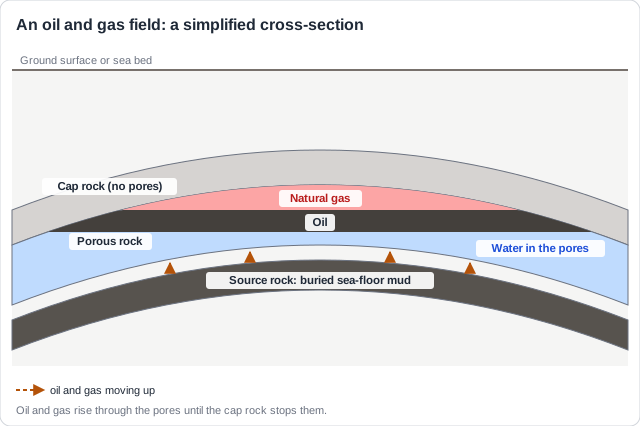
Held in rock, not in lakes: Oil and gas are not in underground lakes or caves. They fill the tiny spaces (pores) between the grains of a porous rock, such as sandstone, like water in a sponge.
Real example: much North Sea oil comes from the Kimmeridge Clay. Buried deeply, it made oil and gas, which moved up into porous sandstone under the sea bed.
Stop wasting time on topics you know
Our AI identifies your weak areas and focuses your study time where it matters. No more overstudying easy topics.
Fossil fuels did not form at a steady rate. Most formed in a few eras when living things, climate and geology came together just right.
Special eras, very long times
- Fossil fuels formed in past geological eras, not evenly through time.
- Formation was greatest in certain eras, when the conditions were most suitable.
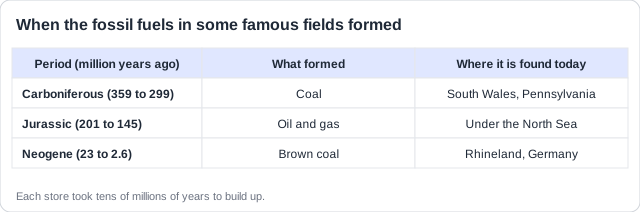
- Coal: the Carboniferous (359 to 299 million years ago), with vast, warm, wet swamps.
- Big stores took tens of millions of years to build up.
- We burn them in a few centuries: they cannot be replaced on a human timescale.
Why the Carboniferous: Huge swamp forests grew in a warm, wet climate near the equator. The ground stayed waterlogged, so dead plants only partly decomposed, and sand and mud buried them again and again.
Real example: the brown coal (lignite) dug from giant open pits in the Rhineland is much younger, from swamps of the last 23 million years. It has had less time, heat and pressure, so it is softer and wetter than Carboniferous coal. Fossil fuels as long-term carbon stores: 2.3.7.
How this comes up: Paper 2, Section A: a table of when fossil fuels formed, then suggest why one era gave so much [2]. Name the conditions and say what they did to the dead plants.
Figure 1 shows when the fossil fuels in some well-known fields formed.
Suggest why so much of the coal mined in South Wales and Pennsylvania formed in the Carboniferous period.
Model answer plan
See the mark-by-mark plan — for / against / judgement, with marking guidance — in study mode.