Coral reefs, shells and limestone at Higher Level: An HL-only statement. The biggest carbon store on Earth was built by animals you can snorkel over today. You will follow carbon from the air into a coral skeleton, and on into the rock of cliffs and mountains.
Practise this as you read
- Explain how carbon from the air ends up in limestone.
- Outline why not all limestone comes from animal remains.
Free preview
This is the free notes preview
You're reading the free notes. Aimnova Pro unlocks the full study experience — and you can try it with your first topic free to keep:
- FlashcardsLock in vocabulary and key terms with spaced repetition.
- Practice questionsAnswer exam-style questions and get instant AI marking.
- Mock exams & past-paper vaultSit full mocks and see exactly how examiners award marks.
- Personalised study planA daily plan built around your exam date and weak areas.
Animals that build with carbon: Reef-building corals and molluscs make their hard parts from calcium carbonate. Every skeleton and shell locks up carbon that was once in the air.
The points to remember
- Reef-building corals and molluscs have hard parts made of calcium carbonate.
- Corals build a stony skeleton; molluscs build a shell.
- They make it from calcium and dissolved carbon taken out of seawater.
- That carbon came from carbon dioxide in the air, which dissolves in the sea.
- So every skeleton and shell is a store of carbon taken from the atmosphere.
Remember it as: Shells are carbon you can hold.
Reef-building corals
- Tiny animals called polyps
- Build a stony skeleton under their bodies
- Millions together build a reef
- Example: the Great Barrier Reef
Molluscs
- Soft-bodied animals
- Build a shell around the body
- Clams, oysters, mussels, snails
- Example: giant clams on the same reef
Real example: the Great Barrier Reef is built from the calcium carbonate skeletons of billions of coral polyps. Giant clams live on it and build their shells from the same compound. Tiny foraminifera add their shells to the sand.
Never wonder what to study next
Get a personalized daily plan based on your exam date, progress, and weak areas. We'll tell you exactly what to review each day.
When corals and molluscs die, their soft parts rot away, but the hard calcium carbonate is left. Over millions of years it can become fossilized in limestone.
From shell to stone
- When the animals die, their shells and skeletons pile up on the sea floor.
- New layers bury them; the weight squeezes out the water (compaction).
- Minerals cement the pieces together (cementation): the pile becomes limestone.
- This takes millions of years; the rock is often full of fossil corals and shells.
- The carbon stays locked in the calcium carbonate the whole time.
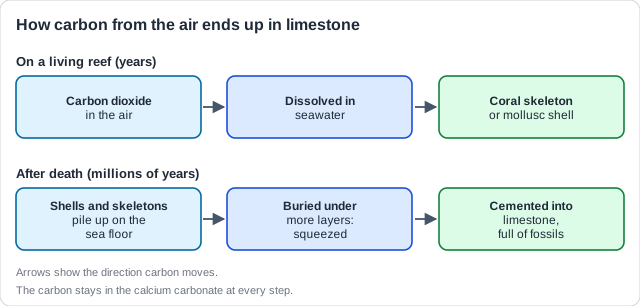
Remember it as: Shell today, stone tomorrow.
Real example: the Dolomites are ancient reefs. They grew in a warm tropical sea about 230 million years ago and were later pushed up into mountains. They are made of limestone and a similar rock called dolomite, and fossil corals and shells can still be seen in them.
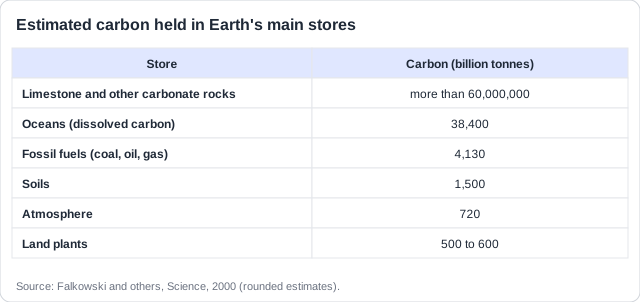
Limestone is the largest store of carbon in Earth systems: far bigger than the oceans, the air or all the coal, oil and gas.
The points to remember
- Limestone and other carbonate rocks are the largest store of carbon in Earth systems.
- They hold about 1,500 times the carbon in the oceans and over 80,000 times that in the air.
- Not all limestone comes from the remains of corals and shells.
- Some forms from other living things, such as the tiny plankton plates in chalk.
- Some forms with no living things: calcium carbonate crystallises out of warm seawater.
Not every limestone is fossil shells: Coral and shell limestone is one kind. Chalk comes mostly from plankton, and some limestone forms from seawater with no living things involved. You only need to know that these other ways exist.
Real example: the White Cliffs of Dover are chalk, a soft limestone made mostly of the tiny calcium carbonate plates of plankton, laid down 100 to 66 million years ago. Around the Bahamas, ooids form today with no shells at all.
Stop wasting time on topics you know
Our AI identifies your weak areas and focuses your study time where it matters. No more overstudying easy topics.
More carbon dioxide dissolving in the sea makes it more acidic (2.3.10). That hits the shell builders, and so the start of the limestone store.
How acid seas weaken the store
- Extra carbon dioxide dissolves in seawater and lowers its pH (more acidic).
- Less carbonate is then free for corals and molluscs to build with.
- Shells and skeletons grow thinner or more slowly; in very acidic water they can dissolve.
- So less calcium carbonate is laid down, and some stored carbon goes back into the water.
Other ways out of limestone: Limestone gives up its carbon very slowly by weathering and through volcanoes. People release it fast: cement works heat limestone and drive out carbon dioxide (2.3.12).
Real example: between 2007 and 2009, oyster hatcheries in Oregon and Washington, USA, lost billions of young oysters when acidic water from the deep ocean rose to the coast. The young could not build their shells. Hatcheries now test the water and treat it before it reaches them.
How this comes up: Paper 2, Section A: a table or diagram of carbon stores, then explain how carbon reached one of them [3]. Follow the carbon one step at a time.
Figure 1 shows estimates of the carbon held in Earth's main stores.
Explain how carbon from the atmosphere came to be held in the largest store shown in Figure 1.
Model answer plan
See the mark-by-mark plan — for / against / judgement, with marking guidance — in study mode.