Carbon in the lithosphere at Higher Level: An HL-only statement: the rocks of the lithosphere are Earth's largest and slowest carbon store. Expect to compare residence times and explain how people move carbon from the slow cycle into the fast one.
Practise this as you read
- Compare residence times, with numbers.
- Explain how burning and cement making empty a slow store fast.
Free preview
This is the free notes preview
You're reading the free notes. Aimnova Pro unlocks the full study experience — and you can try it with your first topic free to keep:
- FlashcardsLock in vocabulary and key terms with spaced repetition.
- Practice questionsAnswer exam-style questions and get instant AI marking.
- Mock exams & past-paper vaultSit full mocks and see exactly how examiners award marks.
- Personalised study planA daily plan built around your exam date and weak areas.
The biggest and slowest store: Most of Earth's carbon is not in the air or in living things but locked in the rocks of the lithosphere, where its residence time is measured in millions of years.
The points to remember
- The lithosphere holds far more carbon than the air, living things, soils and oceans together.
- It has two kinds of carbon store: fossil fuels and carbonate rocks such as limestone.
- Carbon can stay there for hundreds of millions of years: a very long residence time.
- So the lithosphere is part of the slow carbon cycle; air, plants and oceans form the fast one.
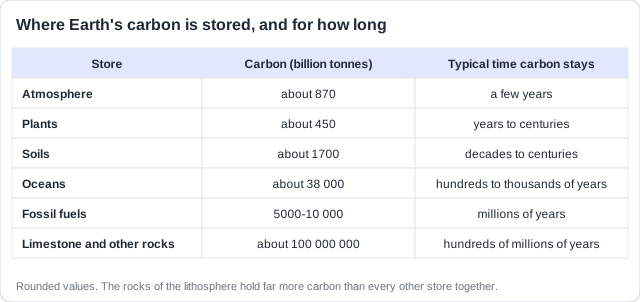
Remember it as: Air: years. Plants: decades. Ocean: centuries. Rock: hundreds of millions of years.
Real example: the carbon-cycle figure in a 2024 exam paper gave Earth's crust 100 000 000 × 10¹⁵ g of carbon, against 750 × 10¹⁵ g in the atmosphere: more than 130 000 times as much.
Stop wasting time on topics you know
Our AI identifies your weak areas and focuses your study time where it matters. No more overstudying easy topics.
Fossil fuels are the lithosphere's organic carbon store: carbon that was once part of living things.
The points to remember
- Coal, oil and natural gas are organic carbon stores in the rock.
- They formed from the remains of ancient plants and plankton buried long ago.
- Left underground, their carbon stays put for millions of years.
- Burning releases it as CO₂ in seconds: a slow store emptied fast.
Left in the ground
- Carbon stored for millions of years
- Part of the slow cycle
- No CO₂ released
Extracted and burned
- Carbon released in seconds
- Joins the fast cycle
- CO₂ builds up in the air
Real example: the coal of the Powder River Basin in Wyoming, USA, formed from swamp plants about 60 million years ago. It is the largest coal-mining region in the USA, and most of it is burned in power stations within weeks of being dug up.
Limestone, chalk and marble contain calcium carbonate. This inorganic store holds far more carbon than all the fossil fuels.
The points to remember
- Limestone and chalk are made of calcium carbonate (CaCO₃): an inorganic carbon store.
- Most formed on ancient sea floors from shells and skeletons.
- This is the largest carbon store on Earth.
- Carbon returns only slowly: weathering by slightly acidic rain, and volcanoes.
- Residence time: hundreds of millions of years.
Organic or inorganic?: Fossil fuels = organic carbon (from living things, made of carbon compounds such as hydrocarbons). Limestone = inorganic carbon (calcium carbonate), even though most of it was made by animals.
Real example: the summit of Mount Everest is limestone that formed on an ancient sea floor about 450 million years ago: its carbon has been locked away ever since. In the Yorkshire Dales, slow weathering by rainwater has dissolved limestone into caves and bare 'limestone pavements', returning a little of its carbon to the water and air.
See how examiners mark answers
Answer exam-style questions with model answers. Learn exactly what earns marks and what doesn't.
Left alone, the lithosphere leaks carbon very slowly. People have turned that trickle into a flood.
The points to remember
- Naturally, only a tiny flow leaves the lithosphere: about 0.1 billion tonnes of carbon a year from volcanoes.
- People move about 100 times more, mainly by burning fossil fuels.
- Cement: heating limestone releases CO₂ (CaCO₃ → CaO + CO₂), even before any fuel is counted.
- So carbon that would have stayed for millions of years moves into the fast cycle in years.
- The extra CO₂ builds up in the air and oceans: warming and acidification.
Why cement releases CO₂ twice: 1. Heating limestone: CaCO₃ → CaO (lime) + CO₂.
2. Burning coal or gas to heat the kiln to about 1450 °C.
Real example: the world makes about 4 billion tonnes of cement a year, and the cement industry releases about 8% of all human CO₂ emissions, more than any country except China and the USA.
How this comes up: Paper 2, Section A: a table or diagram of carbon stores, then explain how people move carbon out of long-term stores [3].
Figure 1 shows the main stores of carbon on Earth and how long carbon typically stays in each.
Explain how human activities have shortened the residence time of carbon in the lithosphere.
Model answer plan
See the mark-by-mark plan — for / against / judgement, with marking guidance — in study mode.