Yields and trophic levels at Higher Level: An HL-only statement: why the same land or sea gives far more food when people eat low in the food chain, and why that makes food production easier to sustain. The ethics of feeding crops to animals comes in too.
Practise this as you read
- Explain why sustainable yields are higher at lower trophic levels.
- Outline why plant-based food is easier to produce sustainably.
Free preview
This is the free notes preview
You're reading the free notes. Aimnova Pro unlocks the full study experience — and you can try it with your first topic free to keep:
- FlashcardsLock in vocabulary and key terms with spaced repetition.
- Practice questionsAnswer exam-style questions and get instant AI marking.
- Mock exams & past-paper vaultSit full mocks and see exactly how examiners award marks.
- Personalised study planA daily plan built around your exam date and weak areas.
Harvest low, harvest more: A sustainable yield is largest when it is taken from a low trophic level, because energy is lost at every step up the chain.
The points to remember
- The sustainable yield of any trophic level is its net productivity (2.2.26).
- Energy is lost at every step up a food chain, mostly as heat from respiration (2.2.8, 2.2.12).
- So each level has far less net productivity than the level below it.
- So the lower the trophic level we harvest, the larger the sustainable yield from the same area.
- Eating plants (level 1) feeds more people than feeding the plants to animals and eating the animals.
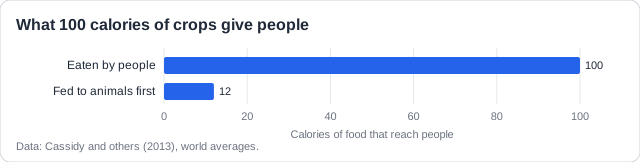
Remember it as: Every step up the chain, the harvest shrinks.
Real example: about a third of the world's crop calories are fed to farm animals, and only about 12 in every 100 of those calories come back as meat, milk and eggs (Cassidy and others, 2013).
Memorize terms 3x faster
Smart flashcards show you cards right before you forget them. Perfect for definitions and key concepts.
Exam questions ask for the reasons why food production is easier to sustain when people eat low in the chain, especially plant foods.
Why plant-based food is easier to sustain
- Plant foods need less land for the same food, because no energy is lost in a farm animal.
- Less land means less habitat cleared, so more space for wild species.
- They also need less water and fertiliser, and cause fewer greenhouse gas emissions (no cattle methane).
- More food from the same land helps feed a growing population without farming more land.
- Crops fed to animals could feed people: a question of fairness where people go hungry.
Real example: Meat, fish farms, eggs and dairy use about 83% of the world's farmland, but give only 18% of the world's calories and 37% of its protein (Poore and Nemecek, 2018).
How diets differ around the world, and their footprints, is taught in 5.2.
The same rule works in the sea and in fish farms, where the trophic level of what we eat varies a lot.
Eating lower in the sea
- In the sea, small fish such as anchoveta feed low in the chain, near the plankton.
- Big predators such as tuna feed 4 or 5 levels up, so each tonne needs far more plankton.
- Turning small fish into fishmeal for farmed salmon adds a step, so most of the energy is lost.
- Eating the small fish ourselves, or farming plant-eaters (carp) or filter feeders (mussels), gives more food.
- Mussels filter plankton from the water, so they need no feed at all.
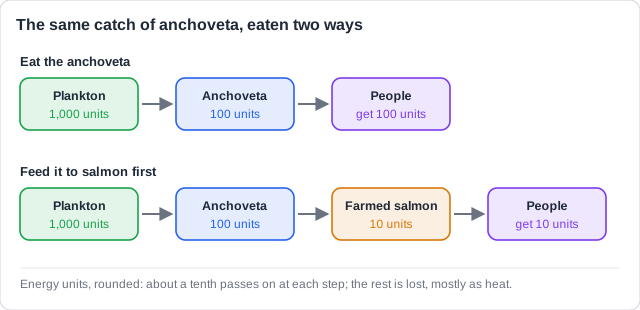
Real example: most of Peru's anchoveta catch is ground into fishmeal. In the 1990s several kilograms of wild fish went into each kilogram of farmed salmon. China's fish farms grow mainly carp, which eat plants and plankton, and mussels, which need no feed.
Know your predicted grade
Take timed mock exams and get detailed feedback on every answer. See exactly where you're losing marks.
Eating low in the chain gives the most food, but a [9] answer also shows where the idea has limits.
Where the rule has limits
- Some land is too dry, steep or cold for crops; grazing animals turn its grass into food.
- Harvesting a low level too hard starves the predators above it: its yield must stay within its NP.
- Animals also eat crop waste people cannot eat, and give manure for the fields.
- So the rule is about energy, not a ban on all meat: the more food from low levels, the easier it is.
Supports the rule
- Less energy lost, more food per hectare
- Less land, water, fertiliser, emissions
Limits
- Grazing land that cannot grow crops
- Low levels feed wild predators too
Real example: on the dry grasslands of Mongolia, crops grow poorly, so herders raise sheep, goats and horses on the grass. At sea, when Peru's anchoveta were overfished, the seabirds that eat them fell sharply, so harvests even at low levels must stay within the net productivity.
How this comes up: Paper 2, Section B (a): outline why eating lower in the chain is more sustainable [4]. Paper 2, Section A: a chart of land or energy for different foods; explain the difference [2-3].
A city in the Netherlands plans to serve more meals made from beans, lentils and vegetables, and less meat, in its school canteens.
Outline why food production is more sustainable when people eat food from lower trophic levels.
Model answer plan
See the mark-by-mark plan — for / against / judgement, with marking guidance — in study mode.