Maximum sustainable yield at Higher Level: An HL-only statement: how much people can harvest from a fish stock, a pasture or a forest every year, forever. The answer is the system's net productivity, and it can be measured in the field.
Practise this as you read
- Explain why the MSY equals the net productivity.
- Describe how to estimate the MSY of a wild population.
Free preview
This is the free notes preview
You're reading the free notes. Aimnova Pro unlocks the full study experience — and you can try it with your first topic free to keep:
- FlashcardsLock in vocabulary and key terms with spaced repetition.
- Practice questionsAnswer exam-style questions and get instant AI marking.
- Mock exams & past-paper vaultSit full mocks and see exactly how examiners award marks.
- Personalised study planA daily plan built around your exam date and weak areas.
Live off the growth: A yield is sustainable when it takes no more than the system grows each year. The largest such yield is the maximum sustainable yield, and it equals the net productivity (NP = GP - R, 2.2.13).
The points to remember
- The maximum sustainable yield (MSY) is the largest harvest that can be taken every year.
- It leaves the stock able to grow just as much next year: future harvests are not reduced.
- The MSY is the net productivity of the system: its new growth each year.
- For plants it is the NPP; for animals it is the NSP.
- The stock is the natural capital; the net productivity is its natural income (7.1).
- Take more than the MSY and the stock shrinks, so next year's growth is smaller.
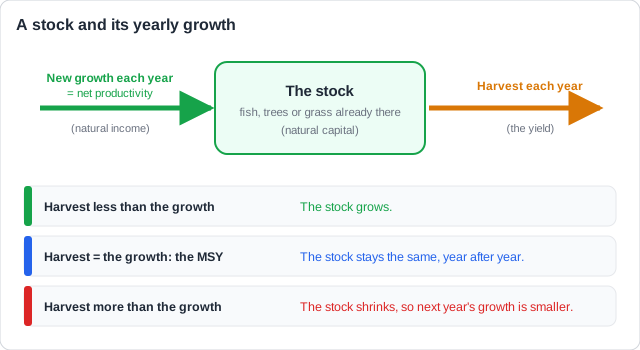
Remember it as: Spend the interest, never the savings.
For example: a fish stock of 10,000 tonnes that adds 2,000 tonnes of new fish a year has an MSY of about 2,000 tonnes a year. Catch 3,000 tonnes and the stock is 1,000 tonnes smaller next year.
Not the whole stock, not GP: The MSY is not the whole population, and not the gross productivity: part of GP is used in respiration and was never added to the stock. Say net productivity.
Know your predicted grade
Take timed mock exams and get detailed feedback on every answer. See exactly where you're losing marks.
Fish and wild animals are harvested from natural ecosystems. Here the MSY is the net secondary productivity of the population (2.2.24).
MSY in natural ecosystems
- In natural ecosystems, the MSY of a wild population is its NSP: the new biomass it adds each year.
- New biomass comes from growth of the animals and young joining the population, minus natural deaths.
- Fishing or hunting up to this amount keeps the population the same size.
- Net productivity changes from year to year (weather, food, breeding), so the MSY does too.
- Harvesting above it, year after year, makes the stock collapse.
Real example: North Sea cod were caught above their net productivity for decades, and the stock fell to a small part of its 1970s size. Catches were cut, the stock grew back, and in 2017 the fishery won a sustainability label; in 2019 the stock fell again and the label was taken away.
When the growth changes: In 1970 Peru caught about 12 million tonnes of anchoveta. Then an El Niño cut the fish's net productivity, the catch stayed high, and by 1973 it had crashed to under 2 million tonnes.
How MSY is used to set fishing limits, and its risks, is taught in 4.3.
Farms and forests are managed so that people take the yearly growth. Here the MSY is usually the net primary productivity.
MSY on farms and in forests
- In agriculture, the MSY of a field or pasture is its NPP: the plant growth each year.
- Grazing animals kept to the grass growth leave the pasture able to regrow.
- In silviculture (forestry), the MSY is the wood the forest grows each year.
- Cut no more timber than the yearly growth and the forest never shrinks.
- Crops take nutrients out with them, so the soil needs fertiliser or manure to keep the NPP up.
Agriculture
- MSY = NPP of the crop or pasture
- Harvest crops, hay, or graze to the grass growth
Silviculture (forestry)
- MSY = the wood grown each year
- Fell no more than the forest regrows
Where the word sustainability comes from: Real example: in 1713, Hans Carl von Carlowitz, who ran the silver mines of Saxony in Germany, saw the forests being cut faster than they grew. He wrote that wood should be cut only as fast as it grows back. His word for it, 'Nachhaltigkeit', is where the word sustainability comes from.
Real example: New Zealand dairy farmers measure how fast their grass grows and move the cows to a fresh strip of pasture each day, so the herd eats about the grass growth and the pasture regrows.
Get feedback like a real examiner
Submit your answers and get instant feedback — what you did well, what's missing, and exactly what to write to score full marks.
To estimate the MSY of a wild population, measure its net productivity: how much it grows in a year. This is a common [7] question.
Estimating the MSY of a wild population
- The MSY is the net productivity, so measure the change in the population over a year.
- Estimate the population size at the start, and again a year later.
- Use mark-release-recapture and the Lincoln index: N = (n₁ × n₂) ÷ m₂ (see 2.1.17).
- Use a mesh or trap size that catches only adults, and give marked animals time to mix.
- The difference between the two estimates, per year, is the net productivity: the MSY.
- A change in total biomass (numbers × mean mass) can be used instead of numbers.
Sample 1
Catch adults with a set mesh size, mark them (n₁), release them.
Mix
Wait a few days so the marked animals mix back in.
Sample 2
Catch again (n₂); count the marked ones (m₂). N = (n₁ × n₂) ÷ m₂.
A year later
Repeat the whole estimate at the same time of year.
MSY
Second estimate minus first, per year = net productivity = MSY.
Worked example: Year 1: N = (240 × 200) ÷ 40 = 1,200 perch. Year 2: N = (250 × 240) ÷ 40 = 1,500 perch.
Net productivity = 1,500 - 1,200 = 300 perch per year, so about 300 adult perch could be taken each year.
The Lincoln index gives only an estimate, and the growth changes from year to year, so managers usually set the catch a little below the MSY.
Open with the definition: Start the answer by saying what MSY is and that it equals the net productivity (natural income). Then describe the method step by step, and end with the difference between the two estimates.
How this comes up: Paper 2, Section B (b): a wild fish or herbivore population is a resource for people. Describe the procedures for estimating its MSY or natural income [7].
Vendace are small fish that live in many lakes in Finland, where they are caught for food.
Describe practical procedures for estimating the maximum sustainable yield of the vendace in one lake.
Model answer plan
See the mark-by-mark plan — for / against / judgement, with marking guidance — in study mode.