aımnova
DashboardMy LearningPaper MasteryStudy Plan

Aimnova site navigation

Stay in the loop

Get the latest study resources and updates

New features, study tips and exam insights — straight to your inbox.

IB Diploma

  • IB Past Papers
  • IB Study Notes
  • IB Question Bank
  • IB Mock Exams
  • IB Revision

IB Subjects

  • IB Math AA
  • IB Math AI
  • IB Economics
  • IB Business Management
  • IB Physics
  • IB Biology
  • View all IB subjects→

IB Past Papers

  • IB Math AA HL Past Papers
  • IB Math AA SL Past Papers
  • IB Math AI HL Past Papers
  • IB Math AI SL Past Papers
  • IB Economics HL Past Papers
  • IB Economics SL Past Papers
  • IB ESS Past Papers
  • View all past papers→

Study Resources

  • Study Notes
  • Question Bank
  • Mock Exams
  • Flashcards
  • Revision Guide
  • Exam Skills
  • Command Terms
  • Grade Calculator
  • Exam Timetable 2026

Aimnova

  • Features
  • Pricing
  • For Teachers
  • For Schools
  • For Parents
  • About Us
  • Blog
  • Contact
aımnova

IB study, practice and feedback built around the real exam.

TermsPrivacyCookies·© 2026 Aimnova. All rights reserved.1b845d5

Aimnova is not affiliated with or endorsed by the International Baccalaureate Organization (IB).

NotesEnglish A: Lang & LitTopic 2.5Text type: the letter
Back to English A: Lang & Lit Topics
2.5.14 min read

Text type: the letter

IB English A: Language and Literature · Unit 2

Exam preparation

Practice the questions examiners actually ask

Our question bank mirrors real IB exam papers. Practice under timed conditions and track your progress across topics.

Start Practicing

Contents

  1. 1What it is
  2. 2Try it yourself
The short version: A letter is written to one particular reader — so its tone, address and formality reveal the relationship between writer and reader, and what the writer wants.

The same news, two letters.

“Dear Sir, I write to express my dissatisfaction…” vs “Mum — you're not going to believe this…”

Before you read a line of content, the greeting and tone already tell you the relationship. A letter always has an ‘I’ writing to a ‘you’ — analyse how they speak to each other, and why.

What to look for

1

Salutation and sign-off

‘Dear Sir’ vs ‘Hey you’ — the greeting sets the formality and relationship instantly.

2

Direct address to ‘you’

A letter always speaks to a specific reader; watch how it treats them.

3

Register (formal / intimate)

Long, polite sentences vs short, warm ones signal distance or closeness.

4

A clear purpose

To thank, complain, persuade, apologise or console — the letter wants something.

The key move: Ask ‘what is the relationship, and what does the writer want?’ A letter's tone and address carry both — analyse how the writer treats the reader.

Free preview

This is the free notes preview

You're reading the free notes. Aimnova Pro unlocks the full study experience — and you can try it with your first topic free to keep:

  • FlashcardsLock in vocabulary and key terms with spaced repetition.
  • Practice questionsAnswer exam-style questions and get instant AI marking.
  • Mock exams & past-paper vaultSit full mocks and see exactly how examiners award marks.
  • Personalised study planA daily plan built around your exam date and weak areas.
Start Studying Free Full access to Aimnova Pro · cancel anytime
Why it matters in the exam: A letter can appear in Paper 1. A strong answer analyses how tone, address and register reveal the relationship and purpose — not just what the letter says.
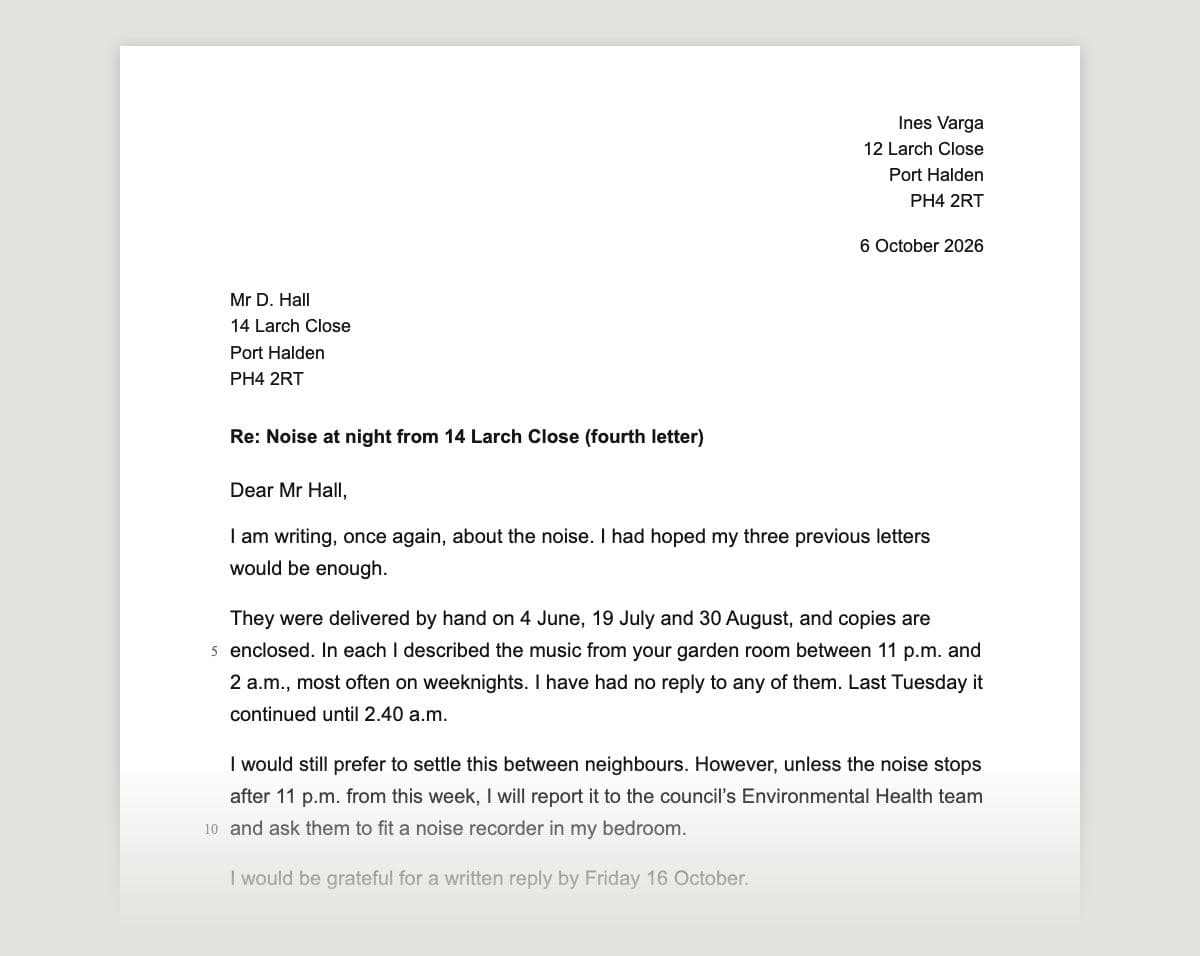
The top of a typed letter on a white sheet: the sender's address top right (Ines Varga, 12 Larch Close, Port Halden, PH4 2RT) and the date, 6 October 2026; the recipient's address on the left (Mr D. Hall, 14 Larch Close, Port Halden, PH4 2RT); a bold subject line ‘Re: Noise at night from 14 Larch Close (fourth letter)’; then ‘Dear Mr Hall,’ and the line-numbered opening, ‘I am writing, once again, about the noise. I had hoped my three previous letters would be enough.’, with dates of the earlier letters and a warning about the council, fading out at the foot of the clipping.
Formal letter, opening (an original text written for Aimnova)
IB-style questionAnalyse[6 marks]

Analyse how the opening of this letter reveals the relationship between the writer and the reader.

Model answer plan

See the mark-by-mark plan — for / against / judgement, with marking guidance — in study mode.

Claim your free topic
Watch out: Don't ignore the greeting and tone. ‘Dear Sir’ vs ‘Hi love’ changes everything — the relationship and register are half the meaning.

IB Exam Questions on Text type: the letter

Practice with IB-style questions filtered to Topic 2.5.1. Get instant AI feedback on every answer.

Practice Topic 2.5.1 QuestionsBrowse All English A: Lang & Lit Topics

How Text type: the letter Appears in IB Exams

Examiners use specific command terms when asking about this topic. Here's what to expect:

  • Define

    Give the precise meaning of key terms related to Text type: the letter.

    AO1
  • Describe

    Give a detailed account of processes or features in Text type: the letter.

    AO2
  • Explain

    Give reasons WHY — cause and effect within Text type: the letter.

    AO3
  • Evaluate

    Weigh strengths AND limitations of approaches in Text type: the letter.

    AO3
  • Discuss

    Present arguments FOR and AGAINST with a balanced conclusion.

    AO3

See the full IB Command Terms guide

Related English A: Lang & Lit Topics

Continue learning with these related topics from the same unit:

2.1.1Text type: the advertisement2.1.2Text type: the poster2.1.3Text type: the brochure or leaflet2.1.4Text type: the campaign material
View all English A: Lang & Lit topics
Improve your exam techniqueCommand terms, paper structure, and mark-scheme tips for English A: Lang & Lit
Previous2.4.6Text type: the film stillNextText type: the memoir extract2.5.2

4 exam-style questions ready for you

Students who practice on Aimnova improve their scores by 15% on average. Get instant feedback that shows exactly how to improve your answers.

Practice Now — FreeView All English A: Lang & Lit Topics