aımnova
DashboardMy LearningPaper MasteryStudy Plan

Aimnova site navigation

Stay in the loop

Get the latest study resources and updates

New features, study tips and exam insights — straight to your inbox.

IB Diploma

  • IB Past Papers
  • IB Study Notes
  • IB Question Bank
  • IB Mock Exams
  • IB Revision

IB Subjects

  • IB Math AA
  • IB Math AI
  • IB Economics
  • IB Business Management
  • IB Physics
  • IB Biology
  • View all IB subjects→

IB Past Papers

  • IB Math AA HL Past Papers
  • IB Math AA SL Past Papers
  • IB Math AI HL Past Papers
  • IB Math AI SL Past Papers
  • IB Economics HL Past Papers
  • IB Economics SL Past Papers
  • IB ESS Past Papers
  • View all past papers→

Study Resources

  • Study Notes
  • Question Bank
  • Mock Exams
  • Flashcards
  • Revision Guide
  • Exam Skills
  • Command Terms
  • Grade Calculator
  • Exam Timetable 2026

Aimnova

  • Features
  • Pricing
  • For Teachers
  • For Schools
  • For Parents
  • About Us
  • Blog
  • Contact
aımnova

IB study, practice and feedback built around the real exam.

TermsPrivacyCookies·© 2026 Aimnova. All rights reserved.21255c1

Aimnova is not affiliated with or endorsed by the International Baccalaureate Organization (IB).

NotesEnglish A: Lang & LitTopic 2.4Text type: the film still
Back to English A: Lang & Lit Topics
2.4.64 min read

Text type: the film still

IB English A: Language and Literature · Unit 2

Your first topic is free to keep

Know exactly what to write for full marks

Practice with exam questions and get AI feedback that shows you the perfect answer — what examiners want to see.

Start Free

Contents

  1. 1What it is
  2. 2Try it yourself
In a nutshell: A film still is one frame from a film — and everything in it is arranged: the setting, lighting, costume, props and where people stand all carry meaning.

Freeze any film on one frame and it still ‘speaks’.

A lone figure at the far edge of a huge, empty, blue-lit room. You instantly feel small, cold, alone— before anyone says a word.

Nothing in that frame is accidental. Directors arrange every element. The word for it is mise-en-scène— ‘what's put in the scene’. Analyse the arrangement.

What to look for

1

Setting and props

Where it is and what's in shot — a bare room vs a cluttered one tells different stories.

2

Lighting and colour

Warm gold feels safe; cold blue or harsh shadow feels tense or sad.

3

Costume and appearance

Clothes signal who a character is and how they feel.

4

Position in the frame

Centre vs edge, big vs small, high vs low — placement shows power and mood.

The key move: Ask ‘what has the director arranged in this frame, and why?’ In a film still, mise-en-scène (setting, light, costume, position) does the storytelling.

Free preview

This is the free notes preview

You're reading the free notes. Aimnova Pro unlocks the full study experience — and you can try it with your first topic free to keep:

  • FlashcardsLock in vocabulary and key terms with spaced repetition.
  • Practice questionsAnswer exam-style questions and get instant AI marking.
  • Mock exams & past-paper vaultSit full mocks and see exactly how examiners award marks.
  • Personalised study planA daily plan built around your exam date and weak areas.
Start Studying Free Full access to Aimnova Pro · cancel anytime
Why it matters in the exam: A film still can appear in Paper 1. A strong answer analyses mise-en-scène — lighting, colour, costume, position — and what it suggests, not just describing the scene.
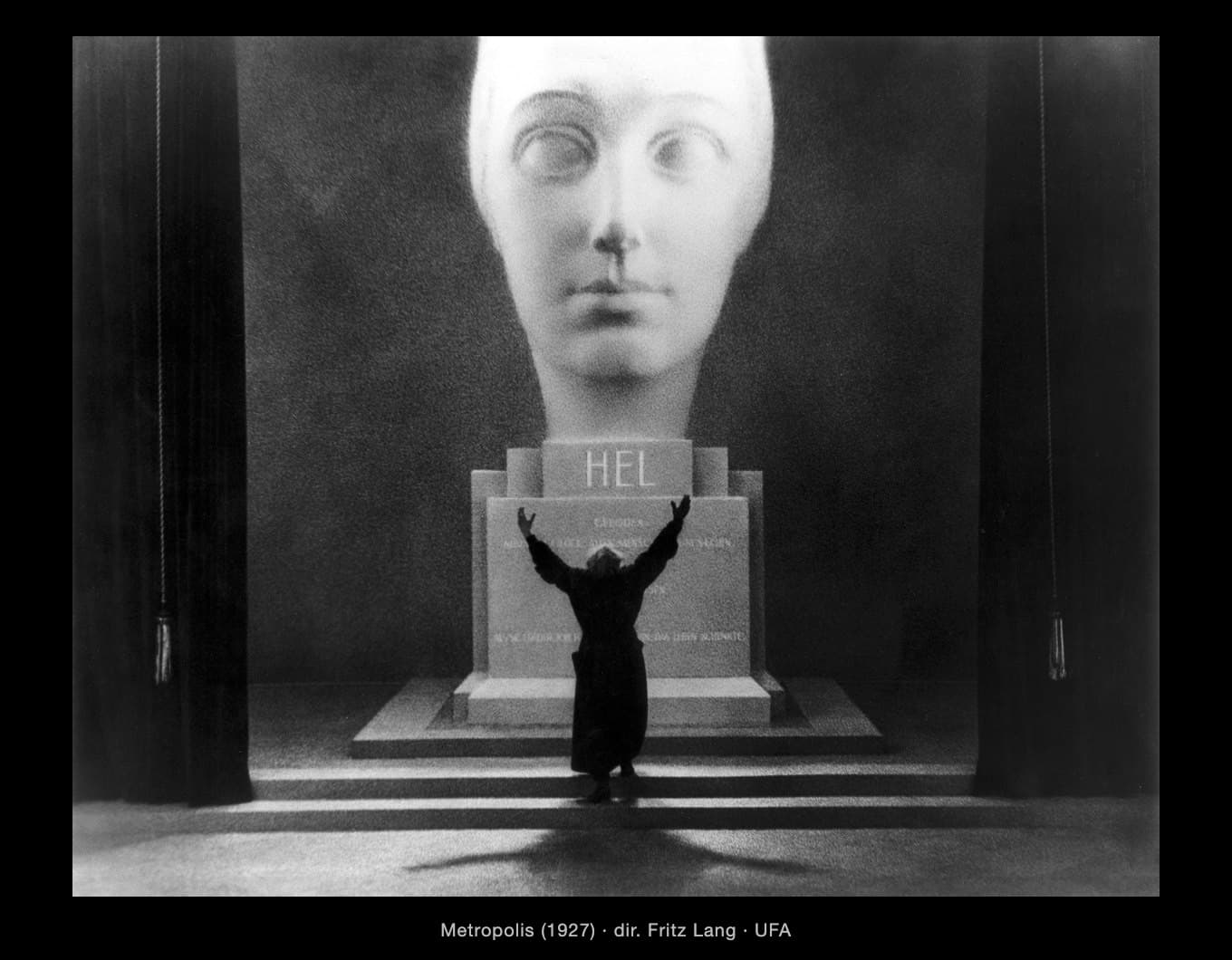
A black-and-white film still from Metropolis (1927). A huge pale stone head of a woman, glowing white, fills the top centre of the frame above a stepped stone plinth carved with the name ‘HEL’. Far below it, a small man in a long black coat stands on the steps with his back to us, arms flung up towards the face. Heavy black curtains hang at both sides like a stage. His long shadow stretches across the floor towards the camera. Caption: ‘Metropolis (1927) · dir. Fritz Lang · UFA’.
Film still: Metropolis (1927, dir. Fritz Lang, UFA), Rotwang before the stone head of Hel; still photograph by Horst von Harbou, public domain via Wikimedia Commons (caption line added)
IB-style questionAnalyse[6 marks]

Analyse how the mise-en-scène of this film still creates meaning.

Model answer plan

See the mark-by-mark plan — for / against / judgement, with marking guidance — in study mode.

Claim your free topic
Watch out: Don't just say what happens in the shot. The marks come from the arrangement — light, colour, position, props — and what it suggests.

IB Exam Questions on Text type: the film still

Practice with IB-style questions filtered to Topic 2.4.6. Get instant AI feedback on every answer.

Practice Topic 2.4.6 QuestionsBrowse All English A: Lang & Lit Topics

How Text type: the film still Appears in IB Exams

Examiners use specific command terms when asking about this topic. Here's what to expect:

  • Define

    Give the precise meaning of key terms related to Text type: the film still.

    AO1
  • Describe

    Give a detailed account of processes or features in Text type: the film still.

    AO2
  • Explain

    Give reasons WHY — cause and effect within Text type: the film still.

    AO3
  • Evaluate

    Weigh strengths AND limitations of approaches in Text type: the film still.

    AO3
  • Discuss

    Present arguments FOR and AGAINST with a balanced conclusion.

    AO3

See the full IB Command Terms guide

Related English A: Lang & Lit Topics

Continue learning with these related topics from the same unit:

2.1.1Text type: the advertisement2.1.2Text type: the poster2.1.3Text type: the brochure or leaflet2.1.4Text type: the campaign material
View all English A: Lang & Lit topics
Improve your exam techniqueCommand terms, paper structure, and mark-scheme tips for English A: Lang & Lit
Previous2.4.5Text type: the documentary extractNextText type: the letter2.5.1

4 questions to test your understanding

Reading is just the start. Students who tested themselves scored 82% on average — try IB-style questions with AI feedback.

Start FreeView All English A: Lang & Lit Topics