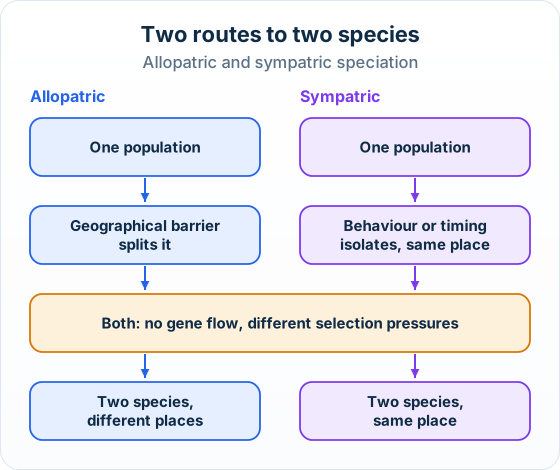
The big idea: Allopatric speciation happens after a geographical barrier separates populations. Sympatric speciation happens in the same place, when behaviour or timing stops groups from mating.
The points to remember
- Allopatric ('other homeland'): populations separated by a geographical barrier.
- Sympatric ('same homeland'): no barrier; behavioural or temporal isolation in one area.
- Both split one existing species into two or more species.
- Both need reproductive isolation: no gene flow between the groups.
- Both need differential selection: different pressures favour different alleles.
Remember it as: Allo = apart, sym = same place.
Real example: allopatric: Bonobos and chimpanzees on either side of the Congo River (1.8.7) are the classic allopatric case: a river, then different selection on each bank.
Watch the difference the exam looks for:
Isolation happens in both: 'Reproductive isolation occurs' is true of both kinds, so it cannot tell them apart. What is different is how it starts: a barrier, or behaviour and timing in the same place.
Free preview
This is the free notes preview
You're reading the free notes. Aimnova Pro unlocks the full study experience — and you can try it with your first topic free to keep:
- FlashcardsLock in vocabulary and key terms with spaced repetition.
- Practice questionsAnswer exam-style questions and get instant AI marking.
- Mock exams & past-paper vaultSit full mocks and see exactly how examiners award marks.
- Personalised study planA daily plan built around your exam date and weak areas.
Start Studying Free Full access to Aimnova Pro · cancel anytime
The big idea: Reproductive isolation can be geographic, behavioural or temporal. Only the first needs a barrier.
| Kind of isolation | What stops mating | Kind of speciation |
|---|---|---|
| Geographic | A barrier such as a river, mountains or sea | Allopatric |
| Behavioural | Different courtship, songs or choice of mate | Sympatric (or after allopatric) |
| Temporal | Breeding at different times of day or year | Sympatric (or after allopatric) |
The points to remember
- Geographic: the groups never meet.
- Behavioural: they meet but do not court each other, for example different songs.
- Temporal: they meet but are ready to breed at different times.
Real examples: sympatric: Apple maggot flies in North America split into a group that lays eggs on apples and one on hawthorn; apples ripen earlier, so the groups mate at different times. Two green lacewings breed in different seasons and use different courtship songs, though they live in the same places.
See how examiners mark answers
Answer exam-style questions with model answers. Learn exactly what earns marks and what doesn't.
Try Exam Vault FreeYour first topic is free to keep • No credit card required
How it is tested: Paper 1A: which feature tells sympatric from allopatric, or the type and cause in a named example. Paper 2: state the type for a map, or compare and contrast the two in four marks.
IB-style questionCompare and contrast[4 marks]
Compare and contrast the speciation of salamanders on either side of a mountain range with the speciation of apple maggot flies on apple and hawthorn trees in the same orchard.
Model answer plan
See the answer broken into clear points, with guidance on how each point earns marks.
Similarities first: A 'compare and contrast' needs both: at least one similarity and one difference, each stated for both kinds.