Speciation at Higher Level: isolation and selection: The same statement as SL. At Higher Level the next micro adds sympatric speciation, where behaviour or timing isolates populations that share one place.
Practise this as you read
- Explain the roles of isolation and differential selection.
- Describe the bonobo and chimpanzee example.
Free preview
This is the free notes preview
You're reading the free notes. Aimnova Pro unlocks the full study experience — and you can try it with your first topic free to keep:
- FlashcardsLock in vocabulary and key terms with spaced repetition.
- Practice questionsAnswer exam-style questions and get instant AI marking.
- Mock exams & past-paper vaultSit full mocks and see exactly how examiners award marks.
- Personalised study planA daily plan built around your exam date and weak areas.
Speciation needs two steps.
Step 1: separate the populations
- First, the populations must be separated so that members of one population stop breeding with members of the other.
- This is reproductive isolation.
- A very common cause is a geographic barrier — a river, a mountain range, or the sea — that physically splits one population into two.
Second, the two separated populations diverge. Once gene flow between them has stopped, each population faces its own environment. Mutation creates different new alleles in each group, and natural selection favours different alleles in each place. Over many generations the two gene pools drift apart.
- Gene flow
- The movement of alleles between populations through interbreeding.
- Geographic isolation
- Separation of populations by a physical barrier such as a river, mountain or ocean.
- Divergence
- The build-up of genetic differences between two separated populations over time.
- Gene pool
- All the alleles present in a population.
When are they finally two species?: The two populations have become two separate species only once they have diverged so much that they can no longer interbreed to produce fertile offspring, even if they are brought back together.
Until that point they are still one species — just two isolated populations.
Feeling unprepared for exams?
Get a clear study plan, practice with real questions, and know exactly where you stand before exam day. No more guessing.
The big idea: Speciation needs two things: reproductive isolation, so no genes flow between the populations, and differential selection, so each population changes in its own way.
The points to remember
- Geographical isolation (a river, mountains, sea) is one way to achieve reproductive isolation.
- With no gene flow, mutations and changes in one population do not spread to the other.
- Each side has different selection pressures, so different alleles are favoured: differential selection.
- Over many generations the allele frequencies diverge.
- In the end the populations cannot interbreed to give fertile offspring: two species.
- Guide example: bonobos and chimpanzees, separated by the Congo River.
Remember it as: Cut off, then pushed apart.
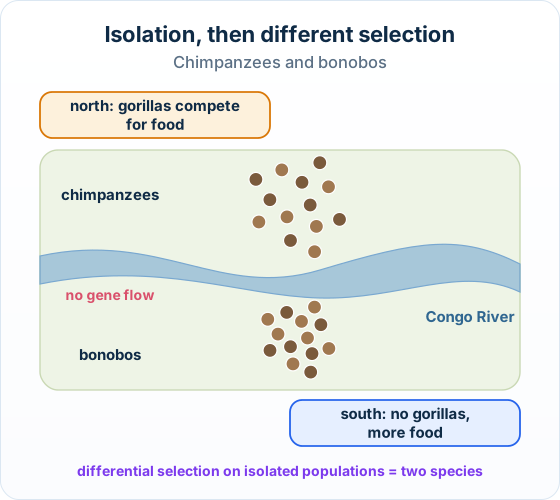
One explanation for the differences: north of the river chimpanzees share their forests with gorillas and compete for food; south of it bonobos have no gorillas and more food, and live in less aggressive groups.
Real example: Galápagos finches: Finch populations on different Galápagos islands meet different seeds. On islands with hard, large seeds, birds with deeper beaks survive and breed more: the same isolation, different selection.
Know where the process ends:
Isolated is not yet a new species: A barrier alone does not make two species. They become separate species only when they can no longer interbreed to give fertile offspring, even if they meet again.
How it is tested: Paper 1A: the consequence of a barrier (reproductive isolation). Paper 2: explain or describe how isolated populations became two species, in three to seven marks.
Two species of ground beetle live on opposite sides of a large river. Describe how both species could have evolved from one ancestral population.
Model answer plan
See the answer broken into clear points, with guidance on how each point earns marks.
Name both roles: Write 'reproductive isolation' and 'differential selection' by name: they are the two ideas in the statement.