Hydrogen bonds in water at Higher Level: The same statement as SL, and the same drawing skill. At HL the multiple-choice questions hand you four drawings and ask which has the partial charges in the right places, so practise placing δ− and δ+ until it is automatic, and draw three molecules rather than two so the bonds to several neighbours are clear.
Practise this as you read
- Draw every molecule bent, with δ− on the O and δ+ on each H.
- Join molecules with a dashed line from a δ+ H to a δ− O, and label it.
- Explain water's behaviour with two words: polar, then many hydrogen bonds.
Free preview
This is the free notes preview
You're reading the free notes. Aimnova Pro unlocks the full study experience — and you can try it with your first topic free to keep:
- FlashcardsLock in vocabulary and key terms with spaced repetition.
- Practice questionsAnswer exam-style questions and get instant AI marking.
- Mock exams & past-paper vaultSit full mocks and see exactly how examiners award marks.
- Personalised study planA daily plan built around your exam date and weak areas.
The big idea: A water molecule is one oxygen atom and two hydrogen atoms, held together by sharing electrons. Oxygen does not share fairly: it pulls the electrons closer to itself.
Picture a tug of war between an adult and a small child, both holding one rope. The rope ends up closer to the adult.
In water, oxygen is the adult and hydrogen is the child. The rope is the pair of shared electrons.
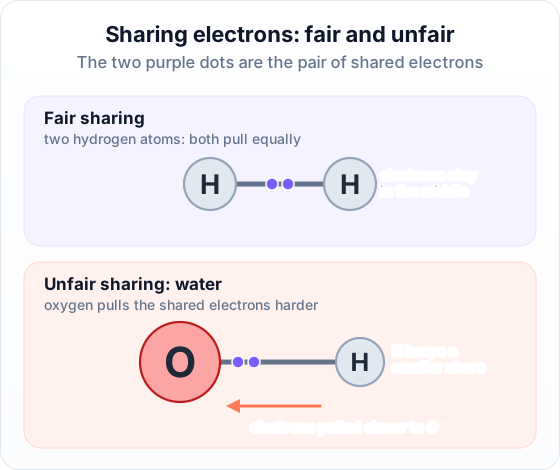
Remember it as: Oxygen wins the tug of war, so the shared electrons sit closer to it.
The points to remember
- The atoms in water are held together by sharing electrons. A shared pair is a covalent bond.
- Oxygen pulls on the shared electrons harder than hydrogen does: it is more electronegative.
- So the electrons sit closer to the oxygen. Sharing that is not equal makes a polar covalent bond.
Real example: hydrogen sulfide: Hydrogen sulfide (H₂S), the rotten-egg gas from volcanoes, has water's shape, but sulfur pulls the shared electrons only a little harder than hydrogen. Its bonds are barely polar; water's are strongly polar.
One mix-up to avoid:
The electrons are still shared: Oxygen does not take an electron away from hydrogen. The pair is still shared, just unequally.
(Taking an electron away would make an ionic bond, and water has none.)
Practice with exam-style questions
Answer exam-style questions and get AI feedback that shows you exactly what examiners want to see in a full-marks response.
The big idea: Because the shared electrons sit closer to the oxygen, the oxygen end is slightly negative and each hydrogen is slightly positive. These small charges are written with the Greek letter delta: a partial charge.
The points to remember
- The oxygen end is slightly negative (δ−); each hydrogen is slightly positive (δ+).
- δ means partial: a small charge, not the full charge of an ion. Water is neutral overall.
- The molecule is bent (about 104.5°), so both δ+ hydrogens sit on one side and the δ− oxygen on the other.
- A molecule with a δ− end and a δ+ end is a polar molecule.
Remember it as: δ means 'a bit': a bit negative on the O, a bit positive on each H.
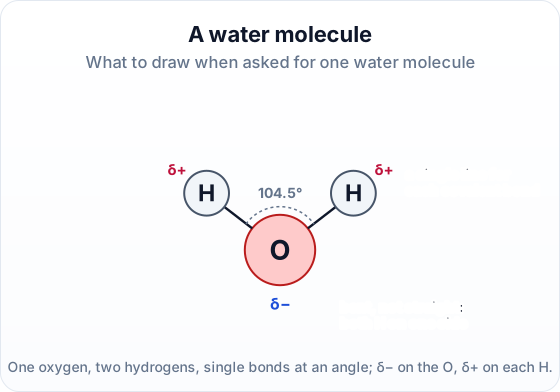
Real example: rub a balloon on a jumper and hold it beside a thin stream of tap water. The stream bends towards the balloon, because the charged balloon pulls on the δ+ and δ− ends of the polar molecules. A stream of a non-polar liquid such as hexane does not bend.
The trap: full charges: Never write a bare + or − on water. A full charge means an ion, and no electron has moved from one atom to another.
Always write δ+ and δ−.
The big idea: Because each water molecule is polar, its molecules attract one another. The δ+ hydrogen of one molecule is pulled towards the δ− oxygen of a neighbour. This weak attraction is a hydrogen bond.
The points to remember
- The δ+ hydrogen of one water molecule is attracted to the δ− oxygen of a neighbour: a hydrogen bond.
- Hydrogen bonds act between molecules; covalent bonds act within one molecule.
- A hydrogen bond is weak compared with a covalent bond, and it is drawn as a dashed line.
- Each water molecule can hydrogen-bond to several neighbours at once.
Remember it as: Covalent WITHIN a molecule, hydrogen bond BETWEEN molecules.
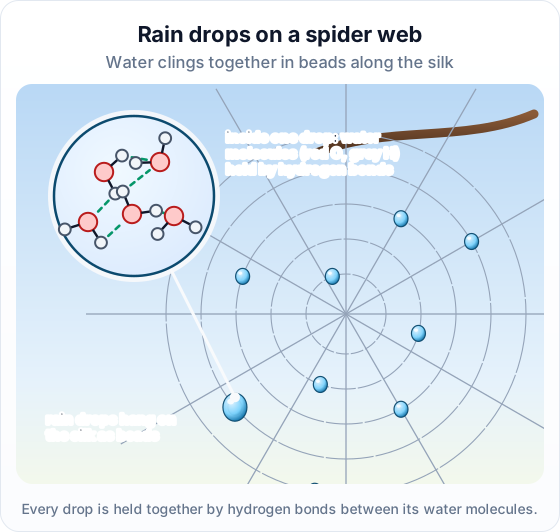
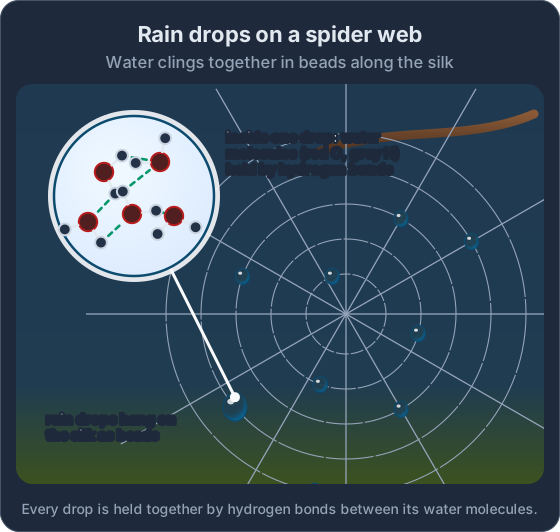
Real example: after rain, drops hang as separate beads along a spider's web instead of running off as a sheet. Hydrogen bonds hold the molecules of each drop to one another.
| Covalent bond | Hydrogen bond | |
|---|---|---|
| Where it acts | within one molecule (O–H) | between separate molecules |
| What causes it | sharing a pair of electrons | δ+ H attracted to δ− O |
| Strength | strong | weak, but there are very many |
| How it is drawn | a solid line | a dashed line |
Feeling unprepared for exams?
Get a clear study plan, practice with real questions, and know exactly where you stand before exam day. No more guessing.
Hydrogen sulfide (H₂S) is water's look-alike: the same bent shape, sulfur in place of oxygen. At 20 °C it is a gas and water is a liquid. The difference is what holds the molecules together.
The points to remember
- One hydrogen bond is easy to break; a drop of water holds a huge number of them.
- So a lot of energy is needed to pull water molecules apart.
- That is why water is a liquid at room temperature while a similar-sized non-polar molecule is a gas.
- The same bonds give water the properties the next pages use: it sticks to itself and it warms up slowly.
Remember it as: One thread snaps easily; a rope of threads holds.
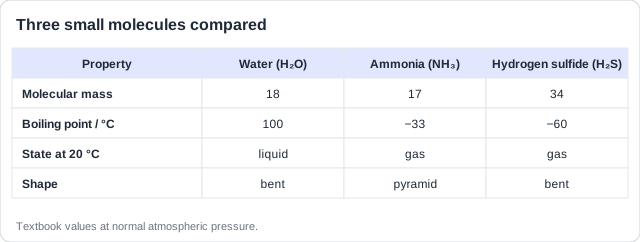
Real example: hydrogen sulfide: Sulfur pulls shared electrons only a little harder than hydrogen, so H₂S is hardly polar and forms almost no hydrogen bonds: it boils at −60 °C. Ammonia (NH₃) is polar and forms some hydrogen bonds, so it boils at −33 °C. Water forms the most, and boils at 100 °C.
Why so many bonds matter. Any one hydrogen bond is easy to break. But there are so many of them that separating water molecules takes a lot of energy, and that is the reason behind nearly all of water's special properties.
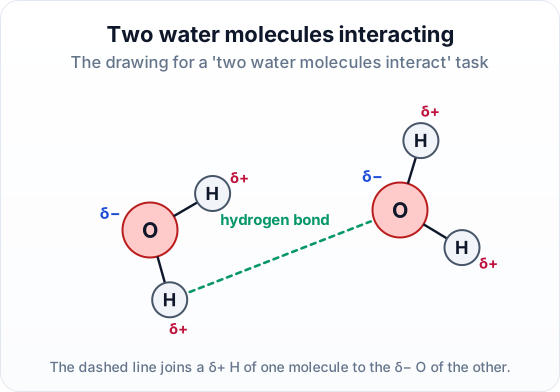
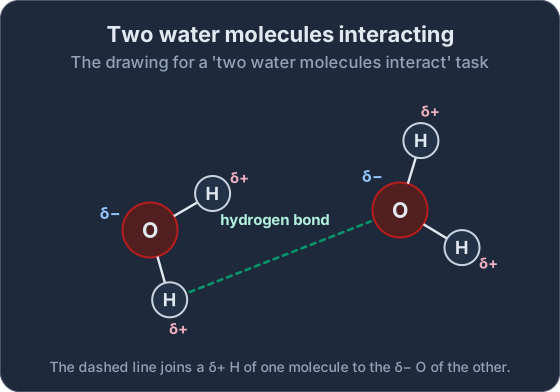
The big idea: The exam asks you to draw two or more water molecules and the hydrogen bonds between them, with δ+ and δ− to show the polarity. Here is the drawing, one step at a time.
The points to remember
- Draw each molecule bent: one O, two H, single lines for the covalent bonds.
- Write δ− on every O and δ+ on every H.
- Draw a dashed line from a δ+ H of one molecule to the δ− O of another, and label it hydrogen bond.
- Never join O to O or H to H, and never draw the hydrogen bond as a solid line.
Remember it as: Bent molecule, δ on every atom, dashed line H to O, label it.
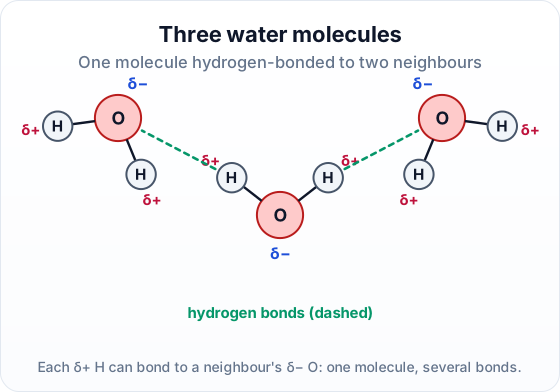
The trap: the wrong ends: A hydrogen bond joins a hydrogen of one molecule to the oxygen of another. A dashed line from O to O, or a solid line between the molecules, does not count.
Real example: in ice, every water molecule is held by hydrogen bonds to exactly four neighbours in an open framework. Your drawing of one molecule with its neighbours shows the start of that pattern.
Memorize terms 3x faster
Smart flashcards show you cards right before you forget them. Perfect for definitions and key concepts.
How this is tested: A multiple-choice question shows four drawings of a water molecule and asks which one has the partial charges in the right places.
A written part asks you to draw one water molecule for two marks, or two or more molecules interacting for four.
Sweat is about 99 % water. Draw a labelled diagram to show how water molecules interact with each other, showing at least two molecules.
Model answer plan
See the mark-by-mark plan — for / against / judgement, with marking guidance — in study mode.
Blood plasma is about 92 % water. Draw a diagram to show the structure of one water molecule.
Model answer plan
See the mark-by-mark plan — for / against / judgement, with marking guidance — in study mode.
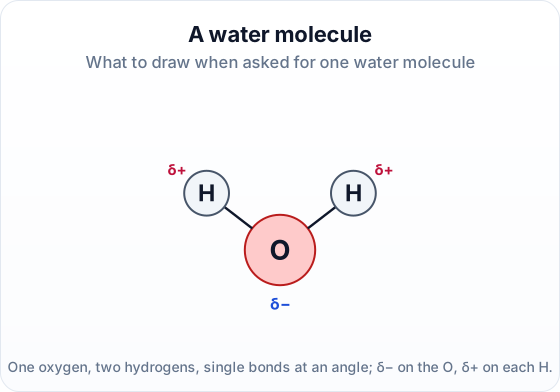
The trap: a straight line: H–O–H drawn in a straight line loses the shape mark: the bonds must sit at an angle.
A circle labelled H₂O is not a structure either. Show each atom and each bond.