The big idea: Speciation is the formation of a new species from an existing one. When it happens again and again across a group, it leaves a pattern in how the species are related and how fast they appeared.
Two patterns you must know
- Adaptive radiation — one ancestor rapidly gives rise to many species that each fit a different way of life.
- Gradual vs abrupt speciation — new species can appear slowly over a long time or in a short, sudden burst.
Adaptive radiation
- One ancestor → many new species
- Each species adapts to a different niche (food, habitat, way of life)
- Often follows reaching a new, empty environment
Rate of speciation
- Gradual — small changes build up slowly over a long time
- Abrupt — a new species appears in a short, sudden burst
- The fossil record can show either pattern
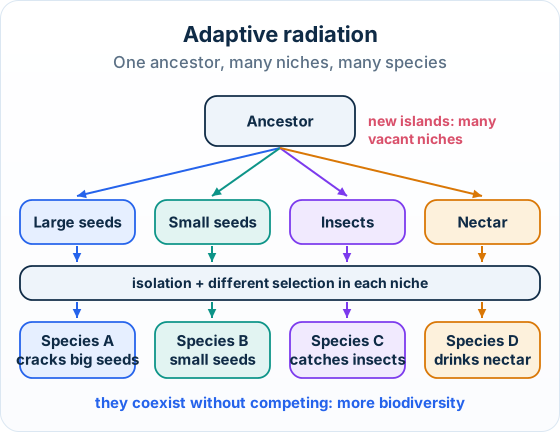
Adaptive radiation: one ancestral finch rapidly branches into many species, each with a different beak suited to a different niche (large seeds, small seeds, insects, cactus/nectar, grubs in bark).
Interactive diagram
Explore the labelled diagram, charts and maps for this topic in full study mode.
Words to be careful with: A niche is the particular role and way of life of a species — what it eats, where it lives and how it behaves.
Diversification just means becoming more varied — here, one group splitting into many different species over time.
Free preview
This is the free notes preview
You're reading the free notes. Aimnova Pro unlocks the full study experience — and you can try it with your first topic free to keep:
- FlashcardsLock in vocabulary and key terms with spaced repetition.
- Practice questionsAnswer exam-style questions and get instant AI marking.
- Mock exams & past-paper vaultSit full mocks and see exactly how examiners award marks.
- Personalised study planA daily plan built around your exam date and weak areas.
Adaptive radiation happens when a single ancestral species spreads into a range of new, empty habitats — for example a group of birds reaching a fresh island chain.
How adaptive radiation happens
- In each habitat, natural selection favours different features (different beaks for different foods, say).
- Over many generations the populations become reproductively isolated.
- They form separate species, each suited to its own niche.
- So one ancestor radiates into many species in a relatively short span of time.
- Speciation
- The formation of a new species from an existing one.
- Adaptive radiation
- The rapid evolution of many new species from a single ancestor, each adapted to a different niche.
- Niche
- The particular role and way of life of a species — what it eats, where it lives and how it behaves.
- Gradual speciation
- Speciation by the slow build-up of small heritable changes over a long period.
- Abrupt speciation
- Speciation that happens suddenly, over a short period (for example by a chromosome change).
Reading a 'species number' graph: In the exam you may see a graph where the number of species rises sharply over a period of time.
A steep rise in species number in one group is the classic signature of adaptive radiation — one ancestor diversifying rapidly into many species, each filling a different niche.
Why it matters for biodiversity:
Radiation and biodiversity
- Adaptive radiation needs vacant niches: ways of life no other species is using.
- Each new species uses a different niche, so closely related species can coexist without competing.
- So adaptive radiation increases biodiversity in that ecosystem.
- It happens by the same steps as other speciation: isolation, then differential selection.
Remember it as: Empty niches, many species.
Real example: Hawaiian honeycreepers: One finch-like ancestor reached the Hawaiian Islands and gave rise to dozens of honeycreeper species. Their beaks fit different foods: seeds, insects under bark, and nectar from flowers.
Practice with exam-style questions
Answer exam-style questions and get AI feedback that shows you exactly what examiners want to see in a full-marks response.
How this is tested: This topic comes up on Paper 1A (multiple choice) and on Paper 2.
Two question types
- Paper 1A: a graph showing a rising number of species in one group is shown, and you must identify the reason for the increase — the answer is adaptive radiation.
- Paper 2: a short question can ask you to state the pattern or type of evolution a lineage shows from its ancestors (for example gradual change, or divergence into separate forms).
Exam-style question — finches on a new island chain
A single species of finch reached a group of newly formed islands. A graph shows that, over the next few thousand years, the number of finch species on the islands rose sharply from one to fourteen. Identify the pattern of speciation shown and explain how it produced so many species. [3]
How to score all three marks
- Name the pattern. A sharp rise from one ancestor to many species is adaptive radiation.
- Link to niches. The new islands offered many empty niches (different foods and habitats), so populations spread into different ways of life.
- Bring in selection + isolation. In each niche natural selection favoured different features; the populations became reproductively isolated and formed separate species — answering 'how it produced so many species'.
Final answer
Adaptive radiation: one ancestral finch spread into many empty niches on the islands, where natural selection favoured different features in each, and reproductive isolation turned the populations into separate species.
The answer drawn out: one ancestral finch radiates into many species, each beak shaped for a different niche. The sharp 1 → many rise on the graph is the signature of adaptive radiation.
Interactive diagram
Explore the labelled diagram, charts and maps for this topic in full study mode.
Why this scores: The answer names the pattern (adaptive radiation), then explains the mechanism — empty niches, natural selection and reproductive isolation.
An 'explain' answer must give the how, not just the label.