Selective breeding at Higher Level: The same statement as SL. At Higher Level, link it to allele frequencies: breeders change the gene pool of a domesticated population just as natural selection changes a wild one.
Practise this as you read
- Explain how selective breeding changes a population.
- Outline why breeds are evidence for evolution.
Free preview
This is the free notes preview
You're reading the free notes. Aimnova Pro unlocks the full study experience — and you can try it with your first topic free to keep:
- FlashcardsLock in vocabulary and key terms with spaced repetition.
- Practice questionsAnswer exam-style questions and get instant AI marking.
- Mock exams & past-paper vaultSit full mocks and see exactly how examiners award marks.
- Personalised study planA daily plan built around your exam date and weak areas.
Start Studying Free Full access to Aimnova Pro · cancel anytime
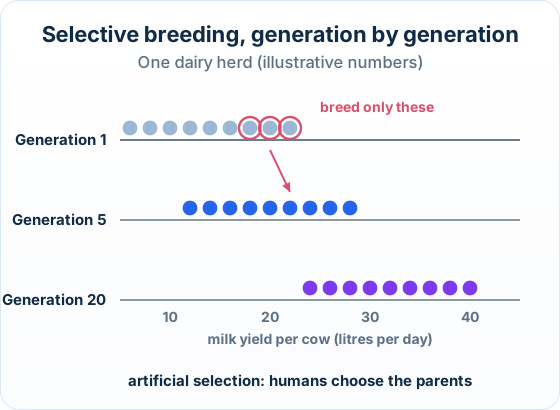
The big idea: In selective breeding, humans choose which animals or plants breed. Over generations the chosen heritable features become common: this is evolution, caused by people.
The points to remember
- There is heritable variation: individuals differ, partly because of their alleles.
- Humans choose the individuals with the feature they want and breed only from them.
- The offspring inherit the alleles for that feature.
- Repeated over many generations, the feature becomes more and more common.
- This is also called artificial selection: people, not the environment, do the selecting.
Remember it as: People pick the parents.
Real example: maize from teosinte: About 9,000 years ago farmers in Mexico began sowing the seeds of teosinte, a wild grass with a few small, hard grains. Choosing the best plants year after year gave maize, with hundreds of soft kernels on each cob.
Name the cause correctly:
Not natural selection: A cattle breed that gives more milk was produced by selective breeding: farmers chose the parents. Natural selection is when the environment decides who survives and reproduces.
Feeling unprepared for exams?
Get a clear study plan, practice with real questions, and know exactly where you stand before exam day. No more guessing.
Get Exam Ready FreeYour first topic is free to keep • No credit card required
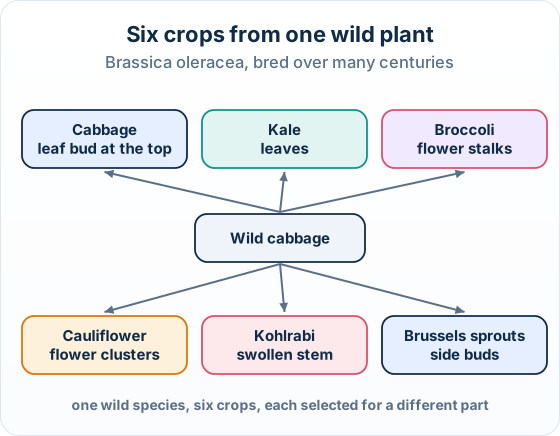
The big idea: Domesticated breeds and crop varieties differ hugely from each other and from their wild ancestors. They show how fast heritable change can happen.
The points to remember
- Breeds differ from each other: a chihuahua and a great dane are one species.
- Breeds differ from the wild species they came from, such as dogs from wolves.
- These changes took thousands of years or less, far faster than most natural change.
- So heritable characteristics can change, and quickly: evidence that evolution happens.
- The mechanism is the same as in nature, selection, but humans are the ones choosing.
Selective breeding
- Humans choose which individuals breed
- Selects what people want (milk, size, taste)
- Can be fast: tens or hundreds of generations
Natural selection
- The environment decides who survives and breeds
- Selects what helps survival and reproduction
- Usually slower: many more generations
How it is tested: Paper 1A: what caused a breed's feature, or which items are evidence for evolution. Paper 2: outline or explain how breeds and crops are evidence, with an example.
IB-style questionExplain[3 marks]
Broiler chickens bred for meat today grow several times faster than chickens did in the 1950s. Explain how this is evidence for evolution.
Model answer plan
See the answer broken into clear points, with guidance on how each point earns marks.
Say who selects: Write 'humans chose which individuals bred'. That is what makes it selective breeding, not natural selection.