Sequence evidence at Higher Level: The same statement as SL, but Higher Level papers bring data: chromosome drawings with telomere and centromere sequences, and sequences to compare. Read the evidence from the figure, one mark per point.
Practise this as you read
- Explain how base sequences are evidence for evolution.
- Justify a chromosome fusion from telomere and centromere sequences.
Free preview
This is the free notes preview
You're reading the free notes. Aimnova Pro unlocks the full study experience — and you can try it with your first topic free to keep:
- FlashcardsLock in vocabulary and key terms with spaced repetition.
- Practice questionsAnswer exam-style questions and get instant AI marking.
- Mock exams & past-paper vaultSit full mocks and see exactly how examiners award marks.
- Personalised study planA daily plan built around your exam date and weak areas.
The big idea: We cannot watch most of evolution happen — it took millions of years.
Building the case
- Instead, scientists build the case from lines of evidence left behind: shared body plans, fossils, where species live, and — the strongest of all — similarities in DNA.
- On its own each clue is weak.
- Together they point the same way: today's species descended, with change, from earlier ones.
The main lines of evidence
- Homologous structures — the same body plan reused for different jobs
- Selective breeding — humans changing species fast, showing change is possible
- Fossils — older rock layers hold simpler, often extinct forms
- Biogeography — where species live matches how they spread and split
- DNA / base sequences — the closer the match, the closer the relatives
Homologous structures — the strongest anatomical clue. A human arm, a bat wing and a whale flipper do completely different jobs, yet all share the SAME bones (humerus, radius+ulna, carpals, digits), inherited from a common ancestor.
Interactive diagram
Explore the labelled diagram, charts and maps for this topic in full study mode.
Key words first: Evolution = a change in the heritable characteristics of a population over many generations.
Evidence here means an observation that supports the idea of common ancestry — not proof of a single event.
Learn what examiners really want
See exactly what to write to score full marks. Our AI shows you model answers and the key phrases examiners look for.
DNA is the strongest evidence: The most powerful clue is molecular: comparing DNA base sequences (or the protein sequences they code for).
What the comparison shows
- Species that share more of their sequence are more closely related and split from a common ancestor more recently.
- This is why a cladogram built from DNA usually agrees with the one built from body plans — two independent clues telling the same story.
Reading an evolutionary tree (cladogram): Evidence is often drawn as a cladogram — a branching tree where each branch tip is a species and each branch point (node) is a shared common ancestor the species above it are descended from.
Finding the closest relative
Trace back
To find a species' closest relative, trace back down both branches until they meet.
Find the lowest node
The pair that meets at the most recent (lowest) node are the most closely related, because they shared a common ancestor most recently.
The trick: The closest relative is NOT the one drawn nearest on the page — it is the one you reach by going back the fewest branch points.
- Cladogram (evolutionary tree)
- A branching diagram showing how species are related by descent from common ancestors.
- Node (branch point)
- A point where the tree splits — it represents the most recent common ancestor of every species above that point.
- Most recent common ancestor
- The latest shared ancestor of two species — found at the node where their two branches join; the two species joined at the most recent node are the most closely related.
Exam-style question — reading a cladogram
A cladogram of four cat species shows: a leopard and a jaguar join at one node; that branch then joins a lion at a deeper (older) node; and a domestic cat branches off at the deepest node of all. Which species is the leopard's closest relative, and how can you tell? [2]
How to read it
- Find the leopard's branch and trace back to its first node. Going back from the leopard, the very first branch point you reach is the one it shares with the jaguar — this is their most recent common ancestor.
- Compare nodes. The lion and the domestic cat only join the leopard's line at deeper (older) nodes, so their shared ancestors with the leopard are further back in time.
- Answer the command term. The leopard's closest relative is the jaguar, because the two share the most recent common ancestor (they meet at the lowest / most recent node).
Final answer
The jaguar — the leopard and jaguar branches join at the most recent (lowest) node, so they share a common ancestor more recently than the leopard does with the lion or the domestic cat.
The leopard and jaguar meet at the most recent node (highlighted), so the jaguar is the leopard's closest relative; the domestic cat branches off earliest.
Interactive diagram
Explore the labelled diagram, charts and maps for this topic in full study mode.
Watch out — not all 'evidence' counts: Inheriting a trait an organism gained during its life (e.g. a giraffe stretching its neck, then passing on a longer neck) is Lamarckism — it is wrong and is not evidence for evolution.
Valid evidence relies on heritable features only: shared body plans, fossils, biogeography, selective breeding and DNA.
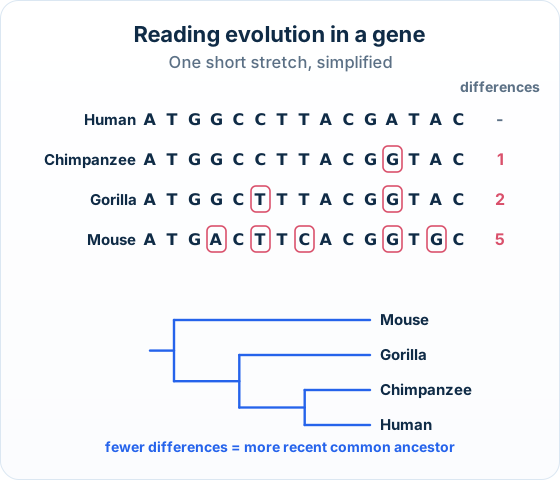
The big idea: Base sequences of DNA or RNA, and amino acid sequences of proteins, can be compared between species. The more similar the sequences, the more recent the common ancestor.
The points to remember
- Compare the same gene (or the same protein) in different living species.
- Shared sequences are evidence of common ancestry: they were inherited from one ancestor.
- Mutations build up gradually after two species split, so differences grow with time.
- More similar sequences mean closer relatives with a more recent common ancestor.
- Base sequences of DNA or RNA, or amino acid sequences of a protein, can all be used.
Remember it as: Fewer differences, closer cousins.
Real example: cytochrome c: Cytochrome c is a protein of respiration found in almost every organism. Its amino acid sequence is identical in humans and chimpanzees and differs in only one amino acid in the rhesus monkey.
Watch the wording in an answer:
Say 'base sequences', not just 'the code': The genetic code is the same in almost all life. The evidence is that the base sequences of genes are shared, and how similar they are.
Sequences inside chromosomes are evidence too. Humans have 46 chromosomes; chimpanzees, gorillas and orangutans have 48. The DNA sequences of human chromosome 2 show it formed when two ancestral chromosomes fused.
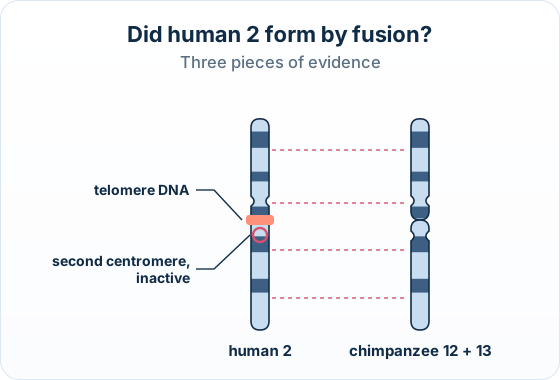
The evidence for fusion
- The bands and base sequences of human 2 match chimpanzee 12 and 13 end to end.
- Human 2 is about as long as the two chimpanzee chromosomes together.
- Telomere sequences, normally at the ends, sit in the middle of human 2: the fusion point.
- Human 2 has a second centromere sequence, no longer active.
Never wonder what to study next
Get a personalized daily plan based on your exam date, progress, and weak areas. We'll tell you exactly what to review each day.
How it is tested: Paper 1A: which evidence shows common ancestry. Paper 1B: justify a fusion from a drawing of chromosomes, one mark per piece of evidence.
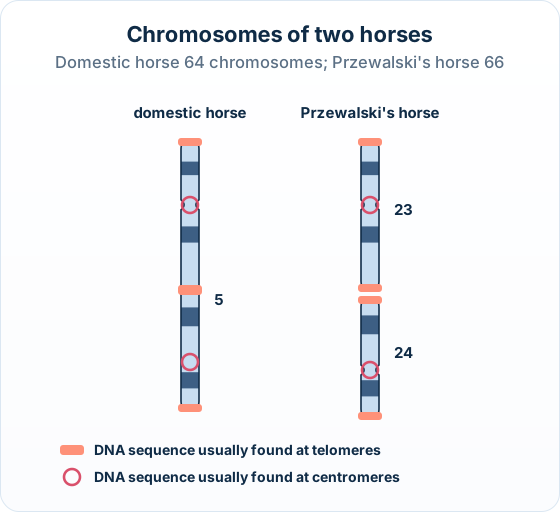
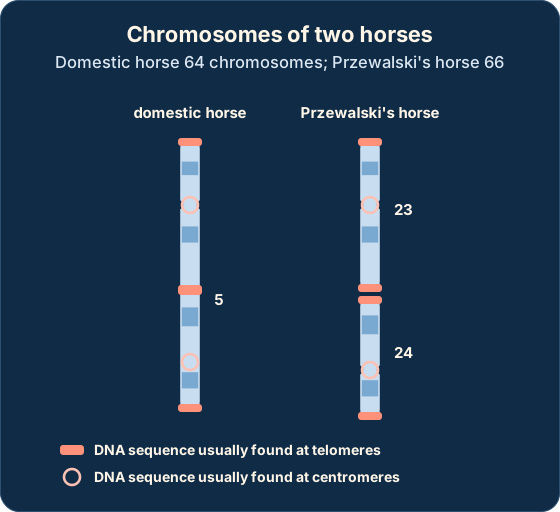
Domestic horses have 64 chromosomes and Przewalski's horses have 66. Using the diagram, justify the hypothesis that domestic horse chromosome 5 arose from the fusion of two chromosomes like Przewalski's horse 23 and 24.
Model answer plan
See the answer broken into clear points, with guidance on how each point earns marks.