To see how the first cell could form, picture the planet billions of years before there was any life. The conditions were very different from today, and those differences are exactly what made the spontaneous origin of cells possible.
| Condition | Early Earth (~3.5–4 bya) | Earth today |
|---|---|---|
| Free oxygen (O₂) | Essentially none — a reducing (anoxic) atmosphere | About 21% O₂ — an oxidising atmosphere |
| Ozone (O₃) layer | None — so intense UV reached the surface | Present — it shields the surface from most UV |
| Main gases | Volcanic gases: methane (CH₄), ammonia (NH₃), water vapour (H₂O), carbon dioxide (CO₂) | Mostly nitrogen (N₂) and oxygen (O₂) |
| Energy sources | Lightning, intense UV, volcanic and geothermal heat | Sunlight captured by photosynthesis |
| Temperature | Hot — frequent volcanism and impacts | Mild and far more stable |
| Liquid water | Present (oceans, hot pools) | Present |
| Living cells present? | No — life had not yet formed | Yes — life is everywhere |
Read each condition as a cause → effect:
| Condition | Effect |
|---|---|
| No free oxygen (a reducing/anoxic atmosphere) | Newly formed organic molecules were not destroyed by oxidation, so they could build up. |
| No ozone layer | Intense UV reached the surface, supplying energy to drive chemical reactions (and, alongside lightning, to power them). |
| Volcanic gases (CH₄, NH₃, H₂O, CO₂) | They provided the raw carbon, hydrogen, nitrogen and oxygen atoms needed to build organic monomers. |
| High temperatures + liquid water | Reactions ran quickly, and water acted as the solvent in which molecules met and combined. |
Biogenesis
- Life comes only from existing life (cells from pre-existing cells).
- This is what we observe today: a frog lays eggs, a bacterium divides.
Abiogenesis
- Life from non-living chemistry.
- This was needed for the very first cell, because back then there was no earlier life to copy from.
A one-off event: Abiogenesis was a unique, one-off event under early-Earth conditions, not something that happens now. Today's oxygen-rich, UV-shielded, life-filled world would destroy or out-compete any new organic molecules before a cell could form.
- Biogenesis
- Living cells arise only from pre-existing living cells. This is the rule that applies today.
- Abiogenesis
- Living matter arising from non-living chemistry. It was required for the first cell, under early-Earth conditions.
- Reducing (anoxic) atmosphere
- An atmosphere with essentially no free oxygen, so organic molecules are not broken down by oxidation.
Once the conditions are in place, the path from non-living chemistry to a first cell is usually summarised as four broad stages:
The four-stage overview (non-living → first cell)
- Organic monomers form — small carbon building blocks (e.g. amino acids, simple sugars, nucleotide bases) are made from the volcanic gases using lightning/UV energy.
- Polymers form — monomers join into larger chains (e.g. short polypeptides and nucleic-acid strands).
- Self-replicating molecules appear — a polymer that can copy itself (an early nucleic acid) lets information be passed on, so natural selection can begin.
- Membrane-bound protocells form — the molecules become enclosed by a membrane, creating a separate internal environment: the first cell-like compartments.
The thread running through all four stages: Each stage builds on the one before: simple monomers → larger polymers → a molecule that can copy itself → those molecules wrapped in a membrane.
The membrane is what finally turns a soup of chemicals into a cell — a separate inside and outside.
Free preview
This is the free notes preview
You're reading the free notes. Aimnova Pro unlocks the full study experience — and you can try it with your first topic free to keep:
- FlashcardsLock in vocabulary and key terms with spaced repetition.
- Practice questionsAnswer exam-style questions and get instant AI marking.
- Mock exams & past-paper vaultSit full mocks and see exactly how examiners award marks.
- Personalised study planA daily plan built around your exam date and weak areas.
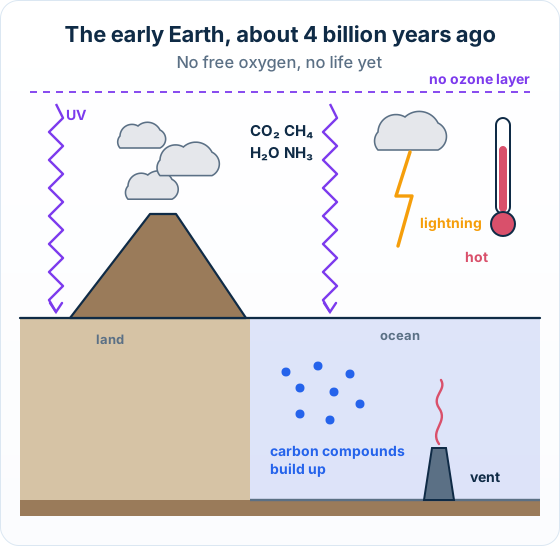
The big idea: Early Earth had the raw materials and the energy to make carbon compounds, and nothing to destroy them. Each condition links to the next.
The points to remember
- No free oxygen: a reducing atmosphere, so new carbon compounds were not broken down by oxidation.
- No oxygen means no ozone layer, so strong ultraviolet (UV) light reached the surface.
- Much more carbon dioxide and methane trapped heat, so temperatures were much higher.
- Energy came from UV, lightning and heat from volcanoes and hydrothermal vents on the sea floor.
- With energy and simple gases, many carbon compounds formed spontaneously, by chemistry that does not happen now.
Remember it as: No oxygen, no ozone, so UV gets in; lots of CO₂ and methane, so it is hot.
Say what each condition did: Write "higher concentrations of carbon dioxide and methane" and "higher temperatures", not just "different gases" or "hot". Each condition is a separate point, so name it clearly.
How do we know the early Earth already had water?
Real example: the oldest crystals: Tiny zircon crystals from the Jack Hills in Western Australia are about 4.4 billion years old. Their chemistry shows that liquid water already existed on Earth then.
Stop wasting time on topics you know
Our AI identifies your weak areas and focuses your study time where it matters. No more overstudying easy topics.
How this is tested: This HL topic is usually tested as a short Outline/Explain on Paper 2: how early-Earth conditions differed from today, and why those differences allowed the first cells to form.
What strong answers do
- Name specific conditions: no oxygen, no ozone/intense UV, volcanic gases, lightning, heat, water.
- Link each condition to an effect.
Other ways it is asked
- Distinguish biogenesis from abiogenesis (1-mark Define/Outline).
- State the order of the four stages.
IB-style question — early-Earth conditions and the origin of cells
Outline how conditions on early Earth differed from those today, and explain why these conditions favoured the spontaneous origin of the first cells. [4]
How to score all four marks
- No free oxygen (reducing/anoxic atmosphere). Unlike today's ~21% O₂, early Earth had essentially no free oxygen, so newly formed organic molecules were not destroyed by oxidation and could accumulate.
- No ozone layer → intense UV (plus lightning). With no ozone shield, strong UV reached the surface; this UV and lightning supplied the energy to drive the chemical reactions that built organic molecules.
- Volcanic gases supplied the raw materials. Gases such as CH₄, NH₃, H₂O and CO₂ provided the carbon, hydrogen, nitrogen and oxygen atoms needed to make organic monomers.
- Hot conditions + liquid water. High temperatures sped up reactions, and liquid water acted as the solvent in which molecules met and combined — together allowing abiogenesis, a one-off event impossible under today's conditions. (Award 1 mark per distinct point, max 4.)
Final answer
Early Earth had no free oxygen (reducing atmosphere) so organics weren't oxidised; no ozone so intense UV (with lightning) gave energy; volcanic gases (CH₄, NH₃, H₂O, CO₂) supplied raw atoms; and hot conditions with liquid water let the reactions run. These let life arise from non-living chemistry (abiogenesis) — a unique event that could not happen on today's Earth.
Why this scores full marks: It names specific conditions and pairs each with an effect (no O₂ → no oxidation; no ozone → UV energy; volcanic gases → raw atoms; heat + water → reactions run), and finishes with the key word abiogenesis.
A common way to lose marks: Listing conditions without saying why each one helped. An 'explain' question needs the effect, not only the fact.
The way it was asked in 2026: one long-answer part, four marks.
Outline the conditions on early Earth that led to the formation of a great variety of carbon compounds.
Model answer plan
See the answer broken into clear points, with guidance on how each point earns marks.