The big idea: The cell is the smallest unit of life that can sustain itself: it can take in materials, release energy, grow and reproduce on its own.
All life is cellular, but cells had a start
- Every living thing we know of is made of cells: bacteria are single cells, and a whale is trillions of them.
- There is no smaller free-living unit than the cell.
- Cells have not always existed. The very first cell had to form from non-living chemistry on the early Earth, roughly 3.5–4 billion years ago.
- That was a unique series of events that we do not see repeating today.
- Cell
- The smallest unit of life that can sustain itself — capable of metabolism, growth and reproduction on its own.
- Unit of life
- The idea that all living things are built from cells, and that the cell is the smallest thing that counts as alive.
- Origin of cells
- How the first living cells arose from non-living matter on the early Earth, a one-off event around 3.5–4 billion years ago.
Why 'self-sustaining' is the key word: A single organelle (such as a mitochondrion) or a virus is not the unit of life — neither can survive and reproduce on its own.
Only a whole cell has everything needed to keep itself going, so the cell is the smallest self-sustaining unit of life.
Free preview
This is the free notes preview
You're reading the free notes. Aimnova Pro unlocks the full study experience — and you can try it with your first topic free to keep:
- FlashcardsLock in vocabulary and key terms with spaced repetition.
- Practice questionsAnswer exam-style questions and get instant AI marking.
- Mock exams & past-paper vaultSit full mocks and see exactly how examiners award marks.
- Personalised study planA daily plan built around your exam date and weak areas.
Start Studying Free Full access to Aimnova Pro · cancel anytime
The big idea: Something is living only if it carries out all the functions of life itself. A cell can; a virus cannot.
The points to remember
- Living things carry out the functions of life: metabolism, growth, reproduction, response, homeostasis, nutrition and excretion.
- A cell does all of them on its own, so the cell is the smallest unit of self-sustaining life.
- A non-living thing may do one: a crystal grows, a flame uses oxygen. It never does all of them.
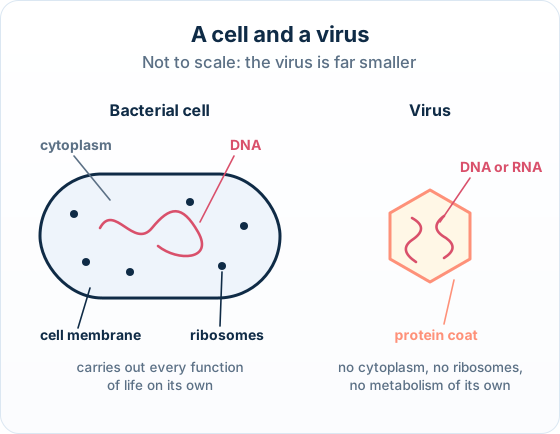
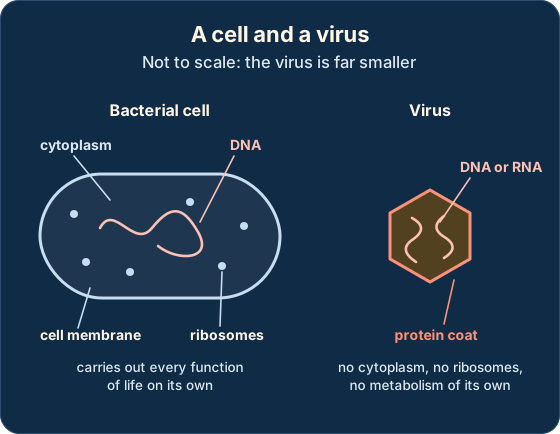
- A virus is not a cell: a protein coat around DNA or RNA, with no cytoplasm and no ribosomes.
- It has no metabolism of its own and is copied only inside a host cell, using the host's enzymes and ribosomes.
- Outside a host, a virus does nothing at all, so viruses are considered non-living.
Remember it as: Alive = does every function of life by itself.
Real example: a virus as crystals: In 1935 Wendell Stanley purified tobacco mosaic virus into needle-shaped crystals, as you can with salt. Put back on tobacco leaves, the crystals still infected the plants. No living cell can be crystallised and come back like that.
When you give reasons, keep to what the virus cannot do for itself.
Reasons that do not count: "Viruses are very small" and "viruses cause disease" are not reasons: some bacteria are tiny and many cause disease, and they are alive.
Know your predicted grade
Take timed mock exams and get detailed feedback on every answer. See exactly where you're losing marks.
Try Mock Exams FreeYour first topic is free to keep • No credit card required
How it could be asked: No paper has asked this yet. The likely shape is a short Paper 2 question: outline why viruses are considered non-living, or distinguish a cell from a virus.
IB-style questionOutline[3 marks]
Outline the reasons that viruses are considered to be non-living.
Model answer plan
See the answer broken into clear points, with guidance on how each point earns marks.