aımnova
DashboardMy LearningCrash CoursesStudy Plan

Aimnova site navigation

Stay in the loop

Get the latest study resources and updates

New features, study tips and exam insights — straight to your inbox.

IB Diploma

  • IB Past Papers
  • IB Study Notes
  • IB Question Bank
  • IB Mock Exams
  • IB Revision

IB Subjects

  • IB Math AA
  • IB Math AI
  • IB Economics
  • IB Business Management
  • IB Physics
  • IB Biology
  • View all IB subjects→

IB Past Papers

  • IB Math AA HL Past Papers
  • IB Math AA SL Past Papers
  • IB Math AI HL Past Papers
  • IB Math AI SL Past Papers
  • IB Economics HL Past Papers
  • IB Economics SL Past Papers
  • IB ESS Past Papers
  • View all past papers→

Study Resources

  • Study Notes
  • Question Bank
  • Mock Exams
  • Crash Courses
  • Flashcards
  • Revision Guide
  • Exam Skills
  • Command Terms
  • Grade Calculator
  • Exam Timetable 2026

Aimnova

  • Features
  • Pricing
  • For Teachers
  • For Schools
  • For Parents
  • About Us
  • Blog
  • Contact
aımnova

IB study, practice and feedback built around the real exam.

TermsPrivacyCookies·© 2026 Aimnova. All rights reserved.10c8990

Aimnova is not affiliated with or endorsed by the International Baccalaureate Organization (IB).

NotesBiology HLTopic 1.2Chargaff's data on the amounts of purine and pyrimidine bases
Back to Biology HL Topics
1.2.154 min read

Chargaff's data on the amounts of purine and pyrimidine bases (Biology HL)

IB Biology · Unit 1

Exam preparation

Practice the questions examiners actually ask

Our question bank mirrors real IB exam papers. Practice under timed conditions and track your progress across topics.

Start Practicing

Contents

  1. 1Chargaff's data
  2. 2Falsifying the tetranucleotide hypothesis
  3. 3Exam-style question (step by step)
The big idea: Chargaff measured the bases in DNA. They were not in equal amounts, but A always matched T and G matched C.

The points to remember

  • The tetranucleotide hypothesis (1910) said DNA has equal amounts of A, G, C and T, in a repeating sequence.
  • A short repeat of four bases could not carry much information, so DNA looked too simple to be the genetic material.
  • Around 1950 Chargaff measured the percentage of each base in DNA from many species.
  • The amounts were not equal, and they differed between species.
  • But in every species %A ≈ %T and %G ≈ %C, so purines ≈ pyrimidines (a ratio of about 1).
Remember it as: Chargaff's rule: A = T, G = C.
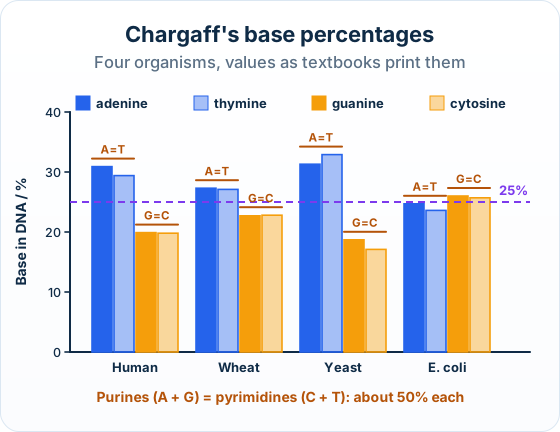
Bar chart of the percentage of adenine, thymine, guanine and cytosine in DNA from humans, wheat, yeast and E. coli, with a dashed line at 25 per cent and brackets showing adenine equal to thymine and guanine equal to cytosine
The amounts differ, but A matches T and G matches C.

Free preview

This is the free notes preview

You're reading the free notes. Aimnova Pro unlocks the full study experience — and you can try it with your first topic free to keep:

  • FlashcardsLock in vocabulary and key terms with spaced repetition.
  • Practice questionsAnswer exam-style questions and get instant AI marking.
  • Mock exams & past-paper vaultSit full mocks and see exactly how examiners award marks.
  • Personalised study planA daily plan built around your exam date and weak areas.
Start Studying Free Full access to Aimnova Pro · cancel anytime
The big idea: No number of agreeing results can prove a hypothesis, but one clear disagreeing result can disprove it. Chargaff's data did that to the tetranucleotide hypothesis.

The points to remember

  • Induction: however many results fit a hypothesis, they can never prove it; the next result might not fit.
  • Falsification: one clear result that contradicts a hypothesis is enough to reject it.
  • Chargaff's unequal amounts contradicted the tetranucleotide hypothesis, so it was falsified.
  • His A = T and G = C ratios were later explained by complementary base pairing in the double helix (1953).
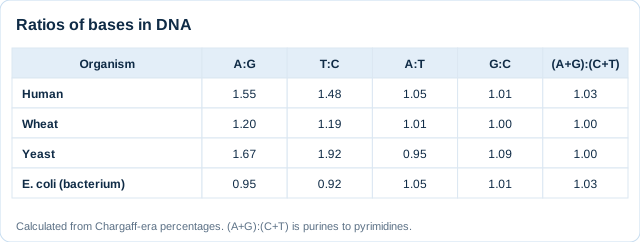
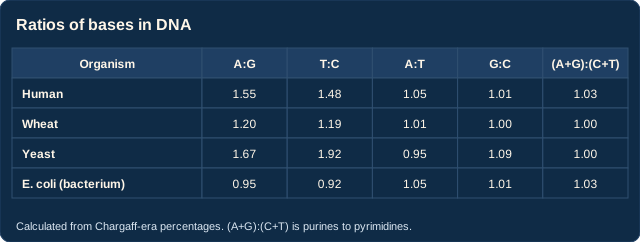
Table of base ratios for humans, wheat, yeast and E. coli: A to G and T to C far from 1 in most, A to T, G to C and purines to pyrimidines close to 1 in allTable of base ratios for humans, wheat, yeast and E. coli: A to G and T to C far from 1 in most, A to T, G to C and purines to pyrimidines close to 1 in all
A:G and T:C are not 1, so the bases are not equal. A:T, G:C and (A+G):(C+T) are close to 1 in all four.
Evaluating a hypothesis with data: Look at every row. Say whether the data support the hypothesis, then name any value that does not fit (an anomaly) and what might explain it, such as measurement error.

Memorize terms 3x faster

Smart flashcards show you cards right before you forget them. Perfect for definitions and key concepts.

Try Flashcards FreeYour first topic is free to keep • No credit card required
How it is asked: Paper 1A: fill in a missing percentage using A = T and G = C. Paper 1B: a table of ratios, then explain how it falsifies the tetranucleotide hypothesis, or evaluate a hypothesis about the ratios.
IB-style questionExplain[2 marks]

A table shows base ratios in DNA from several organisms. Explain how these results falsify the tetranucleotide hypothesis.

Model answer plan

See the answer broken into clear points, with guidance on how each point earns marks.

Claim your free topic

The one-mark evaluation that often follows:

IB-style questionEvaluate[1 mark]

Using the data, evaluate the hypothesis that the ratio of purines to pyrimidines in DNA is 1.00 in all organisms.

Model answer plan

See the answer broken into clear points, with guidance on how each point earns marks.

Claim your free topic

Try an IB Exam Question — Free AI Feedback

Test yourself on Chargaff's data on the amounts of purine and pyrimidine bases. Write your answer and get instant AI feedback — just like a real IB examiner.

Many early results seemed to fit the tetranucleotide hypothesis, yet a single set of results by Chargaff led to it being rejected.

why one set of results was enough to reject the hypothesis.
[2 marks]

Related Biology HL Topics

Continue learning with these related topics from the same unit:

1.1.1Water as the medium for life1.1.2Hydrogen bonds from the polar covalent bonds in water1.1.3Cohesion of water and its consequences for organisms1.1.4Adhesion of water to polar or charged materials
View all Biology HL topics
Improve your exam techniqueCommand terms, paper structure, and mark-scheme tips for Biology HL
Previous1.2.14Evidence from the Hershey–Chase experiment for DNA as the genetic materialNextConditions on early Earth and the pre-biotic formation of carbon compounds1.3.1

10 questions to test your understanding

Reading is just the start. Students who tested themselves scored 82% on average — try IB-style questions with AI feedback.

Start FreeView All Biology HL Topics