aımnova
DashboardMy LearningCrash CoursesStudy Plan

Aimnova site navigation

Stay in the loop

Get the latest study resources and updates

New features, study tips and exam insights — straight to your inbox.

IB Diploma

  • IB Past Papers
  • IB Study Notes
  • IB Question Bank
  • IB Mock Exams
  • IB Revision

IB Subjects

  • IB Math AA
  • IB Math AI
  • IB Economics
  • IB Business Management
  • IB Physics
  • IB Biology
  • View all IB subjects→

IB Past Papers

  • IB Math AA HL Past Papers
  • IB Math AA SL Past Papers
  • IB Math AI HL Past Papers
  • IB Math AI SL Past Papers
  • IB Economics HL Past Papers
  • IB Economics SL Past Papers
  • IB ESS Past Papers
  • View all past papers→

Study Resources

  • Study Notes
  • Question Bank
  • Mock Exams
  • Crash Courses
  • Flashcards
  • Revision Guide
  • Exam Skills
  • Command Terms
  • Grade Calculator
  • Exam Timetable 2026

Aimnova

  • Features
  • Pricing
  • For Teachers
  • For Schools
  • For Parents
  • About Us
  • Blog
  • Contact
aımnova

IB study, practice and feedback built around the real exam.

TermsPrivacyCookies·© 2026 Aimnova. All rights reserved.afd6316

Aimnova is not affiliated with or endorsed by the International Baccalaureate Organization (IB).

NotesPsychologyTopic 3.4Biological factors in cognitive processes
Back to Psychology Topics
3.4.62 min read

Biological factors in cognitive processes

IB Psychology · Unit 3

IB exam ready

Study like the top scorers do

Access a smart study planner, AI tutor, and exam vault — everything you need to hit your target grade.

Start Free

Contents

  1. 1Emotion and memory
  2. 2How strong is the evidence?
Key idea: Emotion is a biological factor in memory: stress hormones help store emotional events, which feel vivid.

Emotion and memory

1

Emotional event

Stress hormones such as adrenaline are released.

2

Amygdala

A brain area for emotion signals the hippocampus to strengthen storage.

3

Result

Emotional events are often remembered more vividly, though not always more accurately.

Arouse · Amygdala · Store

Talarico and Rubin (2003) asked students to record how they heard about the 11 September attacks, and an everyday memory. Both became less accurate at the same rate, but the shocking memory stayed vivid.
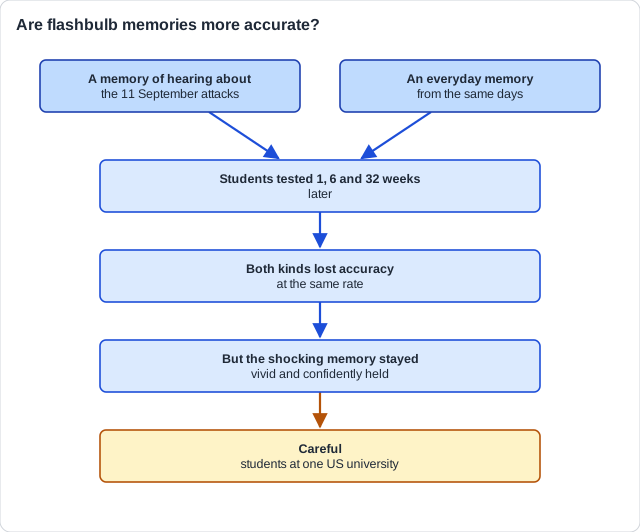
Students recorded a memory of hearing about the 11 September attacks and an everyday memory, were tested 1, 6 or 32 weeks later; both lost accuracy at the same rate but the shocking memory stayed vivid and confidently held; a caution box notes one university.
Follow a study of flashbulb memories.
Go further: higher-level insight: Confidence in a vivid memory is not proof that it is correct. That point links emotion to the reliability of memory.

Free preview

This is the free notes preview

You're reading the free notes. Aimnova Pro unlocks the full study experience — and you can try it with your first topic free to keep:

  • FlashcardsLock in vocabulary and key terms with spaced repetition.
  • Practice questionsAnswer exam-style questions and get instant AI marking.
  • Mock exams & past-paper vaultSit full mocks and see exactly how examiners award marks.
  • Personalised study planA daily plan built around your exam date and weak areas.
Start Studying Free Full access to Aimnova Pro · cancel anytime
Key idea: Emotion clearly changes how memories feel, and stress hormones help store them; whether it makes them more accurate is less clear.

Strengths

  • Biological mechanism tested
  • Explains vivid emotional memories
  • Real events studied

Limitations

  • Vivid is not accurate
  • Lab stories are mild emotions
  • Drug studies raise ethical issues

The best-supported claim is that emotion raises vividness and confidence more than accuracy.

Watch out: Vivid is not accurate. Separate how a memory feels from whether it is correct.

IB Exam Questions on Biological factors in cognitive processes

Practice with IB-style questions filtered to Topic 3.4.6. Get instant AI feedback on every answer.

Practice Topic 3.4.6 QuestionsBrowse All Psychology Topics

How Biological factors in cognitive processes Appears in IB Exams

Examiners use specific command terms when asking about this topic. Here's what to expect:

  • Define

    Give the precise meaning of key terms related to Biological factors in cognitive processes.

    AO1
  • Describe

    Give a detailed account of processes or features in Biological factors in cognitive processes.

    AO2
  • Explain

    Give reasons WHY — cause and effect within Biological factors in cognitive processes.

    AO3
  • Evaluate

    Weigh strengths AND limitations of approaches in Biological factors in cognitive processes.

    AO3
  • Discuss

    Present arguments FOR and AGAINST with a balanced conclusion.

    AO3

See the full IB Command Terms guide

Related Psychology Topics

Continue learning with these related topics from the same unit:

3.1.1Biological explanations of a mental health disorder3.1.2Cognitive models of a mental health disorder3.1.3Cultural differences in mental health3.1.4Environmental factors in mental health disorders
View all Psychology topics
Improve your exam techniqueCommand terms, paper structure, and mark-scheme tips for Psychology
Previous3.4.5Social learning theory in learningNextCognitive models of a cognitive process3.4.7

9 practice questions on Biological factors in cognitive processes

Students who practiced this topic on Aimnova scored 82% on average. Try free practice questions and get instant AI feedback.

Try 3 Free QuestionsView All Psychology Topics