Key idea: Environmental factors are things that happen to a person, such as a loss, poverty or abuse. They help explain why depression starts when it does.
Environmental factors
Severe life events
Losing a partner, a job or a home: a sudden loss or humiliation.
Long-term strain
Poverty, debt, caring for an ill relative, an unsafe neighbourhood.
Childhood adversity
Abuse, neglect or a chaotic home early in life raises later risk.
Little support
No one to confide in makes every other factor harder to bear.
Events · Strain · Childhood · Support
Brown and Harris (1978) interviewed 458 women in Camberwell, south London, about their lives and their mental health. This is an environmental factor explanation.
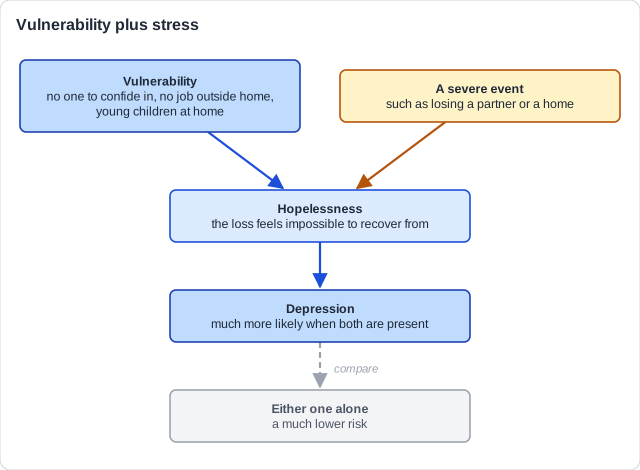
Go further: higher-level insight: Environmental factors fit the diathesis-stress model: the life event is the stress, and a vulnerability (genes, thinking style, no support) decides whether it becomes depression.
Free preview
This is the free notes preview
You're reading the free notes. Aimnova Pro unlocks the full study experience — and you can try it with your first topic free to keep:
- FlashcardsLock in vocabulary and key terms with spaced repetition.
- Practice questionsAnswer exam-style questions and get instant AI marking.
- Mock exams & past-paper vaultSit full mocks and see exactly how examiners award marks.
- Personalised study planA daily plan built around your exam date and weak areas.
Key idea: Life events come before many depressions, but the studies that show this have limits.
Strengths
- Women interviewed in their own community
- Shows a pattern: events plus vulnerability
- Points to prevention: support after a loss
Limitations
- Interviews rely on memory of past events
- Correlational: events cannot be assigned
- One area of London in the 1970s, women only
Causality can run both ways: depression can cause life events, such as losing a job or a partner. Studies that date the event before the first symptoms give the strongest evidence.
Watch out: Not everyone who faces a loss becomes depressed. Say what made the difference: vulnerability and support.