aımnova
DashboardMy LearningCrash CoursesStudy Plan

Aimnova site navigation

Stay in the loop

Get the latest study resources and updates

New features, study tips and exam insights — straight to your inbox.

IB Diploma

  • IB Past Papers
  • IB Study Notes
  • IB Question Bank
  • IB Mock Exams
  • IB Revision

IB Subjects

  • IB Math AA
  • IB Math AI
  • IB Economics
  • IB Business Management
  • IB Physics
  • IB Biology
  • View all IB subjects→

IB Past Papers

  • IB Math AA HL Past Papers
  • IB Math AA SL Past Papers
  • IB Math AI HL Past Papers
  • IB Math AI SL Past Papers
  • IB Economics HL Past Papers
  • IB Economics SL Past Papers
  • IB ESS Past Papers
  • View all past papers→

Study Resources

  • Study Notes
  • Question Bank
  • Mock Exams
  • Crash Courses
  • Flashcards
  • Revision Guide
  • Exam Skills
  • Command Terms
  • Grade Calculator
  • Exam Timetable 2026

Aimnova

  • Features
  • Pricing
  • For Teachers
  • For Schools
  • For Parents
  • About Us
  • Blog
  • Contact
aımnova

IB study, practice and feedback built around the real exam.

TermsPrivacyCookies·© 2026 Aimnova. All rights reserved.afd6316

Aimnova is not affiliated with or endorsed by the International Baccalaureate Organization (IB).

NotesPsychologyTopic 3.4Social learning theory in learning
Back to Psychology Topics
3.4.52 min read

Social learning theory in learning

IB Psychology · Unit 3

Your first topic is free to keep

Know exactly what to write for full marks

Practice with exam questions and get AI feedback that shows you the perfect answer — what examiners want to see.

Start Free

Contents

  1. 1Learning by watching others
  2. 2How strong is social learning theory?
Key idea: Social learning theory says we learn by watching others and copying them, especially when they are rewarded.

Learning by watching

1

Attention

We notice a model, especially one who is similar, liked or powerful.

2

Retention

We remember what the model did.

3

Reproduction

We are able to copy the behaviour.

4

Motivation

We copy it if we expect a reward, for example after seeing the model rewarded.

Attend · Retain · Reproduce · Motivate

Bandura, Grusec and Menlove (1967) showed young children who were afraid of dogs a peer playing happily with a dog. They became more willing to approach a dog, and still were a month later.
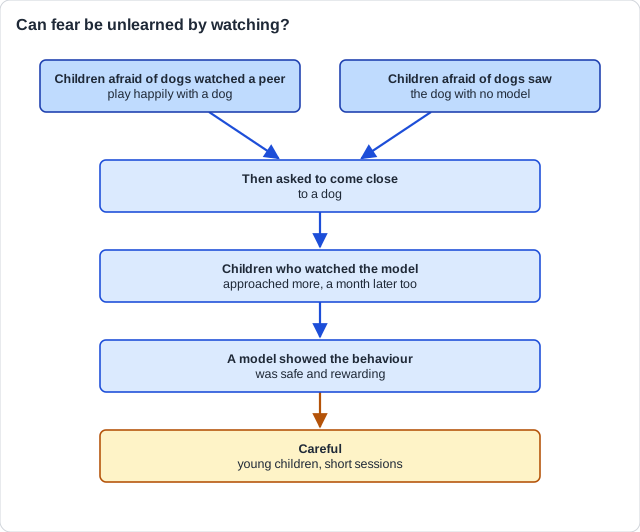
Young children afraid of dogs either watched a peer play happily with a dog or saw the dog with no model; children who watched the model approached dogs more, and a month later too; a caution box notes young children and short sessions.
Follow a study that used a model to change behaviour.
Go further: higher-level insight: Watching can change behaviour without any reward to the learner. That is what conditioning alone cannot explain.

Free preview

This is the free notes preview

You're reading the free notes. Aimnova Pro unlocks the full study experience — and you can try it with your first topic free to keep:

  • FlashcardsLock in vocabulary and key terms with spaced repetition.
  • Practice questionsAnswer exam-style questions and get instant AI marking.
  • Mock exams & past-paper vaultSit full mocks and see exactly how examiners award marks.
  • Personalised study planA daily plan built around your exam date and weak areas.
Start Studying Free Full access to Aimnova Pro · cancel anytime
Key idea: Social learning theory explains learning without direct reward, and modelling is used to change behaviour; real-world effects are harder to show.

Strengths

  • Learning without direct reward
  • Used to change behaviour
  • Explains media influence

Limitations

  • Hard to separate from other causes
  • Why some copy and others do not
  • Short lab sessions

Social learning works alongside conditioning: watching shows what to do, consequences decide whether it is kept.

Watch out: Name the four processes. Say which ones the study shows.

IB Exam Questions on Social learning theory in learning

Practice with IB-style questions filtered to Topic 3.4.5. Get instant AI feedback on every answer.

Practice Topic 3.4.5 QuestionsBrowse All Psychology Topics

How Social learning theory in learning Appears in IB Exams

Examiners use specific command terms when asking about this topic. Here's what to expect:

  • Define

    Give the precise meaning of key terms related to Social learning theory in learning.

    AO1
  • Describe

    Give a detailed account of processes or features in Social learning theory in learning.

    AO2
  • Explain

    Give reasons WHY — cause and effect within Social learning theory in learning.

    AO3
  • Evaluate

    Weigh strengths AND limitations of approaches in Social learning theory in learning.

    AO3
  • Discuss

    Present arguments FOR and AGAINST with a balanced conclusion.

    AO3

See the full IB Command Terms guide

Related Psychology Topics

Continue learning with these related topics from the same unit:

3.1.1Biological explanations of a mental health disorder3.1.2Cognitive models of a mental health disorder3.1.3Cultural differences in mental health3.1.4Environmental factors in mental health disorders
View all Psychology topics
Improve your exam techniqueCommand terms, paper structure, and mark-scheme tips for Psychology
Previous3.4.4Schema theory in behaviour and cognitionNextBiological factors in cognitive processes3.4.6

3 exam-style questions ready for you

Students who practice on Aimnova improve their scores by 15% on average. Get instant feedback that shows exactly how to improve your answers.

Practice Now — FreeView All Psychology Topics