In one line: A mental health disorder can be explained biologically, cognitively and socioculturally, and a full picture usually needs all three.
In the health and well-being context, a key area of study is explaining a mental health disorder. We use depression as the running example, and obesity as the health problem.
This is the concept of perspective: the same disorder looks different through each approach's lens, and no single explanation is the whole story. Learn one study for each explanation: exam answers need them.
Remember: Body, mind, world. One disorder, three explanations that complement each other.
Free preview
This is the free notes preview
You're reading the free notes. Aimnova Pro unlocks the full study experience — and you can try it with your first topic free to keep:
- FlashcardsLock in vocabulary and key terms with spaced repetition.
- Practice questionsAnswer exam-style questions and get instant AI marking.
- Mock exams & past-paper vaultSit full mocks and see exactly how examiners award marks.
- Personalised study planA daily plan built around your exam date and weak areas.
Key idea: Each approach points to a different cause: chemistry, thinking, and social circumstances.
Explaining depression
Biological
Differences in neurotransmitter signalling (such as serotonin) and genetic vulnerability.
Cognitive
Negative thinking patterns: events are read pessimistically and dwelt on, deepening low mood.
Sociocultural
Social factors: isolation, loss, poverty, discrimination, and stigma that discourages help-seeking.
Biology · Thinking · Society
Take one person's depression. Biological: a genetic vulnerability plus low serotonin signalling. Cognitive: they read setbacks as 'my fault, always'. Sociocultural: recent isolation and job loss. The three combine, so causality is an interaction, not one cause.
Go further: higher-level insight: The diathesis-stress model links them: a vulnerability (biological, cognitive or social) only becomes depression when stress arrives.
Never wonder what to study next
Get a personalized daily plan based on your exam date, progress, and weak areas. We'll tell you exactly what to review each day.
Key idea: The biological explanation says some people inherit a higher risk of depression, and that brain chemistry, such as serotonin, is involved.
The biological explanation
Genes
Depression runs in families. Twin studies put roughly a third of the differences in risk down to genes.
Serotonin
Low serotonin signalling between neurons is linked to low mood. Drugs that keep more serotonin in the synapse help some people.
Stress hormones
In many people with depression the stress system stays switched on, with high cortisol for long periods.
Genes · Chemistry · Stress hormones
Sullivan, Neale and Kendler (2000) combined the results of twin studies of major depression. About 37% of the differences between people in their risk was linked to genes: genes add risk, but most of the risk lies elsewhere.
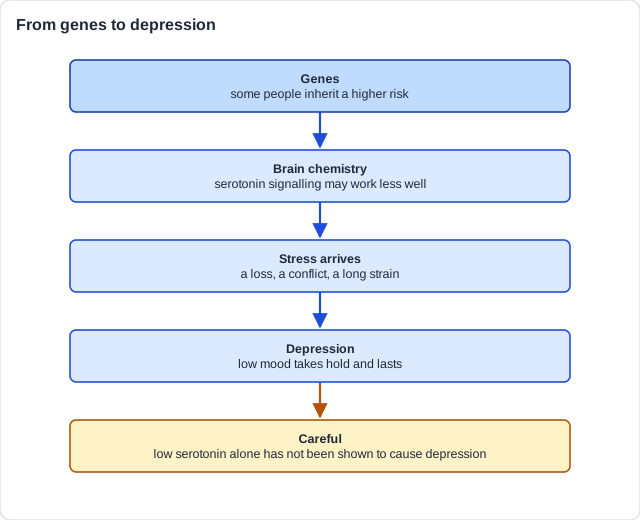
What the serotonin evidence shows: Moncrieff and colleagues (2022) reviewed the research and found no consistent evidence that low serotonin on its own causes depression. Serotonin may still play a part, but as one piece of a wider picture.
Key idea: Each explanation has support and limits; the strongest position integrates them.
Strengths
- Biological: explains why medication can help; genetic evidence
- Cognitive: explains why therapy (challenging thoughts) works
- Sociocultural: explains social patterns and stigma, as with Brown and Harris
Limitations
- Biological: reductionist; often correlation, not cause
- Cognitive: is negative thinking a cause or a symptom?
- Sociocultural: hard to isolate social causes; varies by culture
So each approach explains part of depression and each has a limitation. A strong evaluation uses the biopsychosocial view, arguing that biological, cognitive and social factors interact, which also explains why combined treatment (medication, therapy, social support) often works best.
Watch out: Do not over-claim one cause. 'Depression is just a chemical imbalance' is reductionist. The evidence points to interacting causes.