Key idea: Memory doesn't replay the past like a video — it rebuilds it, which is why it can be confidently wrong.
In the learning and cognition context, memory is a core cognitive process, and understanding it means seeing that it is reconstructive, not a perfect recording. This links to the concepts of measurement (models make memory testable) and bias (schemas distort what we recall).
Remember: Rebuild, don't replay. Memory is reconstructed, so it can be distorted.
Free preview
This is the free notes preview
You're reading the free notes. Aimnova Pro unlocks the full study experience — and you can try it with your first topic free to keep:
- FlashcardsLock in vocabulary and key terms with spaced repetition.
- Practice questionsAnswer exam-style questions and get instant AI marking.
- Mock exams & past-paper vaultSit full mocks and see exactly how examiners award marks.
- Personalised study planA daily plan built around your exam date and weak areas.
Key idea: Models describe memory's structure; schemas explain why recall is distorted.
Memory at a glance
The multi-store model
Memory as sensory, short-term and long-term stores, linked by attention and rehearsal — a testable cognitive model.
Reconstruction
Recall rebuilds an event using existing knowledge, so gaps get filled and details shift.
Schema distortion
Schemas make us add expected details and drop inconsistent ones — a source of memory bias.
Stores · Rehearsal · Schemas
Take an eyewitness to a robbery. The multi-store model describes how they encoded and stored the event; but at recall, their schema of 'a robbery' fills gaps — they may confidently 'remember' a weapon that wasn't there. Memory is reconstructive, so it is vulnerable to bias. This is why measuring memory carefully matters.
Go further — higher-level insight: Reconstruction explains why confidence isn't accuracy. A witness can feel certain yet be wrong, because the schema-filled memory feels just as vivid as a true one. This has huge real-world importance for eyewitness testimony — a strong applied point.
Study smarter, not longer
Most students waste 40% of study time on topics they already know. Our AI tracks your progress and optimizes every minute.
Key idea: A cognitive model is useful if it can be tested. The multi-store model predicts that short-term and long-term memory work differently.
Baddeley (1966) gave people word lists that sounded alike, meant the same, or neither. Sound-alike lists were hardest to recall at once; same-meaning lists were hardest after 20 minutes.
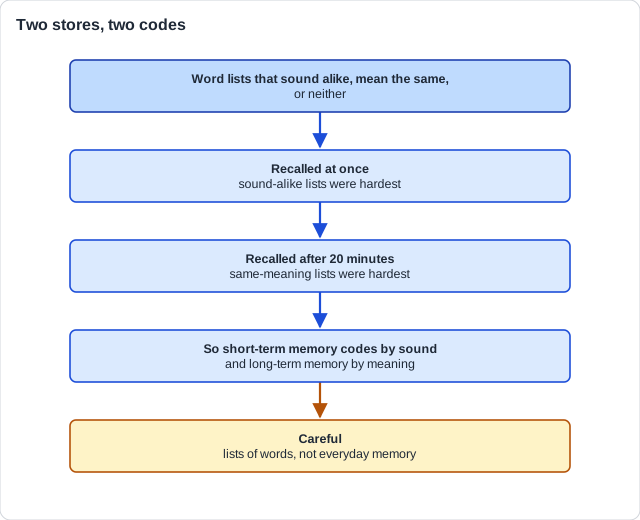
Go further: higher-level insight: A model earns its value by making predictions that can fail. Say what the model predicted and whether the study confirmed it.
Key idea: Memory research is well-evidenced and applicable but relies on models and lab tasks.
Strengths and limitations
| Strengths and limitations | Strengths | Limitations |
|---|---|---|
| Models | Make invisible memory testable and predictable | Models oversimplify (memory is more than boxes) |
| Reconstruction | Strong evidence for schema-driven errors | Schemas hard to measure directly |
| Application | Explains eyewitness errors; improves justice | Lab word-list tasks may lack ecological validity |
So memory research offers a powerful, testable account and has real-world value (e.g. for eyewitness testimony), but a good evaluation notes models simplify, schemas are hard to measure directly, and some lab tasks are artificial. The reconstructive nature of memory is well-supported and practically important.
Watch out: Vivid ≠ accurate. A detailed, confident memory can still be a reconstruction. Never treat certainty as proof of accuracy.