aımnova
DashboardMy LearningCrash CoursesStudy Plan

Aimnova site navigation

Stay in the loop

Get the latest study resources and updates

New features, study tips and exam insights — straight to your inbox.

IB Diploma

  • IB Past Papers
  • IB Study Notes
  • IB Question Bank
  • IB Mock Exams
  • IB Revision

IB Subjects

  • IB Math AA
  • IB Math AI
  • IB Economics
  • IB Business Management
  • IB Physics
  • IB Biology
  • View all IB subjects→

IB Past Papers

  • IB Math AA HL Past Papers
  • IB Math AA SL Past Papers
  • IB Math AI HL Past Papers
  • IB Math AI SL Past Papers
  • IB Economics HL Past Papers
  • IB Economics SL Past Papers
  • IB ESS Past Papers
  • View all past papers→

Study Resources

  • Study Notes
  • Question Bank
  • Mock Exams
  • Crash Courses
  • Flashcards
  • Revision Guide
  • Exam Skills
  • Command Terms
  • Grade Calculator
  • Exam Timetable 2026

Aimnova

  • Features
  • Pricing
  • For Teachers
  • For Schools
  • For Parents
  • About Us
  • Blog
  • Contact
aımnova

IB study, practice and feedback built around the real exam.

TermsPrivacyCookies·© 2026 Aimnova. All rights reserved.afd6316

Aimnova is not affiliated with or endorsed by the International Baccalaureate Organization (IB).

NotesPsychologyTopic 3.4Dual processing theory
Back to Psychology Topics
3.4.33 min read

Dual processing theory

IB Psychology · Unit 3

Your first topic is free to keep

Know exactly what to write for full marks

Practice with exam questions and get AI feedback that shows you the perfect answer — what examiners want to see.

Start Free

Contents

  1. 1How we decide
  2. 2Testing the two systems
  3. 3Evaluating the research
Key idea: Most of our decisions are made by fast, automatic thinking — efficient, but open to predictable errors.

In the learning and cognition context, a central idea is dual processing: the mind uses fast, automatic System 1 and slow, effortful System 2. This links to the concept of bias: System 1's shortcuts are usually helpful but produce systematic errors, such as anchoring and confirmation bias.

Remember: Fast gut, slow check. Decision-making mixes quick intuition with slow reasoning.

Free preview

This is the free notes preview

You're reading the free notes. Aimnova Pro unlocks the full study experience — and you can try it with your first topic free to keep:

  • FlashcardsLock in vocabulary and key terms with spaced repetition.
  • Practice questionsAnswer exam-style questions and get instant AI marking.
  • Mock exams & past-paper vaultSit full mocks and see exactly how examiners award marks.
  • Personalised study planA daily plan built around your exam date and weak areas.
Start Studying Free Full access to Aimnova Pro · cancel anytime
Key idea: Some puzzles make System 1 jump to a wrong answer. Whether System 2 catches it shows the two systems at work.

Frederick (2005) gave students the bat-and-ball problem. About half of students at highly selective universities gave the fast wrong answer.
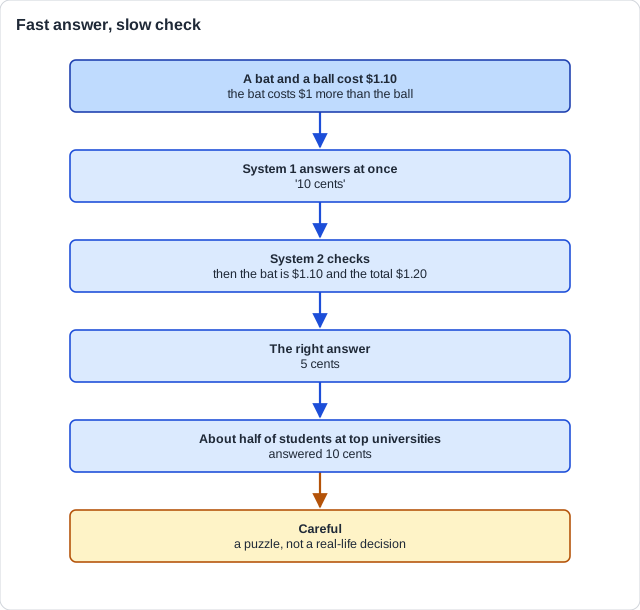
A bat and ball cost $1.10 and the bat costs $1 more; System 1 answers 10 cents; System 2 checks and finds the total would be $1.20; the right answer is 5 cents; about half of students at top universities answered 10 cents; a caution box notes a puzzle.
Follow the bat-and-ball problem step by step.
Go further: higher-level insight: Dual processing theory is taught in 2.2.5. Here the guide asks about its value for understanding thinking and decisions in learning and cognition.

Stop wasting time on topics you know

Our AI identifies your weak areas and focuses your study time where it matters. No more overstudying easy topics.

Try Smart Study FreeYour first topic is free to keep • No credit card required
Key idea: Dual processing is influential and applicable but the 'two systems' may be a simplification.

Strengths and limitations

Strengths and limitationsStrengthsLimitations
ExplainsA huge range of biases and quick judgementsThe 'two systems' may be a metaphor, not real parts
EvidenceSupported by reasoning and reaction-time studiesSome tasks are artificial; hard to isolate a 'system'
ApplicationImproves decisions; warns against snap judgementsBias varies by person and context

So dual processing is a powerful, well-supported framework for understanding decision-making and bias, with real practical value (e.g. slowing down for important decisions). A good evaluation notes the two 'systems' are better seen as modes than literal parts, and that bias strength varies.

Watch out: System 1 isn't 'bad'. It's fast and usually right. The skill — and the exam point — is knowing when to slow down and let System 2 check.

IB Exam Questions on Dual processing theory

Practice with IB-style questions filtered to Topic 3.4.3. Get instant AI feedback on every answer.

Practice Topic 3.4.3 QuestionsBrowse All Psychology Topics

How Dual processing theory Appears in IB Exams

Examiners use specific command terms when asking about this topic. Here's what to expect:

  • Define

    Give the precise meaning of key terms related to Dual processing theory.

    AO1
  • Describe

    Give a detailed account of processes or features in Dual processing theory.

    AO2
  • Explain

    Give reasons WHY — cause and effect within Dual processing theory.

    AO3
  • Evaluate

    Weigh strengths AND limitations of approaches in Dual processing theory.

    AO3
  • Discuss

    Present arguments FOR and AGAINST with a balanced conclusion.

    AO3

See the full IB Command Terms guide

Related Psychology Topics

Continue learning with these related topics from the same unit:

3.1.1Biological explanations of a mental health disorder3.1.2Cognitive models of a mental health disorder3.1.3Cultural differences in mental health3.1.4Environmental factors in mental health disorders
View all Psychology topics
Improve your exam techniqueCommand terms, paper structure, and mark-scheme tips for Psychology
Previous3.4.2Conditioning as a way of learningNextSchema theory in behaviour and cognition3.4.4

6 questions to test your understanding

Reading is just the start. Students who tested themselves scored 82% on average — try IB-style questions with AI feedback.

Start FreeView All Psychology Topics