Key idea: Conditioning is a simple form of learning. Classical conditioning pairs signals; operant conditioning uses consequences, and can be used to change behaviour.
Two kinds of conditioning
Classical conditioning
Learning by pairing: a neutral signal comes to trigger a response, such as feeling anxious at the sound of the dentist's drill.
Operant conditioning
Learning by consequences: behaviour that is reinforced is repeated, behaviour that is punished or ignored fades.
Applying it
Change the consequences, such as praise, tokens or attention, and behaviour changes.
Pair · Consequence
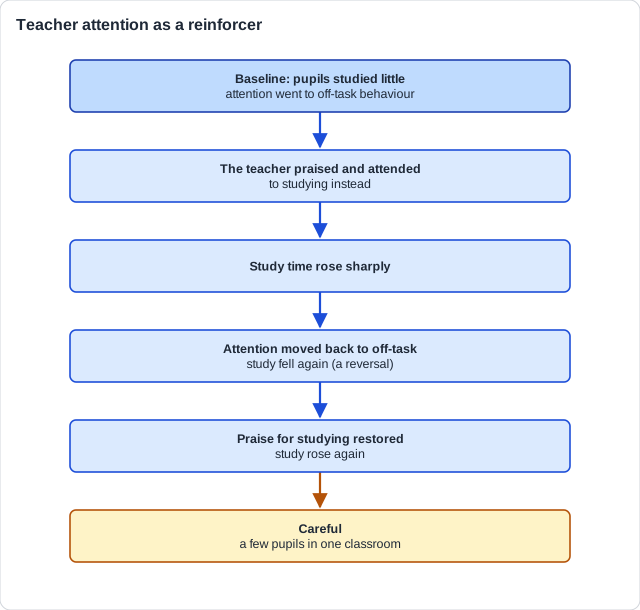
Hall, Lund and Jackson (1968) watched pupils who studied little while their teacher mostly attended to off-task behaviour. When the teacher praised studying instead, study time rose; when attention moved back, it fell.
Go further: higher-level insight: Classical and operant conditioning are taught in 2.2.2 and 2.2.3. Here the guide asks for examples of learning, and for operant conditioning applied to change behaviour.
Free preview
This is the free notes preview
You're reading the free notes. Aimnova Pro unlocks the full study experience — and you can try it with your first topic free to keep:
- FlashcardsLock in vocabulary and key terms with spaced repetition.
- Practice questionsAnswer exam-style questions and get instant AI marking.
- Mock exams & past-paper vaultSit full mocks and see exactly how examiners award marks.
- Personalised study planA daily plan built around your exam date and weak areas.
Key idea: Changing consequences changes behaviour, with strong evidence of cause; lasting change and motivation are the questions.
Strengths
- Reversal design shows cause
- Simple, cheap, widely used
- Same principle in token economies
Limitations
- A few pupils
- May fade when rewards stop
- Ignores thinking and interest
Rewarding an activity that is already enjoyable can reduce interest in it, so rewards need care.
Watch out: Name the consequence. Say what was reinforced, how, and what happened when it stopped.