Key idea: System 1 shortcuts make thinking efficient but produce predictable biases.
Thinking and its errors
System 1 (fast)
Automatic, effortless, intuitive — handles most decisions quickly using shortcuts (heuristics).
System 2 (slow)
Deliberate, effortful reasoning — can check and override System 1, but tires easily and is often not engaged.
Predictable biases
Shortcuts cause errors like anchoring (over-weighting the first number) and confirmation bias (favouring what fits our beliefs).
Fast · Slow · Biased
Take buying a phone. System 1 anchors on the first 'was £900' price, so £600 feels cheap; confirmation bias makes you notice only reviews that praise it. Only System 2, if engaged, checks the actual value. Decision-making is often not fully rational — a clear case of bias.
Go further — higher-level insight: Bias is efficiency backfiring, not stupidity. System 1's shortcuts are usually adaptive and fast; they only mislead in situations designed to trip them up. Framing bias this way — as the cost of an efficient system — is a high-level evaluative point.
Free preview
This is the free notes preview
You're reading the free notes. Aimnova Pro unlocks the full study experience — and you can try it with your first topic free to keep:
- FlashcardsLock in vocabulary and key terms with spaced repetition.
- Practice questionsAnswer exam-style questions and get instant AI marking.
- Mock exams & past-paper vaultSit full mocks and see exactly how examiners award marks.
- Personalised study planA daily plan built around your exam date and weak areas.
Key idea: Cognitive biases affect real decisions, even by experts who think they are not affected.
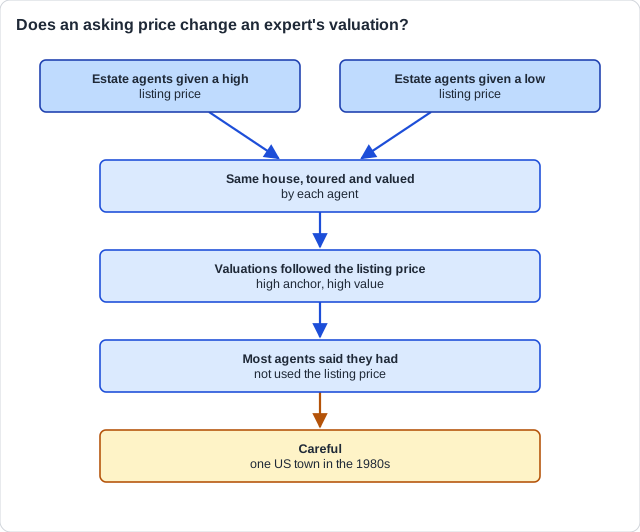
Northcraft and Neale (1987) gave estate agents the same house to value, with either a high or a low listing price. Their valuations followed the listing price, yet most said they had not used it.
Two biases in decisions
Anchoring bias
A first number pulls later estimates towards it, even when it is irrelevant.
Confirmation bias
We look for and favour information that fits what we already believe.
Anchor · Confirm
Go further: higher-level insight: Anchoring and confirmation bias are taught in 2.2.6 and 2.2.7. Here the guide asks about their role in decision-making: who is affected, when, and how it can be reduced.