Key idea: If how couples argue predicts breakup, teaching them to argue differently should help. That is the idea behind couples' programmes.
What couples learn
1
Speaker and listener
One talks about one problem; the other repeats it back before answering.
2
Soft start
Begin with 'I feel' rather than an attack on the partner.
3
Time out
Take a break when anger rises, and agree to come back.
4
Repair
Small gestures after conflict: a joke, an apology, a touch.
Speak · Listen · Pause · Repair
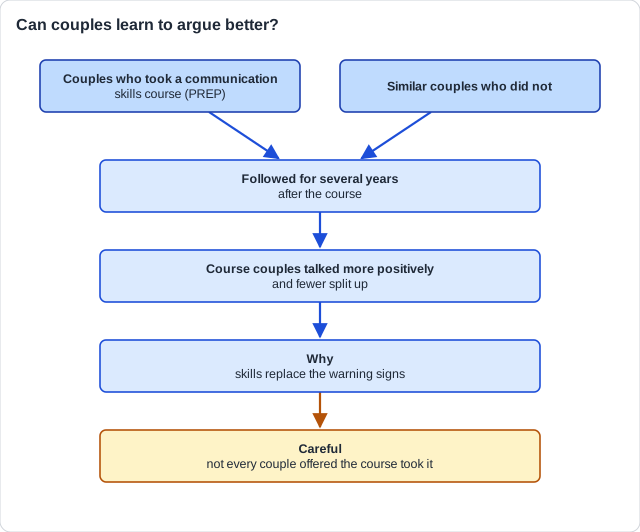
A strategy for improving relationships: Couples' programmes teach communication skills: speaking about one problem at a time, listening and repeating back, and taking breaks when angry. They aim to replace the four warning signs.
Markman and colleagues (1993) followed couples who took a communication skills programme (PREP) and similar couples who did not. Years later, the course couples talked more positively and fewer had split up.
Free preview
This is the free notes preview
You're reading the free notes. Aimnova Pro unlocks the full study experience — and you can try it with your first topic free to keep:
- FlashcardsLock in vocabulary and key terms with spaced repetition.
- Practice questionsAnswer exam-style questions and get instant AI marking.
- Mock exams & past-paper vaultSit full mocks and see exactly how examiners award marks.
- Personalised study planA daily plan built around your exam date and weak areas.
Start Studying Free Full access to Aimnova Pro · cancel anytime
Key idea: Skills training has good evidence for motivated couples; who takes part matters.
Strengths
- Targets behaviours linked to breakup
- Practical and teachable early
- Followed for years
Limitations
- Couples chose to take part
- Effects may fade
- Built on US couples
A strategy can also change thinking (blaming attributions) or circumstances (stress), not only talk.
Watch out: Self-selection. Couples who choose a course may already be more committed.