aımnova
DashboardMy LearningCrash CoursesStudy Plan

Aimnova site navigation

Stay in the loop

Get the latest study resources and updates

New features, study tips and exam insights — straight to your inbox.

IB Diploma

  • IB Past Papers
  • IB Study Notes
  • IB Question Bank
  • IB Mock Exams
  • IB Revision

IB Subjects

  • IB Math AA
  • IB Math AI
  • IB Economics
  • IB Business Management
  • IB Physics
  • IB Biology
  • View all IB subjects→

IB Past Papers

  • IB Math AA HL Past Papers
  • IB Math AA SL Past Papers
  • IB Math AI HL Past Papers
  • IB Math AI SL Past Papers
  • IB Economics HL Past Papers
  • IB Economics SL Past Papers
  • IB ESS Past Papers
  • View all past papers→

Study Resources

  • Study Notes
  • Question Bank
  • Mock Exams
  • Crash Courses
  • Flashcards
  • Revision Guide
  • Exam Skills
  • Command Terms
  • Grade Calculator
  • Exam Timetable 2026

Aimnova

  • Features
  • Pricing
  • For Teachers
  • For Schools
  • For Parents
  • About Us
  • Blog
  • Contact
aımnova

IB study, practice and feedback built around the real exam.

TermsPrivacyCookies·© 2026 Aimnova. All rights reserved.afd6316

Aimnova is not affiliated with or endorsed by the International Baccalaureate Organization (IB).

NotesPsychologyTopic 3.3Chemical messengers in relationships
Back to Psychology Topics
3.3.72 min read

Chemical messengers in relationships

IB Psychology · Unit 3

Your first topic is free to keep

Know exactly what to write for full marks

Practice with exam questions and get AI feedback that shows you the perfect answer — what examiners want to see.

Start Free

Contents

  1. 1The chemistry of love
  2. 2How much does chemistry explain?
Key idea: Chemical messengers help explain the rush of new love and the bond that follows. They are one part of the story.

Chemical messengers in relationships

1

Dopamine

Reward and wanting: the rush of new love.

2

Oxytocin

Trust and bonding, released during touch and closeness.

3

Cortisol

The stress hormone, raised by conflict between partners.

Reward · Bond · Stress

Aron and colleagues (2005) scanned 17 people who were intensely in love. Looking at a photo of their partner, rather than an acquaintance, activated dopamine-rich reward areas of the brain.
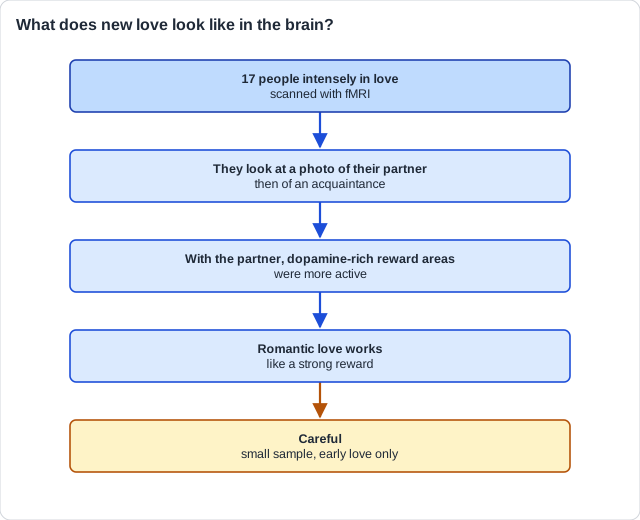
17 people intensely in love were scanned looking at their partner and at an acquaintance; with the partner, dopamine-rich reward areas were more active, so romantic love works like a reward; a caution box notes a small sample.
Follow a brain-scan study of new love.
Go further: higher-level insight: Chemical messengers are taught in 2.1.4. Here the guide asks about their role in relationships: starting them, keeping them, and conflict.

Free preview

This is the free notes preview

You're reading the free notes. Aimnova Pro unlocks the full study experience — and you can try it with your first topic free to keep:

  • FlashcardsLock in vocabulary and key terms with spaced repetition.
  • Practice questionsAnswer exam-style questions and get instant AI marking.
  • Mock exams & past-paper vaultSit full mocks and see exactly how examiners award marks.
  • Personalised study planA daily plan built around your exam date and weak areas.
Start Studying Free Full access to Aimnova Pro · cancel anytime
Key idea: Chemistry helps explain feelings in relationships, but not choices, talk or culture.

Strengths

  • Brain scans of real couples
  • Explains the rush of new love
  • Fits animal research on bonding

Limitations

  • Activity is a link, not a cause
  • Small samples, early love only
  • Leaves out thinking and culture

This is biological reductionism: a whole relationship reduced to chemicals.

Watch out: Chemistry is one level. Combine it with cognitive and sociocultural explanations.

IB Exam Questions on Chemical messengers in relationships

Practice with IB-style questions filtered to Topic 3.3.7. Get instant AI feedback on every answer.

Practice Topic 3.3.7 QuestionsBrowse All Psychology Topics

How Chemical messengers in relationships Appears in IB Exams

Examiners use specific command terms when asking about this topic. Here's what to expect:

  • Define

    Give the precise meaning of key terms related to Chemical messengers in relationships.

    AO1
  • Describe

    Give a detailed account of processes or features in Chemical messengers in relationships.

    AO2
  • Explain

    Give reasons WHY — cause and effect within Chemical messengers in relationships.

    AO3
  • Evaluate

    Weigh strengths AND limitations of approaches in Chemical messengers in relationships.

    AO3
  • Discuss

    Present arguments FOR and AGAINST with a balanced conclusion.

    AO3

See the full IB Command Terms guide

Related Psychology Topics

Continue learning with these related topics from the same unit:

3.1.1Biological explanations of a mental health disorder3.1.2Cognitive models of a mental health disorder3.1.3Cultural differences in mental health3.1.4Environmental factors in mental health disorders
View all Psychology topics
Improve your exam techniqueCommand terms, paper structure, and mark-scheme tips for Psychology
Previous3.3.6Social learning and group behaviourNextCognitive explanations of relationships3.3.8

4 questions to test your understanding

Reading is just the start. Students who tested themselves scored 82% on average — try IB-style questions with AI feedback.

Start FreeView All Psychology Topics