Key idea: Social learning theory explains how prejudice passes from parents, friends and media to children, and how new models could change it.
How prejudice is learned
Models
Parents, friends and media show how 'people like us' treat other groups.
Watching
Children notice tone, jokes and who is avoided, not only what is said.
Reward
Laughter at a joke or approval from friends reinforces it.
Copying
The child repeats the attitude and behaviour, often without noticing.
Model · Watch · Reward · Copy
Castelli, Zogmaister and Tomelleri (2009) measured the hidden attitudes of 72 white Italian children aged 3 to 6 and of their parents. Children's attitudes towards black people matched their mothers', not their fathers'.
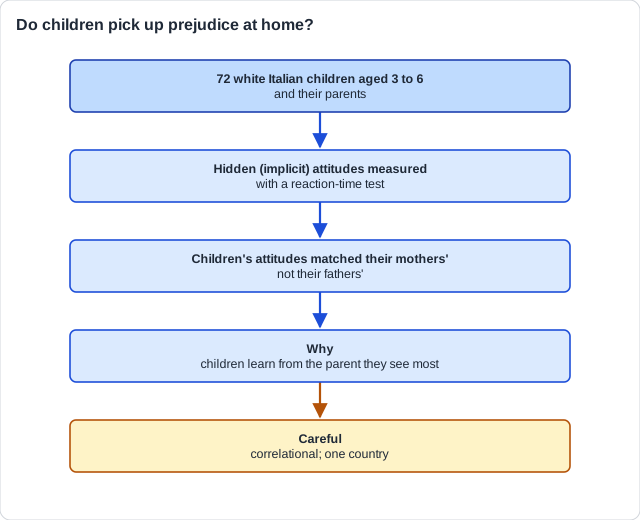
Go further: higher-level insight: Social learning theory is taught in 2.3.2. Here the guide asks how it explains, and can change, a group behaviour such as prejudice.
Free preview
This is the free notes preview
You're reading the free notes. Aimnova Pro unlocks the full study experience — and you can try it with your first topic free to keep:
- FlashcardsLock in vocabulary and key terms with spaced repetition.
- Practice questionsAnswer exam-style questions and get instant AI marking.
- Mock exams & past-paper vaultSit full mocks and see exactly how examiners award marks.
- Personalised study planA daily plan built around your exam date and weak areas.
Key idea: Social learning explains how prejudice is passed on; it explains less about prejudice between brand-new groups.
Strengths
- Children's attitudes match a parent's
- Explains passing on across generations
- Points to a fix: new models
Limitations
- Correlational: genes and home shared
- One country
- Tajfel: favouritism with no models
To change prejudice, social learning offers new models: media characters who cooperate across groups.
Watch out: Use two explanations. Social learning and social identity theory explain different parts of prejudice.