aımnova
DashboardMy LearningCrash CoursesStudy Plan

Aimnova site navigation

Stay in the loop

Get the latest study resources and updates

New features, study tips and exam insights — straight to your inbox.

IB Diploma

  • IB Past Papers
  • IB Study Notes
  • IB Question Bank
  • IB Mock Exams
  • IB Revision

IB Subjects

  • IB Math AA
  • IB Math AI
  • IB Economics
  • IB Business Management
  • IB Physics
  • IB Biology
  • View all IB subjects→

IB Past Papers

  • IB Math AA HL Past Papers
  • IB Math AA SL Past Papers
  • IB Math AI HL Past Papers
  • IB Math AI SL Past Papers
  • IB Economics HL Past Papers
  • IB Economics SL Past Papers
  • IB ESS Past Papers
  • View all past papers→

Study Resources

  • Study Notes
  • Question Bank
  • Mock Exams
  • Crash Courses
  • Flashcards
  • Revision Guide
  • Exam Skills
  • Command Terms
  • Grade Calculator
  • Exam Timetable 2026

Aimnova

  • Features
  • Pricing
  • For Teachers
  • For Schools
  • For Parents
  • About Us
  • Blog
  • Contact
aımnova

IB study, practice and feedback built around the real exam.

TermsPrivacyCookies·© 2026 Aimnova. All rights reserved.afd6316

Aimnova is not affiliated with or endorsed by the International Baccalaureate Organization (IB).

NotesPsychologyTopic 3.3Cognitive explanations of relationships
Back to Psychology Topics
3.3.84 min read

Cognitive explanations of relationships

IB Psychology · Unit 3

Smart study tools

Turn reading into results

Move beyond passive notes. Answer exam-style questions, get AI feedback, and build the skills that earn top marks.

Get Started Free

Contents

  1. 1Why we form relationships
  2. 2Three explanations of attraction
  3. 3Rewards, costs and commitment
  4. 4Evaluating the explanations
In one line: Why we are drawn to some people and not others can be explained through biology, thinking and social context.

In the human relationships context, a key area of study is how interpersonal relationships form, are maintained and end. All three approaches offer explanations, and the fullest picture combines them.

This links to the concept of perspective: attraction looks different through each lens. Learn one study for each explanation: exam answers need them.

Remember: Body, mind, world, even in love. Relationships have biological, cognitive and social explanations.

Free preview

This is the free notes preview

You're reading the free notes. Aimnova Pro unlocks the full study experience — and you can try it with your first topic free to keep:

  • FlashcardsLock in vocabulary and key terms with spaced repetition.
  • Practice questionsAnswer exam-style questions and get instant AI marking.
  • Mock exams & past-paper vaultSit full mocks and see exactly how examiners award marks.
  • Personalised study planA daily plan built around your exam date and weak areas.
Start Studying Free Full access to Aimnova Pro · cancel anytime
Key idea: Each approach explains a different part of why relationships form.

Explaining relationships

1

Biological

Chemical messengers such as oxytocin, which support bonding and trust between partners.

2

Cognitive

How we think about a partner: perceived similarity, positive attributions, beliefs about the relationship.

3

Sociocultural

Proximity, familiarity, social norms and cultural expectations (arranged or individual-choice relationships).

Biology · Thinking · Society

Take two people who become close at work. Biological: bonding chemistry as they spend time together. Cognitive: they see each other as similar. Sociocultural: proximity and shared social circles.

Go further: higher-level insight: Proximity and similarity are surprisingly powerful. We tend to like people we see often and who seem similar to us, not just those with 'chemistry'.

Festinger, Schachter and Back (1950) asked students living in Westgate, a housing site at MIT in the United States, to name their closest friends there.
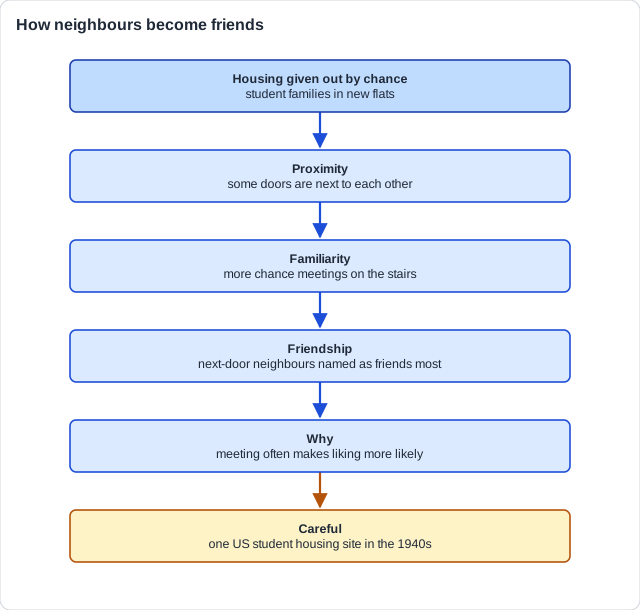
A chain from housing given by chance to proximity, familiarity and friendship between next-door neighbours.
Follow how neighbours became friends.

See how examiners mark answers

Answer exam-style questions with model answers. Learn exactly what earns marks and what doesn't.

Try Exam Vault FreeYour first topic is free to keep • No credit card required
Key idea: Cognitive explanations look inside people's heads: how they weigh a relationship, and how they explain each other's behaviour.

Cognitive explanations

1

Social exchange

Partners weigh rewards against costs, and against what they could have elsewhere.

2

Investment

Time, shared friends and plans make leaving costly, so commitment grows.

3

Attributions

How partners explain each other's behaviour keeps the relationship good or bad.

Weigh · Commit · Explain

Rusbult (1983) surveyed students in dating relationships again and again over several months. Satisfaction, the quality of alternatives and how much each had invested together predicted commitment, and commitment predicted who stayed together.
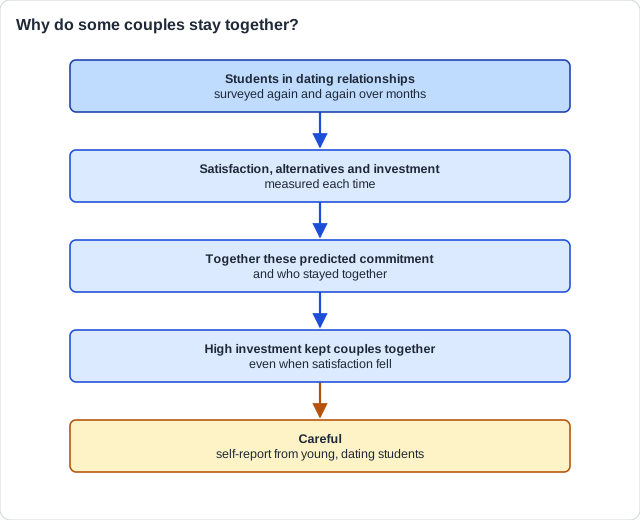
Students in dating relationships were surveyed repeatedly; satisfaction, alternatives and investment were measured; together they predicted commitment and who stayed together; high investment kept couples together even when satisfaction fell; a caution box notes self-report.
Follow a study of commitment.
Go further: higher-level insight: This explains why some people stay in unhappy relationships: leaving would cost too much of what they have invested.
Key idea: Each explanation has support and limits, and relationships vary a lot across cultures.

Strengths

  • Biological: explains universal patterns of bonding
  • Cognitive: explains how perceptions maintain relationships
  • Sociocultural: explains proximity effects and cultural differences

Limitations

  • Biological: reductionist; downplays choice and culture
  • Cognitive: thoughts can be a cause or an effect
  • Sociocultural: hard to isolate social causes; varies widely

So each approach explains part of how relationships work, but none is complete. Relationships vary enormously across cultures, from individual choice to arranged, which warns against assuming Western norms are universal, an imposed-etic risk.

Watch out: Do not assume one culture's relationships are the norm. Applying one culture's model everywhere is ethnocentric.

IB Exam Questions on Cognitive explanations of relationships

Practice with IB-style questions filtered to Topic 3.3.8. Get instant AI feedback on every answer.

Practice Topic 3.3.8 QuestionsBrowse All Psychology Topics

How Cognitive explanations of relationships Appears in IB Exams

Examiners use specific command terms when asking about this topic. Here's what to expect:

  • Define

    Give the precise meaning of key terms related to Cognitive explanations of relationships.

    AO1
  • Describe

    Give a detailed account of processes or features in Cognitive explanations of relationships.

    AO2
  • Explain

    Give reasons WHY — cause and effect within Cognitive explanations of relationships.

    AO3
  • Evaluate

    Weigh strengths AND limitations of approaches in Cognitive explanations of relationships.

    AO3
  • Discuss

    Present arguments FOR and AGAINST with a balanced conclusion.

    AO3

See the full IB Command Terms guide

Related Psychology Topics

Continue learning with these related topics from the same unit:

3.1.1Biological explanations of a mental health disorder3.1.2Cognitive models of a mental health disorder3.1.3Cultural differences in mental health3.1.4Environmental factors in mental health disorders
View all Psychology topics
Improve your exam techniqueCommand terms, paper structure, and mark-scheme tips for Psychology
Previous3.3.7Chemical messengers in relationshipsNextCommunication in relationships3.3.9

14 exam-style questions ready for you

Students who practice on Aimnova improve their scores by 15% on average. Get instant feedback that shows exactly how to improve your answers.

Practice Now — FreeView All Psychology Topics