In one line: People often behave very differently in a group than they would alone.
In the human relationships context, group behaviour is a key area of study. Being part of a group changes what we do, through conformity, group identity and copying the people around us.
This links to bias (group pressure can distort judgement) and perspective (the same act looks different from inside and outside a group). Learn one study for each effect: answers need them.
Social identity theory in three steps
Categorise
We sort people into groups: our team, their team.
Identify
We take on our group's identity and its norms.
Compare
We compare our group favourably with others, which boosts self-esteem and can turn into favouritism or prejudice.
Categorise · Identify · Compare
Remember: Alone or in a crowd. Groups reshape behaviour, sometimes for better, sometimes worse.
Free preview
This is the free notes preview
You're reading the free notes. Aimnova Pro unlocks the full study experience — and you can try it with your first topic free to keep:
- FlashcardsLock in vocabulary and key terms with spaced repetition.
- Practice questionsAnswer exam-style questions and get instant AI marking.
- Mock exams & past-paper vaultSit full mocks and see exactly how examiners award marks.
- Personalised study planA daily plan built around your exam date and weak areas.
Key idea: Groups shape behaviour through conformity, shared identity and social learning.
How groups change behaviour
Conformity
People match the group's behaviour (normative and informational influence), even against their own view.
Social learning
Newcomers copy what group members do, especially members they admire and see rewarded.
Group identity
People take on their group's identity and favour their own group, which can lead to unfair treatment of others.
Conform · Identify · Copy
Take a student who joins a school football team. She wears the team's colours and cheers against the rival school (group identity), arrives early like everyone else (conformity), and copies the captain, whom she sees praised (social learning).
Go further: higher-level insight: In-group favouritism needs no history. In Tajfel's minimal group studies, boys grouped on a trivial basis still favoured their own group.
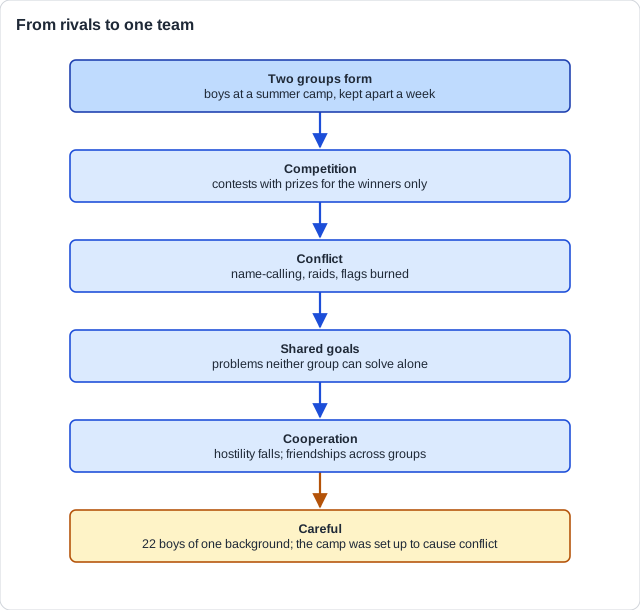
Sherif and colleagues (1961) showed how competition creates conflict, and how it can end, with two groups of 11- and 12-year-old boys at a camp in Robbers Cave, Oklahoma.
Get feedback like a real examiner
Submit your answers and get instant feedback — what you did well, what's missing, and exactly what to write to score full marks.
Key idea: Prejudice is what people feel; discrimination is what they do.
Three ways to reduce conflict
Contact
Meeting as equals, with support from those in charge (Allport's contact conditions).
Shared goals
A goal neither group can reach alone turns rivals into partners.
A shared identity
A bigger group that includes both: 'them' becomes part of 'us'.
Meet · Need each other · Become 'us'
Aronson's jigsaw classroom (1978) put pupils from different groups into teams where each held one piece of the lesson, so everyone needed everyone. Pupils liked each other more and prejudice fell.
Why groups compete: When groups want the same scarce prize, conflict grows (Sherif's camp); even with no prize, a group label is enough for favouritism (Tajfel).
Key idea: Group-behaviour research is influential and applicable but often artificial and culturally variable.
Strengths
- Robust demonstrations of conformity and in-group favouritism
- Explains crowds, rivalry and how to reduce conflict
- Group effects appear across societies
- Reveals powerful social forces
Limitations
- Some classic studies are artificial or ethically questionable
- Effects vary by situation and are not guaranteed
- Strength varies by culture (such as collectivism)
- Conformity studies raise ethical concerns (banned for practicals)
So group-behaviour research convincingly shows how groups reshape behaviour, but a good evaluation notes some classic studies were artificial or ethically problematic, effects vary by situation and culture, and group influence is a tendency, not a certainty.
Watch out: Group effects are not destiny. People resist conformity and treat other groups fairly: a strong answer notes when and why.